

Javits Center Booth Build: A 48-Hour Turnaround Guide

Last reviewed by Amit · June 2026
Anyone who’s run a build at the Javits Center can recite the same opening scene from memory. The marshalling yard moves at the pace of a held breath. The freight elevators are first-come, first-served, and somehow never yours. And the aisle outside your space fills with a neighbor’s crates before your crew can get a tape measure near the booth. Meanwhile the clock — the only thing at Javits that is punctual — is counting down to a 48-hour load-in, after which the doors open whether you’re ready or not.
Here’s the part nobody says out loud: hitting Tuesday-morning open has almost nothing to do with how fast your crew can build on the show floor. It’s about how little they have to build there. The teams that make it look easy are the ones who did the hard part weeks earlier, in a quiet shop, with no forklift traffic and no countdown. After twenty-plus years of building these for shows at Javits, the Metropolitan Pavilion, and lofts all over the boroughs — here’s how the 48 hours actually unspool.
The weeks before: build it once where nobody’s watching
A booth should never meet itself for the first time on the show floor. We pre-fit the entire run in our Brooklyn shop — every panel cut, finished, and stood up at least once; every connection dry-fit so it clicks together in seconds on-site; every wrap and graphic applied where it possibly can be, because an hour spent on vinyl at Javits is an hour you simply do not have. Then each panel gets labeled by position, so the install crew works from a numbered map instead of a hunch. By the time the truck rolls up to the dock, the booth is technically a reassembly job. That’s the whole trick, and everything below depends on it.
T-minus 36 hours: marshalling and freight
The marshalling yard runs slower than every exhibitor’s plan assumes, so ours doesn’t assume. We build a two-hour buffer onto either side of the freight call, because a delayed truck doesn’t get to reschedule the show. The pre-fit panels travel on labeled pallets that match the booth map — and at Javits that labeling earns its keep twice, because the dock is union jurisdiction: the house crew unloads your truck, and a pallet system they can read at a glance moves straight to the space with nobody standing at the dock playing “guess which crate.”
T-minus 24 hours: the actual build
At Javits, the install itself belongs to the house crew — union jurisdiction covers the build, and they work from our numbered panel map. A typical 20×20 with freestanding walls goes up in four to six hours with a three-person crew. It breaks down roughly like this:
- Hour one — move-in, marking the floor, and deciding mobility panel by panel: stationary on the perimeter, on wheels where the booth needs to shape-shift mid-show.
- Hours one to three — walls go up, connections lock, runs come into alignment. Because everything’s freestanding, nothing drills the venue floor or hangs from the venue ceiling — which means no damage penalties and no permits to file with the convention authority.
- Hours three to five — graphics, lighting, and the eternal war against visible AV cable.
- Final hour — walk-through, touch-ups, and photos for the file.
Running a 10×10? Halve it. A 30×40? Add a crew and another four hours. The math scales cleanly because the process does.
Show open: why “gallery-grade” earns its keep here
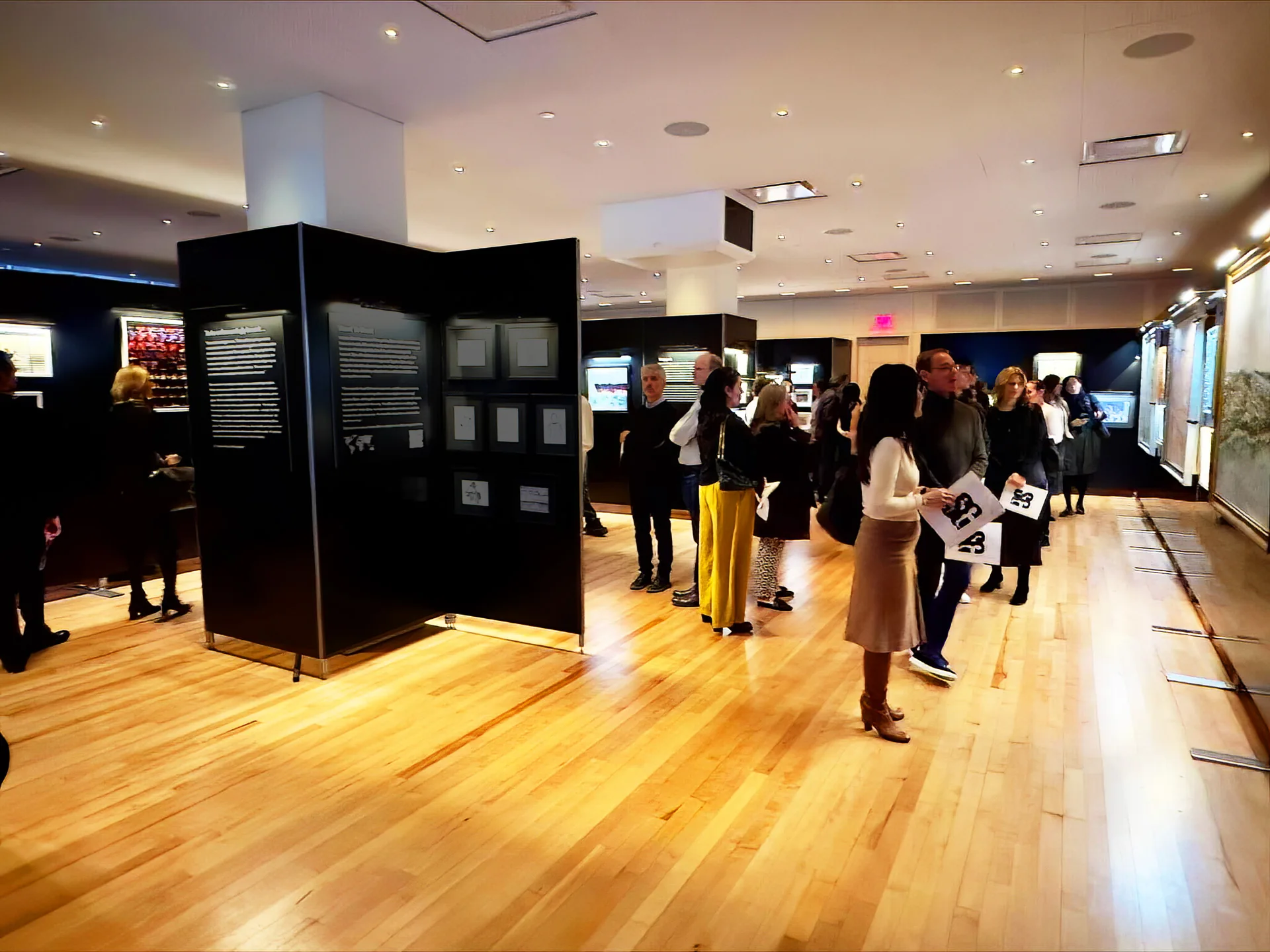
A trade show is the most ruthless room your brand will ever stand in. Your booth is one of hundreds, and the only way to get noticed is to look like you spent more than the show fee. A booth that reads as a finished, built environment from clear across the aisle pulls people in. Pipe-and-drape — at any distance, in any lighting — quietly tells them to keep walking. That gap is the entire reason this category exists.
Strike: the unglamorous part that wins the repeat
Half the producers who call us a second time do it because of how strike went, not install. And strike at Javits is genuinely brutal — everyone’s tearing down at once, the freight elevators jam solid, aisle waits triple. Because our walls are freestanding (nothing drilled, nothing rigged), teardown is fast: panels unlink, lie flat, palletize, and roll out on the same numbered system they arrived on. A 20×20 strike runs about two hours instead of the four or five a built booth demands — which, when the loading dock is a parking lot, is the difference between making your truck and missing it.
What it costs, roughly
The economics flip in your favor after the second show. Build one is comparable to a custom booth on a square-foot basis. Build two is a fraction of that, because these walls are made to come back — show after show — rather than get tossed in a dumpster Sunday night. By the third outing, the booth has paid for itself and started earning.
Frequently asked
How long does a Javits booth build take? A 20×20 freestanding booth reassembles in four to six hours, because the structure is pre-fit in the shop and every panel is numbered. At union venues like Javits, the house crew works from a numbered map — fewer labor hours on your bill. At non-union venues, our own crew handles it end to end.
Do freestanding trade-show walls need permits or damage the venue? No. They don’t drill into the floor or hang from the ceiling, so there are no damage penalties and nothing to file with the convention authority.
Can the booth be reused at the next show? Yes — it’s built to travel and reassemble across repeat shows, which is why the cost drops sharply after the first build.
Can you handle a tight or rush load-in window? Often, yes. Flag the show dates at first inquiry; we hold rush capacity for the builds that genuinely need it.
Got a show on the calendar? Email sales@1w2r.com or call 212.671.0722 with the venue, the booth size, and your move-in window — we’re Brooklyn-based, about twenty minutes from most NYC venues. At union halls we deliver dock-ready and the house crew takes over — the numbered panel system is built for exactly that handoff. Everywhere else, the same crew that pre-fit your walls installs and strikes them.
See sizes, finishes, and configurations on our modular trade show booths in NYC page.
— Amit · Founder, 1W2R
Price your choice of product in 10 seconds
NewPick your product — rent or purchase — the real quote lands in 24 hours.
Venue-approved and freestanding — delivered, installed, and struck the same night.
Live 3D preview
Figure shown is 6′ tall for scaleRental estimate
From $2,600
Financing available through SweetPay — apply in minutes
$650 per wall, picked up from our Brooklyn location — delivery quoted by order size and location.
Get the spec PDF + 24h quote
No contractor, no permit, ships nationwide.