



The Roommate Dividend: $1,730 a Month, and the One Thing That Ends It


Reach me: 212.671.0722 · sales@1w2r.com
Last reviewed by Amit · August 2026
$1,730 a month.
That is what a roommate is worth in New York City — the gap between renting a one-bedroom alone at an average $4,380 and splitting an average $5,300 two-bedroom two ways at $2,650 each.
Twenty thousand seven hundred and sixty dollars a year. Tax-free. Paid to you, every month, by the person on the other side of the living room.
No policy in this city has ever handed a renter that much money. Not the rent freeze. Not a single one of the tenant reforms. Nothing.
And almost nobody protects it.
The Roommate Dividend
Call it what it is: the Roommate Dividend. The single largest housing discount available to a New Yorker, and the only one you don’t need anyone’s permission to collect.
Here is the strange part. We published a number in July that sits almost exactly on top of it — the gap between what you pay in your current apartment and what the market would charge you to move has crossed $1,750 a month for the average renter.
Two numbers. Twenty dollars apart. Pointing in opposite directions.
Moving costs you roughly $1,750 a month. A roommate saves you roughly $1,730 a month. Which means, near enough, the roommate is the thing cancelling out the penalty for staying in New York at all.
So the roommate isn’t a compromise you are making until things improve. In this market, at these rents, the roommate is the plan. Often for years.
Which raises the question nobody budgets for: what are you doing to make that arrangement survivable?
The people collecting it are getting older — a lot older
The roommate stopped being a twenty-two-year-old thing.
Over the decade from 2015 to 2025, SpareRoom’s numbers show room-seekers aged 35 to 44 up 45.2%. Over the same ten years, the 18-to-24 group fell 13.6%, and 25-to-34 slipped 5%. The 55-plus brackets posted large gains of their own.
Read that again, because it inverts the stereotype completely. The fastest-growing roommate in New York is closer to forty than to twenty.
And a forty-year-old wants something different out of the arrangement. Sarah Hill, who runs the NYC roommate-matching service Perfect Strangers, told Brick Underground that her 35-plus clients are choosing to share so they can save, travel, and spend on experiences rather than pour their income into living alone. What they screen for, she says, is larger bedrooms and separate bathrooms.
That is not someone economizing. That is someone buying privacy and refusing to give it up.
A twenty-three-year-old will take a curtain and a promise. A forty-one-year-old with a job, a partner who stays over, and a 7 a.m. call has a different threshold entirely — and if the apartment can’t meet it, the dividend ends. Not because of money. Because of the door.
Chart 1 — What the roommate is worth, and what a wall costs
| The line item | Per month | Per year |
|---|---|---|
| Living alone, average NYC one-bedroom | $4,380 | $52,560 |
| Your half of an average two-bedroom | $2,650 | $31,800 |
| The Roommate Dividend | $1,730 saved | $20,760 saved |
| A freestanding divider | Purchase from $1,176 | Yours — it isn’t rent |
| What the divider costs, priced in dividend | About three weeks of it. A sliding door is an add-on on top of that — ask us for the number on your span before you budget. | |
I want to be careful with that last row, because it is the kind of line a marketer would stretch. It is not a claim that a wall pays for itself, and $1,176 is the divider on its own — a sliding door is a separate add-on, and a wide span costs more than a narrow one. The arithmetic is simply this: the starting price is roughly two-thirds of one month’s dividend. If sharing the apartment is what makes the rent work, the cost of making the sharing tolerable is small against what the sharing is already saving you. Get a real quote for your dimensions before you plan around any figure, including ours.
The dividend has a maintenance cost, and it isn’t money
In twenty-five years of installs I have learned to hear the real reason behind the call. With roommates it is almost never the rent.
It is that the living room is also somebody’s bedroom. It is the person who works nights and the person who works mornings sharing one open space. It is a partner who moved in and made a two-person apartment a three-person apartment. It is a converted one-bedroom where the “second room” is a bookshelf, an IKEA curtain, and an understanding.
Those arrangements don’t collapse over money. They collapse over the slow accumulation of never being alone.
And when they collapse, the $1,730 goes with them. Somebody moves out, somebody covers a full one-bedroom alone or starts the search again, and the most valuable thing about the apartment — that two adults could live in it without resenting each other — is gone.
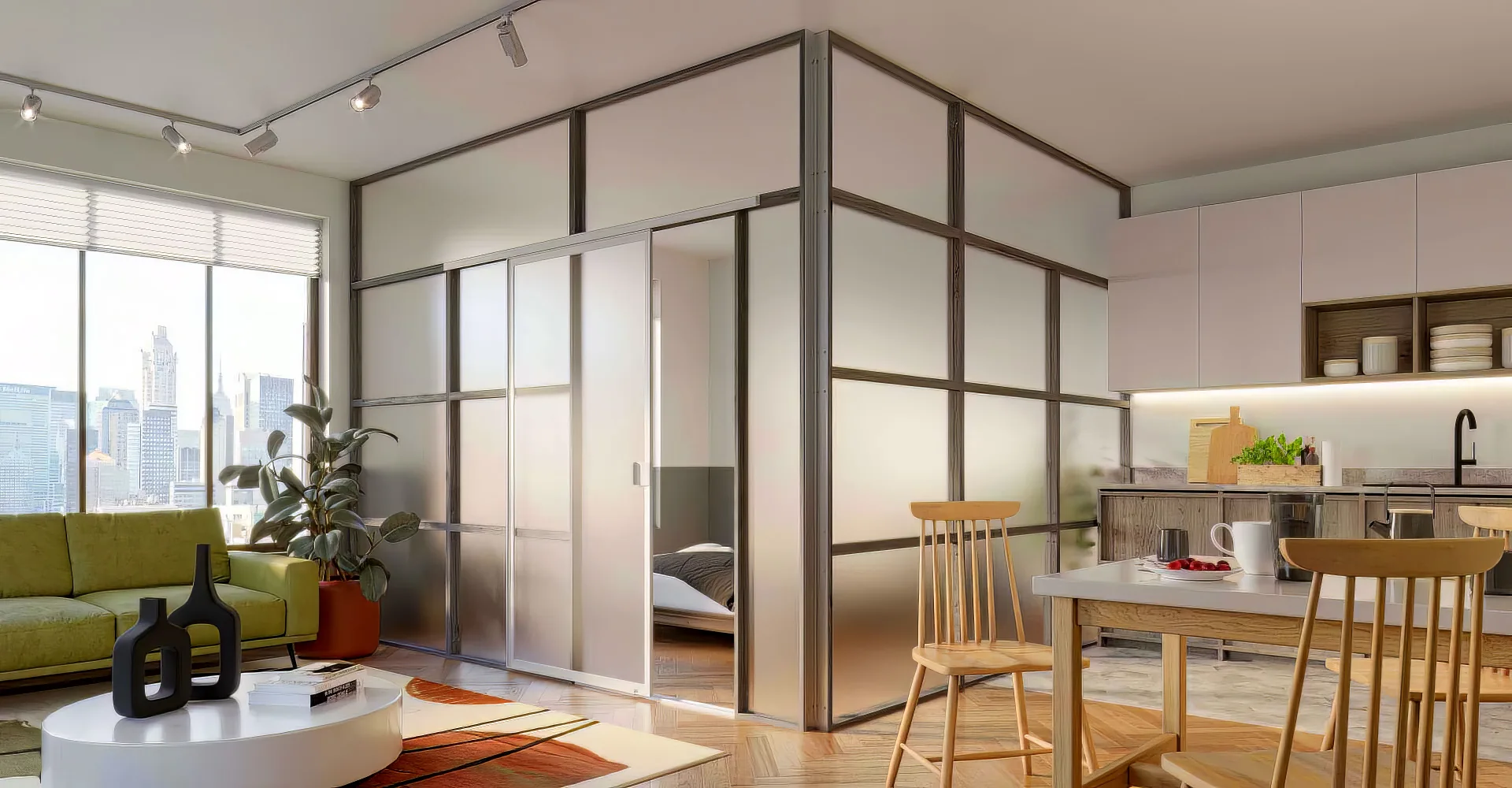
That is the whole argument for a real interior wall, and it has nothing to do with décor. A pressurized “flex” conversion is one way to get there. So is a divider that stands on the floor and touches nothing. The point is that the thing separating two adult lives should be more substantial than fabric.
The honest turn — what a wall does, and what it does not
We build these, so weigh what follows accordingly — and then hold us to every word.
It is not soundproof. No temporary wall is — not pressurized, not bookcase, not ours, not anyone’s. This matters more in a shared apartment than almost anywhere else, because sound is usually the exact thing you are complaining about. A full-height panel blocks sightlines completely and makes a space meaningfully quieter. It does not deliver sound isolation, and if your roommate takes calls at 11 p.m. you will still know it. Here is our full answer on sound, and here is what “acoustic” actually means when a divider is marketed that way.
It does not create a legal bedroom. A legal bedroom in New York has code requirements — minimum dimensions, a window, egress. A divider gives you a private room with a real door inside the space you already pay for. For roommates that is usually the entire ask. If you need a room that exists in the eyes of your lease or the code, read this first, and talk to a housing attorney rather than a wall company.
It does not fix the wrong roommate. A door solves an architecture problem. It does not solve a person who never does the dishes. If the friction is about who someone is rather than where the walls are, furniture will not touch it.
What it does do is attach to nothing. Ours stand on adjustable leveling legs, on the floor — no wall, no ceiling, no fixture. That is not a marketing line, it is the entire legal argument: attach nothing, alter nothing, and what you have installed is furniture. No permit, no board approval, no deposit at risk. Why standing on the floor is the whole legal argument.
Before you add the person: what the law actually says
Worth knowing, because a lot of New Yorkers assume their lease decides this and it largely doesn’t.
New York’s Real Property Law §235-f — everyone calls it the Roommate Law — gives a tenant the right to share their apartment. If you are the only person named on the lease, you may generally add one roommate plus that roommate’s dependent children, and a lease clause purporting to forbid it does not override the statute. The broad limit is that occupants not named on the lease should not outnumber those who are. Your landlord is entitled to know who lives there and can ask; you are expected to respond, typically within 30 days. A landlord generally may not charge you extra rent simply for having a roommate the law allows.
That is the shape of it, not legal advice, and rent-stabilized units, HDFCs, income-restricted housing and subletting all carry their own rules. Check your own situation before you hand anyone a key.
What the statute plainly does not do is give you another room. It gives you the right to have the person. The room is on you — which is the same gap we wrote about when the city released 23 tenant protections and not one of them added a bedroom.
Protect the dividend
If sharing is what makes your rent work, then the arrangement is worth about $20,760 a year to you, and it is worth defending like an asset rather than tolerating like a phase.
Do it in the order that survives a move. Something you own, that attaches to nothing, that keeps your deposit out of the conversation, and that slides out fully built the day the lease ends — then reconfigures straight, L-shaped or Z in the next apartment.
And get one sentence in writing from anyone you hire, before a crew walks in: no fasteners into the apartment. That sentence is the line between furniture and an alteration, and it is the sentence that keeps your deposit.
The roommate saves you $1,730 a month. Give them a door.
Send us your dimensions and a photo of the space. You’ll get a configuration and a quote back within 24 hours — built to your ceiling height in our Brooklyn shop, delivered finished, installed with a drill and two clamps. Yours on move-out day.
Frequently asked questions
Usually, yes. Splitting a living room into a sleeping area and a shared area is a standard configuration, and a sliding door is what makes it a room rather than a partition. It won’t become a legal bedroom, and the person in it should still have access to light and air — but as a private space with a door that closes, that is exactly what the system is for. Send dimensions and a photo and we’ll tell you honestly whether the layout works.
A freestanding wall touches only the floor, the same as a wardrobe or a bookcase, so there is no alteration to approve. Plenty of management companies and boards still want a heads-up, and we’ll provide a vendor letter for that conversation. What we won’t do is drill into your building. Adding the roommate is a separate question — see the Roommate Law section above.
Your call entirely — that one is between the two of you. The thing worth knowing before you decide: the wall is a purchase, not rent. Whoever buys it still owns it after the lease ends, after the roommate changes, and in the next apartment. It is the one part of the arrangement that doesn’t evaporate when someone moves out. Financing is available if that makes the split easier.
Quieter, yes. Quiet, no. A full-height panel blocks sightlines completely and cuts down what carries across a room, which is a real difference you will notice on day one. It is not sound isolation, and nobody’s temporary wall is — if a company tells you theirs is soundproof, ask them to put that in writing.
The wall doesn’t. It disassembles into panels and reconfigures — straight, L-shaped or Z — so the same system becomes a home office, a nursery, or a divided studio in the next place. That is the difference between buying a wall and renting one: the arrangement ends, the wall doesn’t.
Sources & further reading
- SmartAsset, What a Roommate Can Save You in 100 U.S. Cities — 2026 Study (updated April 7, 2026), using Zumper average asking rents, March 2025–March 2026 — the $1,730/month NYC figure, the $4,380 one-bedroom and $5,300 two-bedroom averages. Averages of listed asking rents, not medians of signed leases.
- SpareRoom room-seeker data, 2015–2025, reported by Brick Underground (March 27, 2026) — ages 35–44 up 45.2%, 25–34 down 5%, 18–24 down 13.6%, with large gains in the 55-plus brackets. Same article: Sarah Hill of Perfect Strangers on why 35-plus renters share, and their priority on larger bedrooms and separate bathrooms.
- Realtor.com, Q1 2026 New York City Rental Report (published April 28, 2026) — the roughly $1,750/month gap between staying and moving, cited in our own July post.
- Corcoran, June 2026 NYC residential rental market report (published July 10, 2026) — record borough medians, Manhattan $5,295 and Brooklyn $4,350, for context on how far citywide averages sit below borough medians.
- New York Real Property Law §235-f, the Roommate Law — a tenant’s right to share, the occupancy limit, and the landlord’s right to be told who lives there. Consult a housing attorney for your own lease and housing type.
- 1W2R guides: what the second bedroom actually costs · why almost nobody is moving · splitting a one-bedroom in two · a bedroom with a door and no contractor.
Get the spec PDF + 24h quote
No contractor, no permit, ships nationwide.