


The In-Law Suite You Can Build This Week, and Take Down When You Need To


Reach me: 212.671.0722 · sales@1w2r.com
Last reviewed by Amit · August 2026
CBS Evening News ran a segment on August 4th about adult children moving back in with their parents. A record 25.2 million adults under 35 were living at home last year. The reporter interviewed a 34-year-old in South Carolina who moved into her parents’ place after a breakup, and an economist from Wharton who explained why the housing market did this to her.
Good segment. It ends exactly where your actual problem starts.
Because nobody on television has to figure out where the bed goes.
The number the coverage keeps getting backwards
Worth knowing before you read another article about this, because most of them have it wrong.
25.2 million is a record count. The rate is 33.0%, which is actually lower than the pandemic peak of 33.6%. The count is at a record partly because there are simply more people under 35 than there used to be.
And roughly 17.7 million of that 25.2 million are between 18 and 24. The government survey behind the number counts college students in dorms as living in their parents’ home, so a big share of the scary headline is freshmen.
Here’s the figure that actually tells you something. Among 30-to-34-year-olds, the share living with parents went from 7.1% in 2000 to 12.7% last year. That is nearly double, and those are not college kids. About 70% of the 25-to-34-year-olds living at home have jobs.
That last number matters more than any of the others, and it’s the one that gets left out. These are employed adults who cannot clear the cost of a lease. It isn’t a character problem. It’s a math problem, and it doesn’t get solved by anyone trying harder.
The problem is a door, not square footage
Almost every house I walk into for this already has the space. A finished basement. A dining room nobody has eaten in since 2019. A den. A bedroom over the garage that became storage.
What the house doesn’t have is a door.
That distinction is the whole thing. Two adults can share a house indefinitely and stay on good terms. What they can’t do is share a house where one of them sleeps in a room with no door and takes work calls from the couch. Privacy isn’t about square feet. It’s about being able to close something.
The same is true in the other direction, which is the version people talk about less. Your mother moves in after a fall. Your father-in-law sells his place because the stairs stopped making sense. Same house, same missing door, and now there’s a dignity question attached to it that nobody wants to say out loud.
An in-law suite is just a room with a door and a wall you can’t see through. Everything else is decoration.
Why the permanent version is usually the wrong answer
Search “in-law suite” and you get contractors, addition builders, and house plans. Framing, permits, inspections, and a number with five digits in it.
That’s a real product. It’s the wrong product for most of the people reading this, for one reason: you don’t know how long you need it.
Your kid is saving for a down payment. Best case, that’s eighteen months. Your mother’s needs in three years might be a first-floor bathroom instead of a bedroom, or they might be a facility. The 34-year-old CBS interviewed told them she plans to move out in November.
Permanent construction is a bet that the arrangement is permanent. It usually isn’t, and the people making that bet find out with a finished basement bedroom that no longer has anyone in it and a home equity line that still does.
There’s also a resale question nobody raises until it’s expensive. A chopped-up basement reads as chopped-up to the next buyer. A room you can take down in an afternoon reads as a basement.
What we actually build
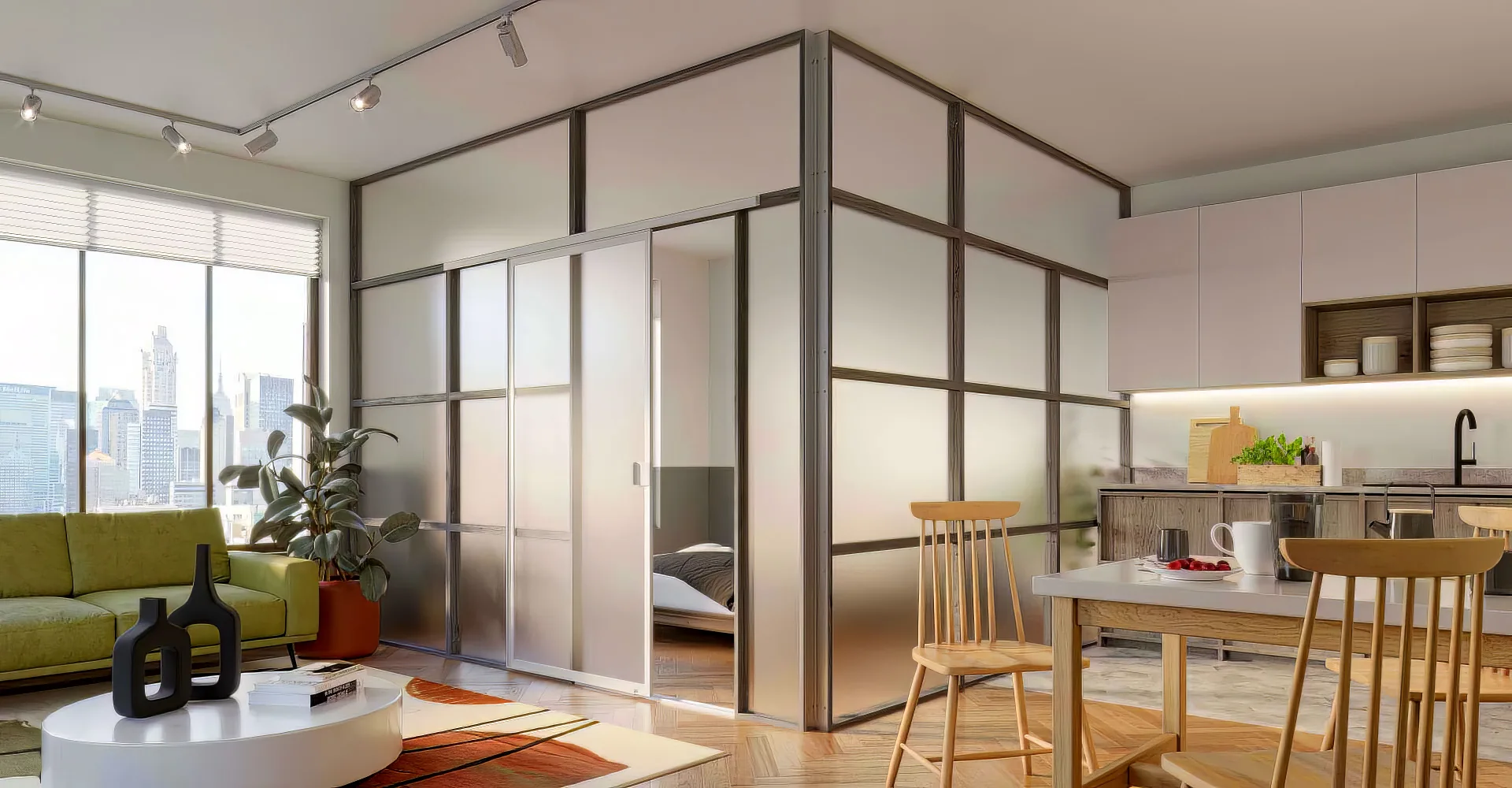
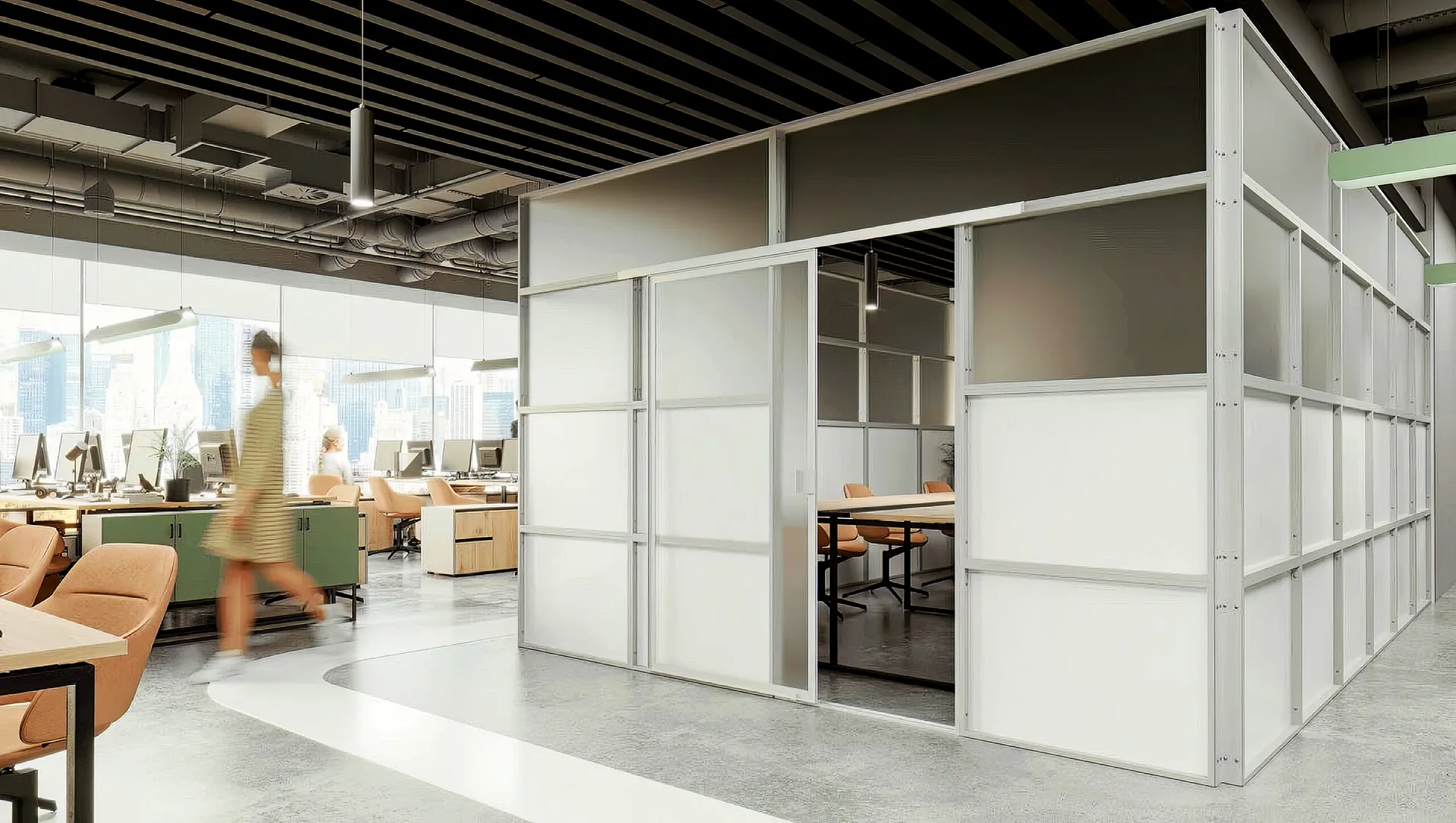
A freestanding wall. It stands on its own legs, levels itself onto whatever the floor is doing, and touches nothing. Nothing gets drilled into the house, screwed to a joist, or glued to a slab.
Because nothing attaches to the building, no work is being performed on it. There’s nothing for the city to permit and no contractor to schedule. It’s a delivery, the same as a bookcase is a delivery.
It goes up with a real door. Not a curtain, not a screen, not a shelving unit turned sideways. Full height, so it reads as part of the room rather than as a thing someone put in the room.
And when it’s finished being useful, two people take half a day and the space goes back to being the space.
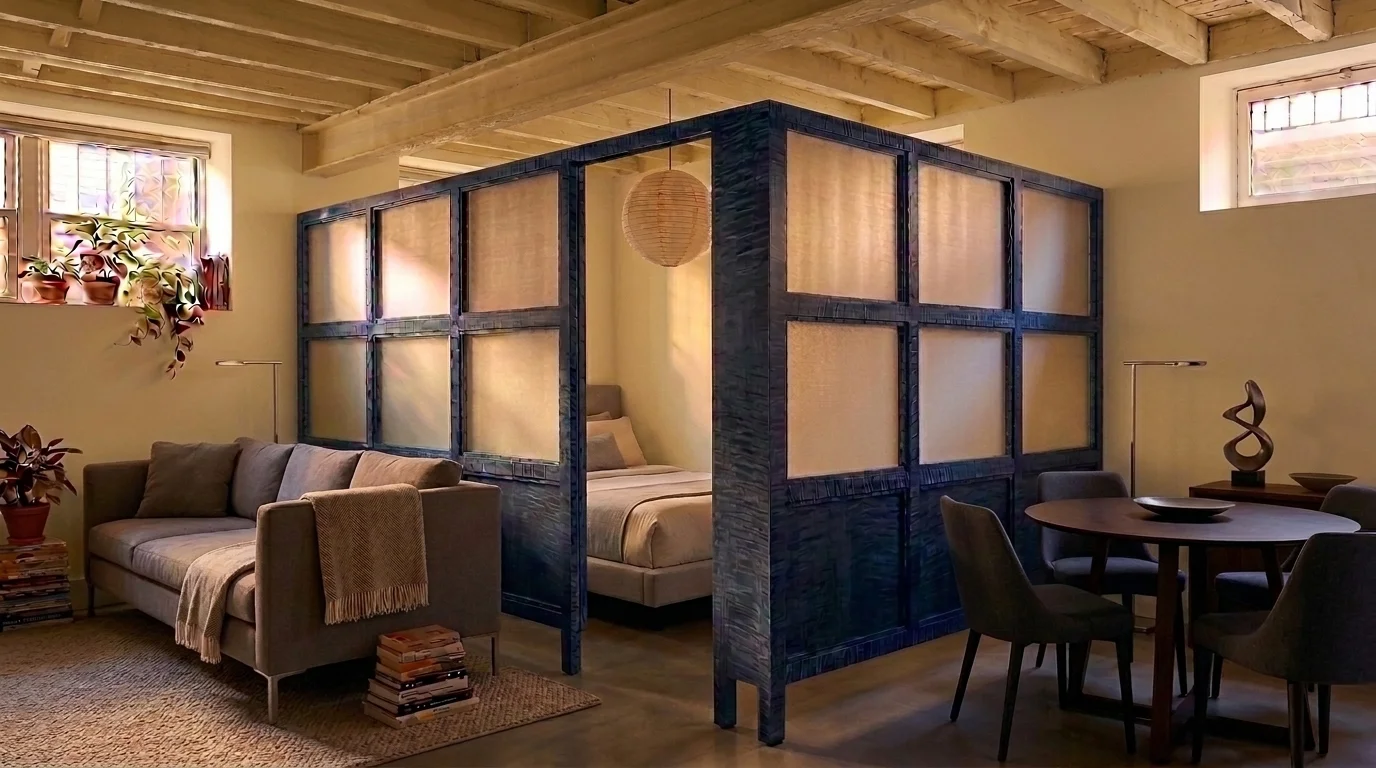
We did one of these in a 1930s multi-family off Shepherd Avenue in East New York, a few minutes from the shop where every wall gets built. The basement was the usual situation: finished, dry, and one long undivided box. We ran an L, which is two runs meeting at a right angle, to carve a private room out of the corner rather than cutting the whole floor in half. Frosted panels, so the room borrowed daylight from the rest of the basement instead of turning into a closet. A real sliding door, because a swing door eats floor you don’t have down there.
It went up in an afternoon. The wall stands fixed and only the door moves.
When it’s your parent, not your kid
The brief flips, but the build doesn’t. The room usually needs to be on the main floor, near the bathroom, and the light matters more, not less — nobody puts their mother in the dark, which is exactly why the panels are frosted instead of solid.
And the door does a different job. For an adult kid it’s about taking calls and keeping hours. For a parent it’s about having a room that is theirs, in a home that is yours — the dignity question from earlier, answered with hardware instead of a conversation.
In 2024, 17% of homes purchased were bought for multigenerational living, an all-time high. The families who don’t buy a bigger house solve it inside the one they have.
What it’s like having us in the house
Worth addressing, because it’s the thing people are actually nervous about. You’re not buying a wall so much as agreeing to let two guys work in your home while your mother or your kid is standing right there.
A customer wrote this last week:
“He was respectful of our home, cleaned up after the job, and answered all of our questions. It’s rare to find someone who cares so much about the quality of their work.”
— deulon lesure, Google review, five stars
No dust, no debris bag dragged through the hallway, no demolition. We pre-fit the whole run at the shop first, so what happens at your house is assembly, not construction.
And I’ll be straight about what basements throw at us, because it’s never nothing. Floors down there are level the way the subway is punctual. Ducts, soffits, a beam where the wall wants to go, low clearances that kill standard-size anything. That’s the real reason every run is measured, custom-sized, and pre-fit before it ships: the surprises get solved on our shop floor, not in your basement. And if your space has something the wall can’t work around, you’ll hear it from me when you send the photos, not after you’ve ordered.
What a divider is, and what it isn’t
Worth being precise here, because there’s a lot of bad information floating around.
This is a divider. It’s furniture. It doesn’t change the legal configuration of your home. The room you divided still has its window, still has its dimensions, and on paper and in fact is still the room it always was. Nobody from the city inspects how you arrange your furniture, and there’s no rule telling you where to put a panel, a screen, or a bookcase inside a room you already legally occupy.
Which also means a divider isn’t a way to manufacture a second legal bedroom. Not because anyone forbids it, but because a legal bedroom is a function of the room’s window, size, and ceiling, and furniture doesn’t change any of those. If you’re dividing a room so your mother or your kid has privacy, you’re arranging your home. If you’re dividing it to rent half of it out as a separate unit, that’s a conversion, and conversions are governed by an entirely different set of rules.
The one thing I won’t do is box you in. We lay every job out so the door you’d leave by stays clear — not because anyone is checking, but because it’s your home and a fire doesn’t care about your floor plan. If your layout doesn’t leave room for that, I’ll say so on the phone before you order anything.
What it costs
A freestanding suite wall runs from $1,176, and scales with length, finish, and whether you want a door.
The comparison that matters isn’t against doing nothing. It’s against the alternatives:
A basement build-out with framing and a permit runs many multiples of this, takes weeks, and leaves you with a room you can’t undo. Renting a pressurized wall means paying every month, forever, plus a removal fee at the end, and you own nothing. A folding screen costs a few hundred and blocks a sightline, which is not the same as blocking a room.
Ours you buy once. It moves with you, and it goes up again in the next place.
Financing is available if you’d rather spread it.
When I’ll talk you out of it
I turn down a few of these a year, and I’d rather do that than sell you something you’ll resent.
If the only spot you have is a dark interior corner with no daylight reaching it, I’ll say so. We use frosted panels precisely so the divided side borrows light, but there’s a limit, and nobody thrives in a box.
If what you actually need is real acoustic isolation — a parent with dementia who’s up at 3am, a musician, a shift worker sleeping days — set expectations now. A wall this size blocks sightlines and takes the edge off conversation. It does not stop sound. Mass stops sound, and mass means construction.
If a family member needs an accessible bathroom, a stairlift, or a first-floor setup with plumbing, that’s a contractor’s job and I’ll say so on the phone.
And if the arrangement is genuinely permanent — a parent moving in for the rest of their life, in a house you’re staying in — build the real thing. Reversibility is worth paying for when you need it. It’s not worth paying for when you don’t.
Frequently asked
Do I need a permit for an in-law suite like this?
Not for a freestanding wall. Nothing attaches to the structure, so there’s no work for the city to permit. Anything that involves framing, plumbing, or electrical is a different conversation.
Can I do this in a rental or a co-op?
Usually. Because nothing is fastened to the apartment, most standard alterations clauses don’t reach it, and most buildings handle it as a furniture delivery. Read your house rules — a few name partitions specifically. Send us the language and we’ll help you write the request.
How long does it take?
Most residential installs are a two-person crew for two to three hours. We pre-fit the whole run in our Brooklyn shop first, so by the time we’re at your door the wall has already been built once.
What happens when they move out?
Half a day to strike it, and the room goes back to what it was. Keep it for the next thing or move it to the next place. You own it.
Is this the same as a room divider?
Same family, different job. A divider suggests a boundary. What we’re describing here is full height with a real door, which is what makes it a room instead of a zone.
See doors, finishes, and configurations on our room dividers with doors page. If the space in question is downstairs, start with basement dividers.
— Amit · Founder, 1W2R · 25+ years of installs across all five boroughs
Sources & further reading
- Realtor.com Economic Research, “The Empty Nest Is on Hold: 1 in 3 Adults Under 35 Lives With Their Parents,” Hannah Jones, Senior Economist, June 18, 2026 — analysis of IPUMS Current Population Survey ASEC data, 2000–2025.
- CBS Evening News, “Record number of U.S. adults are moving in with their parents as costs rise, study finds,” Megan Cerullo and Jericka Duncan, August 4, 2026.
- Federal Reserve Board, Economic Well-Being of U.S. Households in 2025, published May 19, 2026.
- National Association of Realtors, Profile of Home Buyers and Sellers.
- 1W2R guides: when an adult kid moves back home · three generations in one apartment
Adult kid moving home, or a parent moving in? Text 212.671.0722 or email sales@1w2r.com with a couple of photos of the space and a rough measurement, and we’ll quote it the same day — from $1,176. If the room won’t take a wall, we’ll say so.
Get the spec PDF + 24h quote
No contractor, no permit, ships nationwide.