


The $4,200 Menu: One NYC Rent, Five Boroughs, Five Different Room Counts


Reach me: 212.671.0722 · sales@1w2r.com
Last reviewed by Amit · September 2026
Five apartments. Five boroughs. One number: $4,200 a month.
In Chelsea, that buys a studio. On Staten Island, it buys a house with five bedrooms.
On September 3, Gothamist’s David Brand and James Ramsay went out and toured one listing in each borough, all at roughly the citywide median asking rent, and published what each one actually gets you. It is the most useful thing anyone has written about NYC rent this year, and I don’t think it says what people think it says.
Start with the number underneath it. At $4,200 a month, the 30% rule puts the household income you need at $168,000 a year. That is the price of admission to the middle of this market.
And once you’ve paid it, here is what you get to decide.
The $4,200 Menu
Look at those five listings side by side and something strange happens. The rent stops behaving like a price.
A price is what you pay for a thing. But here the payment is fixed — $4,200, every one of them — and the thing is what moves. One room. Two rooms. Five rooms.
That’s not a price. That’s a menu. And every item on it costs the same.
Call it the $4,200 Menu. You are not choosing how much to spend. The market already told you that number. You are choosing what to give up to get a door.
| Borough | Neighborhood | What $4,200 gets you | Rooms |
|---|---|---|---|
| Manhattan | Chelsea | A studio. In the same building, a rent-stabilized unit goes for $2,300. | 0 bedrooms |
| Brooklyn | Greenpoint | A two-bedroom over a massage parlor near McGuinness Blvd. The listing broker expected 50 showings. | 2 bedrooms |
| Queens | Jamaica | A “giant” two-bedroom — the reporter’s own pick, for family and transit. | 2 bedrooms |
| Bronx | Riverdale | A nicer apartment, called out as “tricky” for its distance from transit. | More space |
| Staten Island | — | A house. | 5 bedrooms |
Chart 1 — What one rent buys, borough by borough. All five listings from Gothamist’s borough tour, published September 3, 2026. Citywide median asking rent of roughly $4,200 is consistent with StreetEasy’s record of $4,199, set in May 2026 — the highest since StreetEasy began tracking in 2010. Verified September 2026.
Zero to five — and the rent never moved
Run your eye down that last column. Zero bedrooms to five bedrooms, and the number in your bank statement is identical every time.
Nobody talks about rent this way. We argue about how much. We compare $4,200 to $3,800 to $5,000 and call that the conversation. But the households actually living this don’t experience rent as a number they’re negotiating. They experience it as a fixed toll, and then a much harder second question: where do I have to go to get a second bedroom?
Notice what the reporter did with his own choice. He took the Jamaica two-bedroom — explicitly for family needs and transit. He didn’t pick the biggest place on the menu. The five-bedroom house was right there, same money, and he passed.
Because the menu has a hidden column, and everybody reads it before they order: how far this puts you from your actual life. Your job. Your kid’s school. The parent you check on. The partner whose commute is already 50 minutes.
Those aren’t preferences you can shop around. That’s the part of the equation that doesn’t move.
So the real menu isn’t five items. For most people it’s two or three — the ones inside the radius their life allows. And inside that radius, the room count drops fast.
The Greenpoint tell: 50 showings
One detail in that tour is worth more than the rest of it combined.
The Greenpoint two-bedroom — the one above the massage parlor, on a boulevard — had a broker expecting 50 showings as soon as it hit the market.
Fifty. For an apartment whose honest description includes what’s downstairs.
That is what demand for a second bedroom inside a livable radius looks like right now. It is not a comfortable market where you weigh options. Fifty households are going to walk through that door, and forty-nine of them are going to lose, and every one of them still needs the room they came for on Monday morning.
Which is the actual question this story leaves on the table. Not what does $4,200 buy. The question is: what do the forty-nine do?
The sixth item nobody put on the menu
Here’s what I’ve watched people do for twenty-five years, and what almost never makes it into a rent story:
They stay where they are, and they add the room themselves.
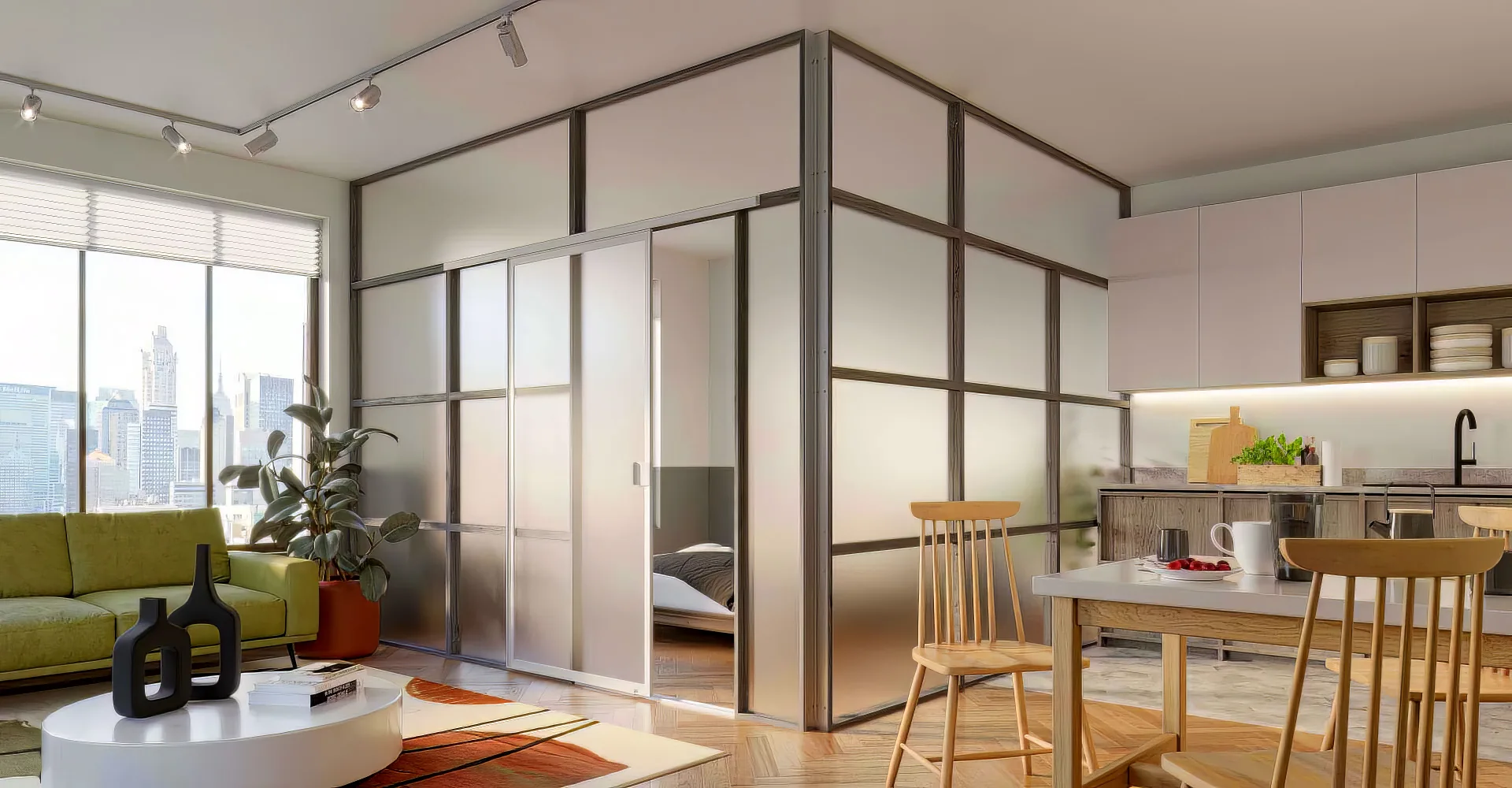
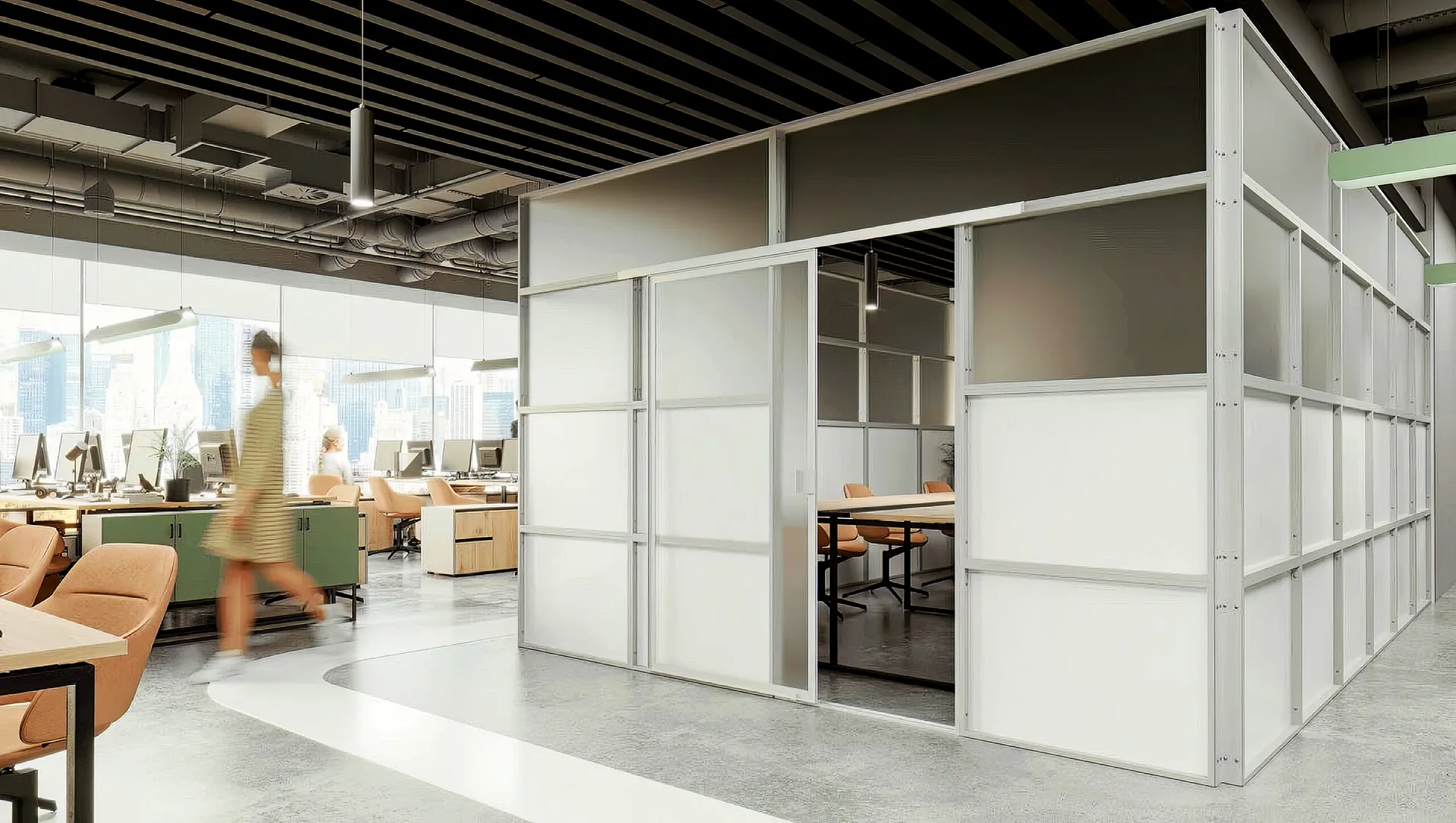
Not by building. By putting up a freestanding, modular room divider — a finished wall that stands on the floor, attaches to nothing, and turns one open space into two real rooms with a door between them.
It touches no wall, no ceiling, no fixture. That’s not a clever reading of the rules; it’s just what furniture is. A wardrobe doesn’t need a permit. Neither does this. No contractor, no filing, no hole in anything you’ll be asked about at move-out. Read the longer version in what “classified as furniture” really means.
Ours start at $1,176. A typical 11–13 ft span runs a few hundred more, and a door is an add-on — I’d rather say that here than surprise you later.
Set that against the alternative the menu offers. Moving to where the extra bedroom is cheap means a broker, a deposit, a truck, and a commute you’ll pay for every weekday for a year. We put real numbers on that in what moving in NYC actually costs, and on the price of the bedroom itself in the Door Premium.
And when the lease does end, the divider slides out fully built or breaks down into panels and goes up again in the next place — straight, L-shaped, or Z. You bought it. It isn’t rented, and it doesn’t stay behind.
The honest turn — what this does not fix
I’m not going to pretend a divider answers the story above. It doesn’t.
It does not add square footage. If you have 600 square feet, you will still have 600 square feet. A divider changes how many rooms those feet are divided into — that’s all it does, and it’s worth being blunt about it. Two rooms out of a real one-bedroom works. Five bedrooms out of a studio is a fantasy, and anyone selling you that is selling you something.
It does not lower your rent. The $168,000 problem is a housing-supply problem and a wall is not a policy. If your rent is the thing breaking you, this isn’t the fix, and I’d rather say so.
It does not create a legal bedroom. Legal bedrooms in NYC need their own window, a minimum size, and egress — those are the building’s constraints, not the furniture’s. What you get is a private room with a real door inside the apartment you already have. For most people that is the need. It is still not a change to your lease or to code. More on that in adding a bedroom to a one-bedroom, legally.
On sound: you get full visual privacy, and a room that is significantly quieter — conversation stops carrying. We don’t sell these to recording studios or therapy practices, because those rooms need sealed construction and we’d rather turn the job down than oversell it. The full accounting is in what our dividers actually do about noise.
One rent. Your address. One more room.
Send us your dimensions and we’ll send a quote within 24 hours. Brooklyn shop, our own crew across the five boroughs and New Jersey, and we ship nationwide for self-install.
Get a QuoteOr read the residential guide first →
Frequently asked questions
Going by Gothamist’s September 3 borough tour, yes — that is exactly what roughly $4,200 buys in Manhattan, where the listing they toured in Chelsea was a studio. The same rent bought two bedrooms in Greenpoint and Jamaica and a five-bedroom house on Staten Island. Room count at the median is set far more by where you are than by what you pay.
On rent alone, often yes. That’s the whole point of the menu. The costs that don’t show up in the rent line are the broker fee, deposit, movers, and the commute you pay in time every weekday afterward — plus, in a market where one Greenpoint listing drew an expected 50 showings, the real chance you don’t win the apartment at all. Run both numbers before you assume moving is the cheaper path.
A freestanding divider stands on the floor and attaches to nothing, so there is no alteration for anyone to approve — same as a bookcase or a wardrobe. Plenty of management companies and co-op boards still want a heads-up, and we provide a vendor letter for that conversation. See what your board can and can’t actually enforce.
Studios divide, and it’s the most common job we do — you’re creating a sleeping area with a door rather than a second bedroom. What decides it is the window, the light, and where the radiator and closets sit, not the square footage on the lease. Studio configurations are here.
It slides out fully built or breaks down into panels, and reconfigures in the next apartment — straight, L-shaped, or Z. You own it outright. That is the difference between buying a wall and renting one: the lease ends, the divider doesn’t.
Usually it’s the same idea sold to you at a markup — an apartment marketed as a flex 2 is often a one-bedroom with a divider already in it, or the expectation that you’ll put one in. Worth knowing which you’re paying for before you sign. We break the vocabulary down in what a flex apartment actually is.
Sources & further reading
- Gothamist, “Here’s what NYC’s median rent of $4,200 gets you in each borough” by David Brand and James Ramsay (September 3, 2026) — the five borough listings, the Chelsea studio and its $2,300 rent-stabilized neighbor, the Greenpoint two-bedroom and its expected 50 showings, the Jamaica two-bedroom, Riverdale’s distance from transit, the Staten Island house, and the $168,000 income figure under the 30% rule.
- StreetEasy rental market data — citywide median asking rent of $4,199, set in May 2026, up 7.3% year over year and the highest since StreetEasy began tracking in 2010. Establishes that a citywide median near $4,200 is a record-level figure, not a seasonal blip.
- NYC Housing Maintenance Code §27-2074 — the legal-bedroom requirements (minimum size, window, ceiling height, egress) that a piece of furniture cannot satisfy, and the reason we never describe a divided room as a legal bedroom.
- 1W2R guides: private rooms with real doors · Brooklyn apartment configurations.
Get the spec PDF + 24h quote
No contractor, no permit, ships nationwide.