

Massage Room Ideas: Your Clients Are Waiting in the Room You Need


Reach me: 212.671.0722 · sales@1w2r.com
Last reviewed by Amit · August 2026
Count the chairs in your waiting area.
Now count how often more than two of them are full at the same time.
That’s the room.
Is your waiting area earning its rent? You pay by the square foot, and the landlord charges the same for the corner with the magazine rack as for the room with the table in it. One of them takes bookings. The other one has never taken a single one.
Have you put off building because you don’t know if you’ll renew? You’ve run the numbers on a second room more than once. You stop in the same place every time — you’d be paying a contractor to improve a space that isn’t yours.
Do you know a licensed massage therapist who’d rent from you tomorrow? If you had a room to give her. You probably know two.
Whichever one of those made you nod, it ends in the same place: one more room. And it is probably where your clients are sitting right now.
I call the gap the Waiting Room Tax — the rent you pay every month on floor that has never taken a booking. Nobody bills you for it separately. It just comes out of the same check.
The math nobody runs
Commercial rent is charged by the square foot. Every foot costs the same. Only some of them earn.
Take a 1,000 sq ft studio. At $50 per square foot, that’s roughly $4,170 a month. Now walk it: the treatment rooms earn. The waiting area, the wide spot by the back door, the stretch of floor nobody has ever put anything on — those don’t. Call it 200 square feet of surplus, which is conservative for most studios I’ve worked in.
That’s about $830 a month you are already paying for floor that has never taken a booking. You paid it last month. You’ll pay it again on the first.
Turn 100 of those feet into a treatment room and your rent doesn’t move a dollar. The same money starts producing.
That’s the whole argument. Not spend more. You are already spending it.
What one more room is worth
A room that books even three sessions a day, four days a week, is doing real work against that number. Run your own rate — you know it better than I do. The point is that the comparison isn’t new room vs. no room. It’s new room vs. the surplus you’re already renting.
And the room doesn’t have to be yours to work.
You don’t have to be the one on the table
Half your potential tenants are already independent. SchedulingKit’s industry statistics put 48% of salon and studio professionals in independent or booth-rental arrangements, and 66% of solo pros report higher net income working for themselves. Massage therapist employment is projected to grow 18% over 2023–33, per the American Massage Therapy Association’s reading of federal labor projections.
That’s a growing pool of licensed people who need somewhere to work — and the first thing every one of them wants is a private room, not a corner.
So the second room can be a room you book, or a room you rent. Same wall either way. Either way it is the same build we do for private treatment rooms across the city.
Three ways to add a treatment room
| Move to a bigger space | Construction build-out | Freestanding walls | |
|---|---|---|---|
| What it costs | New lease, higher rent, forever | Contractor bid + permits | From $1,176, once |
| How long | Months, plus a move | Weeks of dust and closed rooms | An afternoon |
| Landlord / DOB | New lease negotiation | Permits and landlord sign-off | Nothing attaches to floor, wall or ceiling — no permits |
| Your rent | Goes up | Same | Same |
| When the lease ends | You start over | The build-out stays — a gift to the landlord | Strikes clean, moves with you |
| Change your mind | Move again | Demolition | Move the wall |
Prices are 1W2R’s published rates. Permit contrast per NYC DOB rules for fixed construction vs. freestanding furniture-class walls. Independent-practitioner figures per SchedulingKit industry statistics; massage employment growth per AMTA. Verified August 2026.
Why freestanding is the part that matters
A built wall is construction. Permits, landlord approval, and a permanent improvement that legally belongs to the landlord the day your lease ends. You pay for it, and you leave it behind.
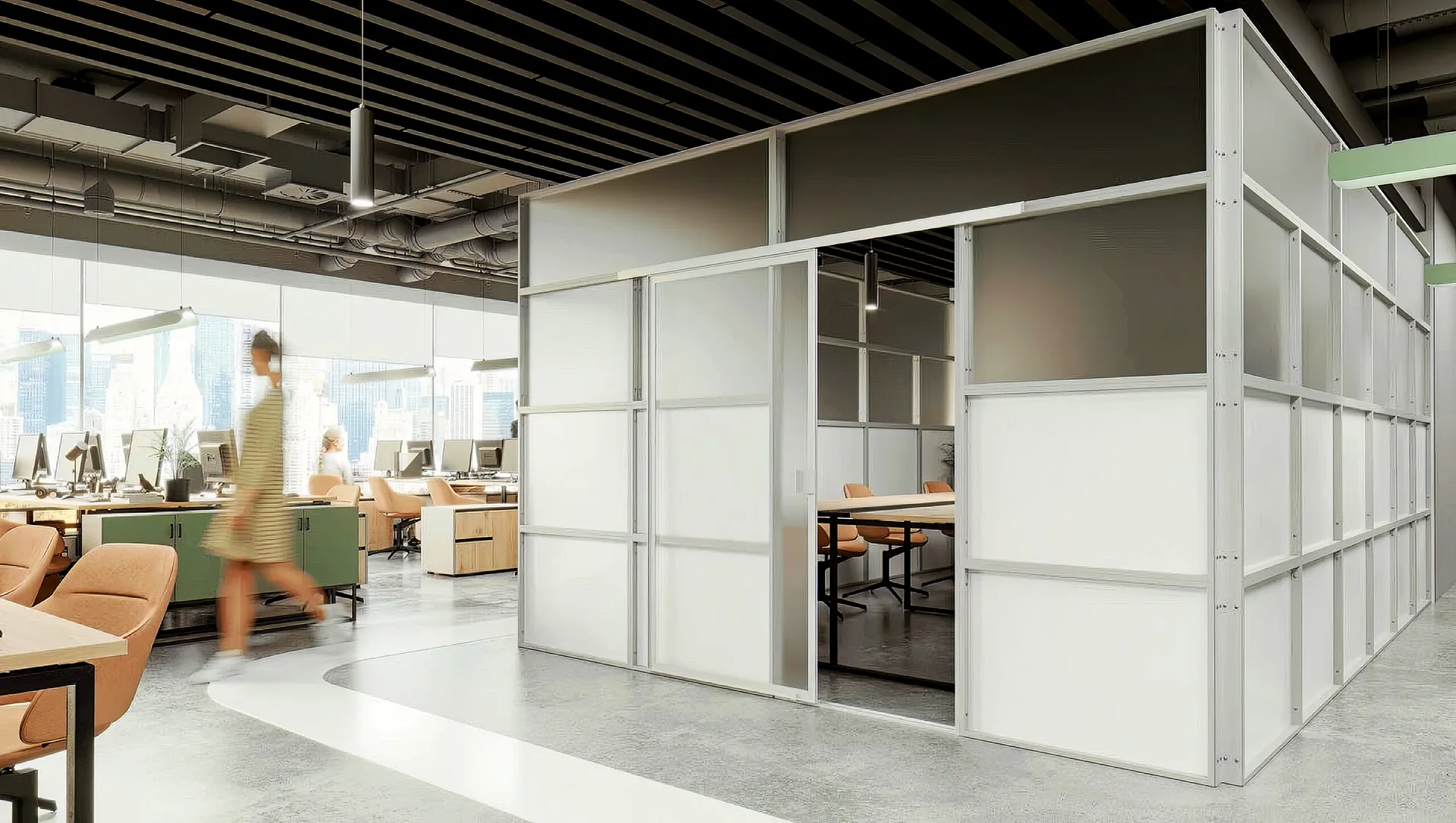
Our walls touch nothing. They stand on their own weight, full height, no anchors in the floor or the ceiling. That’s what keeps them out of permit territory, keeps the landlord conversation short, and — the part that matters for a studio on a five-year lease — makes the room portable. New address, same rooms.
Disassembly, not demolition.
It’s the same approach we build on for spa and massage treatment rooms, for salon and studio floors, and for tattoo studios. Different trades, same problem.
The honest turn — what this won’t do
I’ve built walls in NYC for 25+ years. Here is what this one does not do.
- It won’t soundproof the room. No divider will — anyone promising soundproofing is lying to you. What you get is sound dampening and complete visual privacy. For massage, that’s usually the product: the conversation next door softens, the sightline closes entirely. If you need clinical silence, this isn’t it. The physics of why is here.
- You’re not deleting the waiting area. Clients need somewhere to sit, and the arrival moment is part of what they’re paying for. You’re taking the surplus — the half that’s furniture and floor rather than people.
- The walls take up their own space. A few inches of footprint, and the new room needs its own way in. Walk it before you order.
- Some corners won’t work. Anything that needs plumbing is a different job with a different trade.
- It won’t change your license obligations. If a service you offer requires a code-built enclosure under state rules, a divider doesn’t substitute for it. New York licenses massage therapists through NYSED — check your own rules before you rent a room to anyone.
Everything else, it does the same afternoon it arrives.
Massage room ideas that actually work
- The door room. A fully enclosed room with a real door is what a renting therapist pays the most for. The door is the product.
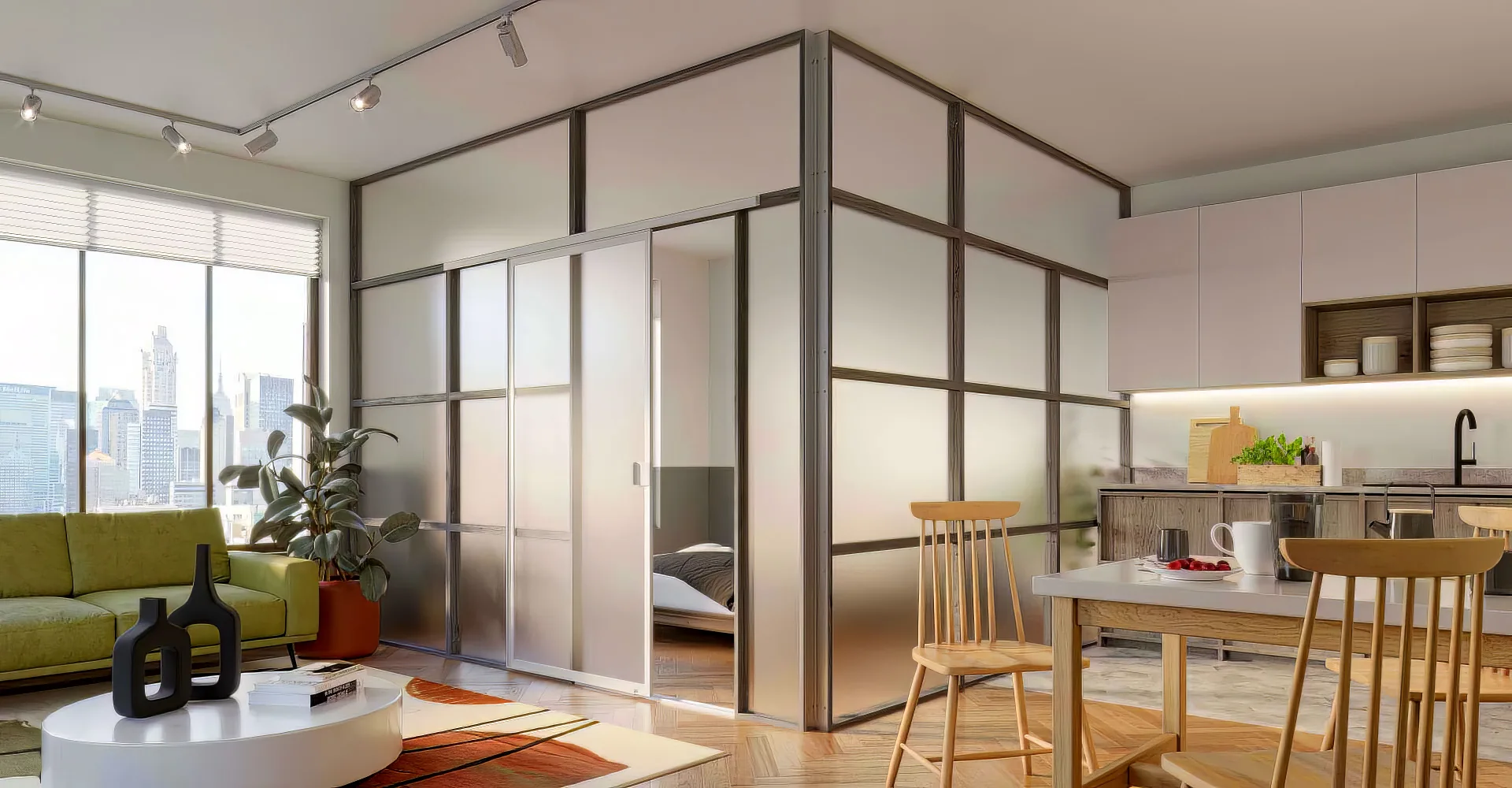
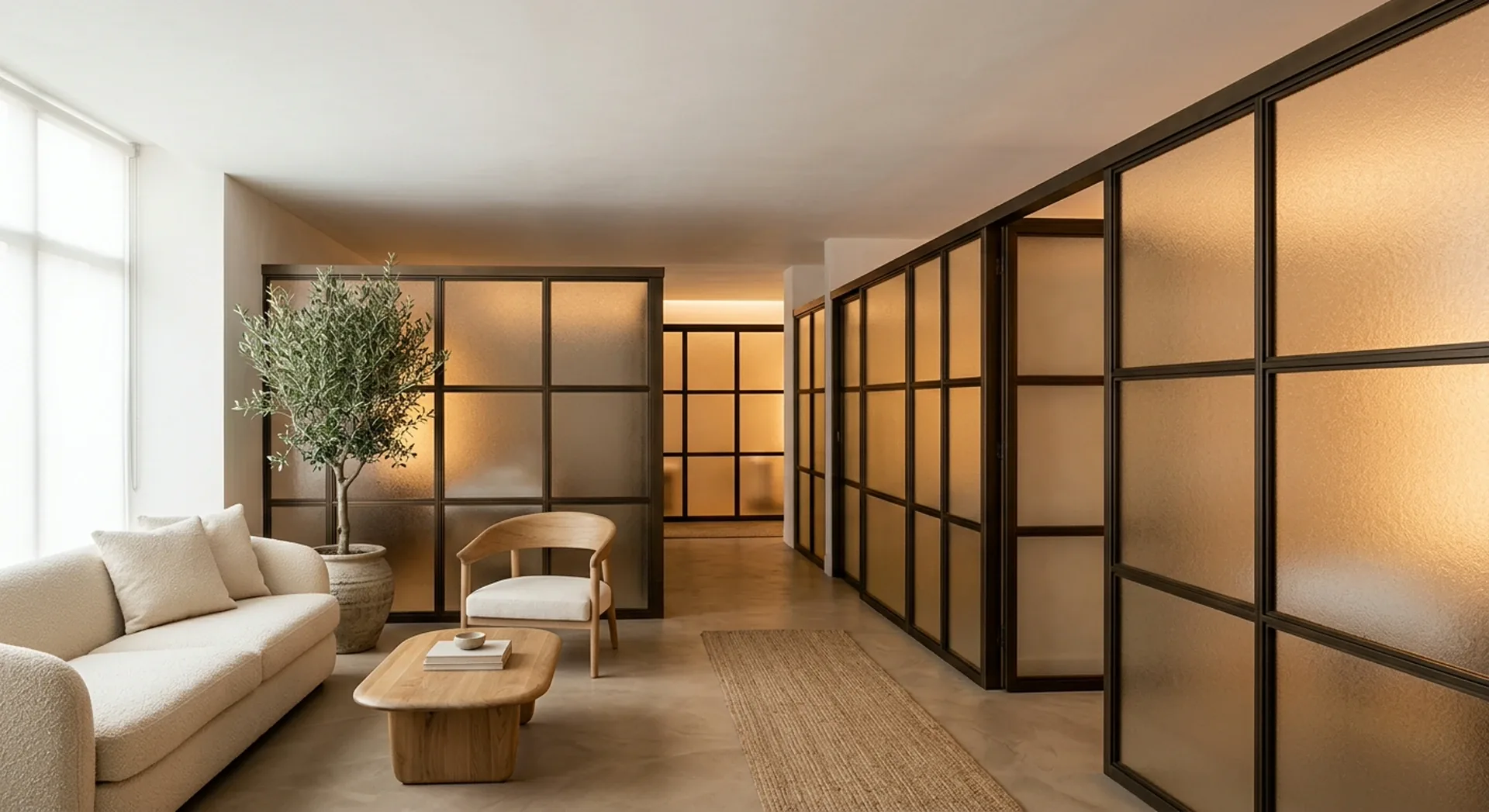
- The daylight room. Panels that let light through while closing sightlines — the room reads calm and bright instead of boxed in. It also means you’re not adding a windowless box to a studio that had good light.
- The two-room split. One oversized room divided into two. The cheapest first step, and it doesn’t touch the waiting area at all.
- The flex room. Because the walls move, a different tenant mix next year is a reconfiguration, not a renovation. How the system works.
Walk your floor, then send it to us
Take a tape to the waiting area before you decide anything. You are looking for the part of it that is never full — that is the room, and it is usually bigger than it looks with the chairs in the way.
Then send us the measurements or a photo. Our spa and massage treatment room page has the configurations, the sizes and what a room costs to own, and if you are working out of a leased commercial floor the same system covers reconfigurable partitions for the rest of the space. You will have a number the same day.
Frequently asked
Less than most owners assume. Walk your surplus with a tape before you decide — the waiting area is usually where the slack is, and you only need the part of it that is never full.
Usually there is nothing to allow. The walls are freestanding — nothing is attached to the floor, walls, or ceiling — so no alteration is happening. Read your lease anyway; some commercial leases have their own rules.
No. Freestanding walls sit outside DOB permit territory the same way furniture does, because nothing is fixed to the building.
No, and we will not tell you otherwise. They dampen sound and close sightlines completely.
From $1,176 to purchase. Ships flat-pack nationwide; our own crew installs across the tri-state. A room goes up in an afternoon.
The walls come apart and move with you. Disassembly, not demolition — the room is an asset you keep, not an improvement you leave for the landlord.
Get the spec PDF + 24h quote
No contractor, no permit, ships nationwide.