



Can You Paint Walls in a Rental? What NYC Leases Actually Say


Reach me: 212.671.0722 · sales@1w2r.com
Last reviewed by Amit · July 2026
Short answer: usually yes — with permission. Longer answer: the paint question is rarely the whole question. After twenty-five years working in NYC apartments, I can tell you that half the renters asking “can I paint this wall” are really asking “can I make this apartment feel like mine.” Sometimes a gallon of paint does that. Sometimes what you actually want is a wall that isn’t there yet. Let’s take both, honestly.
What your lease probably says
Nearly every standard NYC lease has an alterations clause: no changes to the apartment without the landlord’s written consent. Paint counts as an alteration. So does wallpaper, and so does anything screwed into a wall beyond a normal picture hook. Painting without asking isn’t going to get you evicted over one accent wall, but it does hand your landlord a legitimate deduction from your security deposit at move-out.
When landlords say yes
Most will, under some version of these conditions:
- Written permission first. An email is fine. “Can I paint the bedroom [color]? I’ll repaint it the original white before I move out.” Get the yes in writing and keep it.
- Neutral or restorable colors. A light gray gets approved. A matte black ceiling gets a no — or a repaint bill.
- You restore at move-out. This is the standard deal: paint whatever they approved, return it to the original color before the walk-through. Budget a weekend and about $60–100 in primer and paint per room.
Where your deposit is at risk
Two situations cost renters money. First: painting without permission — the landlord can charge restoration against your deposit, and dark colors that need multiple primer coats get expensive fast. Second: leaving your color behind, even a nice one. “But it looks better now” has never once won a deposit dispute. Restore it or pay for the restore; those are the options.
The question behind the question
Here’s what I see constantly: someone wants to paint one wall a different color because they’re trying to define a space — carve a bedroom feel out of a studio, give a kid a corner that reads as theirs, separate the desk from the bed so work stops following them to sleep. Paint can suggest a boundary. It can’t create one.
If that’s the real project, you’re not shopping for paint — you’re shopping for a wall. And in a rental, that usually stops people cold, because everyone knows you can’t build a wall in an apartment you don’t own.
The freestanding route: a wall that’s furniture
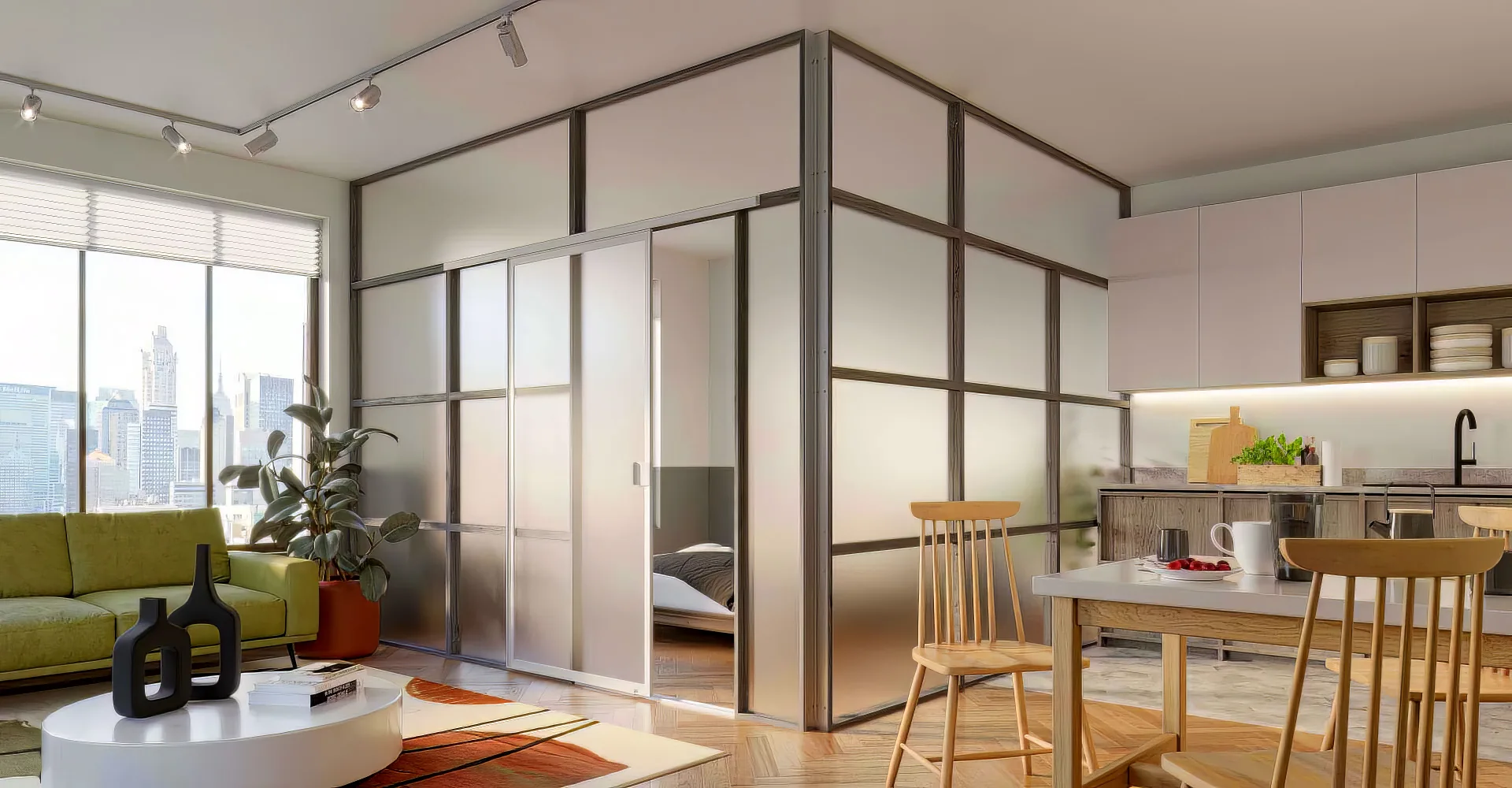
You can’t build one. You can place one. A freestanding room divider is a finished, rigid wall system that stands on its own — nothing screws into the floor, ceiling, or existing walls. That makes it furniture, not construction: no permit, no contractor, no landlord alteration clause triggered, nothing to restore at move-out. It goes up in hours, and when your lease ends, it moves with you like a sofa does.
Compared to the paint conversation, notice what disappears: no written-permission email, no restoration weekend, no deposit exposure. The wall was never attached, so there’s nothing to undo. Renters use them to give a roommate or a kid a space of their own, split a live/work loft, or turn one open room into two genuinely separate ones — with a real sliding door, if you want to actually close it behind you.
If you want the full legal picture, we’ve written up how NYC treats freestanding walls versus pressurized ones — it’s the most common follow-up question we get.
Bottom line
- Want a color? Ask in writing, keep it restorable, repaint before move-out. Most landlords say yes.
- Want a boundary? Paint won’t get you there. A freestanding divider will — no permission slip required, because it’s furniture.
Want a wall, not a color?
A freestanding divider gives the room a real boundary — no landlord email, no repaint weekend, no deposit risk. Custom-built in Brooklyn, ships nationwide.
Get a Custom QuoteSee how renters add a private room →
FAQ
Usually yes, with the landlord’s written permission — most NYC leases require consent for any alteration, including paint, and many landlords agree if you commit to repainting the original color before move-out.
If you painted without permission or leave a non-original color at move-out, repainting costs can come out of your deposit. Normal wear to landlord-applied paint generally cannot.
Built walls require landlord approval and, in NYC, usually permits. A freestanding room divider is classified as furniture — it touches nothing, requires no approval, and leaves with you on move-out day.
Sources & further reading
- Standard NYC lease alteration clauses (REBNY-form and common landlord riders) — consent required for alterations, including paint; restoration at move-out.
- 1W2R guides: why freestanding walls are classified as furniture · the pressurized-wall ban and the freestanding loophole · dividing a studio without losing the deposit · what the DOB actually says in 2026.
Get the spec PDF + 24h quote
No contractor, no permit, ships nationwide.