



How to Divide a Room Without a Wall: First, Find Out Who Vetoed It


Reach me: 212.671.0722 · sales@1w2r.com
Last reviewed by Amit · October 2026

Nobody types “how to divide a room without a wall” because they dislike walls.
They type it because somebody said no to one.
The lease said no. The building said no. The bank account said no. Or the calendar did — you’re out in fourteen months, and paying for a wall you’ll leave behind feels like setting money on fire.
I’ve built walls in New York for 25 years, and the question that settles this fastest isn’t how big is the room. Who vetoed the wall? Because the answer picks the solution for you. I call it the Veto Test: name what stopped the wall, then only look at options that survive that particular no.
The four vetoes
1. The lease. A standard lease has an alterations clause. Drill into a ceiling, frame a partition, mount a track — that’s an alteration, and the damage lands on you at move-out, not on whoever installed it. The test here is simple: does anything get screwed, nailed or pressed into the apartment?
2. The building. Even if the lease is quiet, the board or management may not be. Plenty of co-op and condo boards ban pressurized walls outright, and some buildings decide which vendors are allowed to work there at all — the building that plays favorites is a real New York problem. The test: does this need a crew, a certificate of insurance and somebody’s sign-off?
3. The wallet. A real number, not a feeling. If you can spend a few hundred dollars and no more, that rules most things out — and it rules a couple of good things in.
4. The clock. When does this end? A lease that runs out next year changes the math on anything you can’t take with you. The test: on move-out day, what do you still own?
You may be facing two at once. If you rent, the first and the fourth come with the lease.
The math, before anyone sells you anything
Here is the cost-per-door arithmetic on the one option that gives you a closing door without construction — ours, because those are the only prices I can stand behind.
A freestanding divider with a real sliding door starts at $1,664 for a wall 7 feet tall and up to 8 feet wide. Spread that over a single 12-month lease and it’s about $139 a month for a door. But it comes apart and moves with you, so carry it into a second 12-month lease and the same wall works out to about $69 a month. A third lease, about $46. The door gets cheaper every year you keep it, because you keep it.
Now the other kind of temporary wall. In our three-year cost breakdown we laid out the published figures: a pressurized wall with a door usually lands between $1,000 and $2,500 installed, per Brick Underground and Temporary Walls NYC’s own published range. It is demolished when you leave. Divide that by one lease and stop — there is no second lease, because there is no wall.
That’s the clock veto in one paragraph. The rest is fit.
The five real options, graded
There are dozens of ways to suggest a boundary — rugs, plants, lamps, a sofa floated with its back to the bed. If zoning is all you need, our fifteen ideas ranked by what they actually block covers every one. Here I’m only grading the five things people actually buy when they mean wall.
1. A curtain
Privacy: closes the sightline completely when drawn. Light: blackout fabric blocks it; sheer fabric keeps it. Door: no — the curtain is the door, and it moves every time someone walks past. Landlord and deposit: depends entirely on what holds it up. A ceiling track usually screws into the ceiling, which is exactly what a lease prohibits. A floor-to-ceiling tension pole avoids the screws but still presses on the ceiling, so check what its feet are pressing against.
Survives: the wallet, the clock. It’s the honest answer when the budget is small and you need it up tonight.
2. A bookcase
Privacy: a closed-back unit blocks the sightline; an open-back one blocks most of it. Light: open backs let it through, closed backs don’t. Door: no. Landlord and deposit: a tall, loaded bookcase is a tip hazard unless it’s secured, and securing it means drilling. The “bookcase wall” that some companies install is a different animal — built in place, with an open gap of about a foot at the top, and per Brick Underground’s reporting, doors are typically not permitted at all.
Survives: partly the lease, partly the building. Fails the clock — a seven-foot unit cut to one ceiling doesn’t follow you anywhere useful.
3. A folding screen
Privacy: real when open, with gaps at every hinge. Light: blocks it where it stands; light goes over the top. Door: no. Landlord and deposit: zero risk. It’s furniture in the plainest sense. The catches: screens tip, they’re rarely taller than about six feet, and they announce “temporary” the moment anyone walks in.
Survives: every veto. It just doesn’t give you a room. Priced from under a hundred dollars, it’s the right call whenever the whole job is hiding a bed.
4. A pressurized (tension) wall
Privacy: full height, real visual privacy, decent noise reduction — credit where it’s due. Light: blocks it unless the panels are clear. Door: yes, at extra cost. Landlord and deposit: this is where it falls apart. The panels are tensioned between floor and ceiling with mechanical pressure, which needs a professional crew, can leave marks at move-out, and is precisely what many boards have banned. If the DOB gets involved with a layout change that needed a permit, fines start around $2,500 — the 2026 rules are here.
Survives: the wallet, sometimes. Fails the building, often. Fails the clock always — it comes down as debris.
5. A freestanding, full-height divider
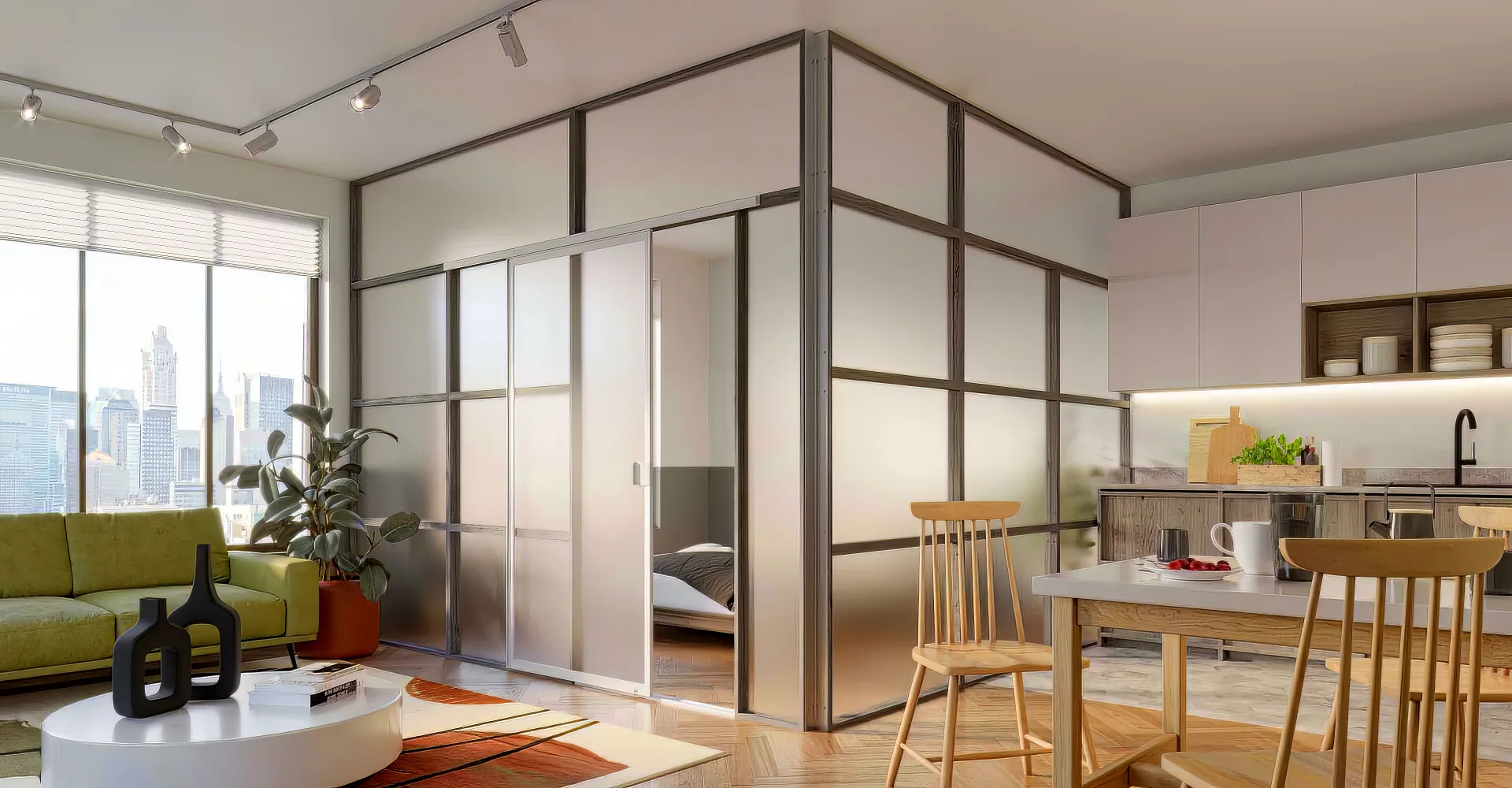
Privacy: full visual privacy, built up near your ceiling height so there’s no open band on top. Light: your choice — solid panels, or panels that let sunlight through while closing the sightline, or a sliding window beside the door to borrow light and air from the brighter side. Door: single or double sliding door, built into the divider’s own frame, placed where you want it. Landlord and deposit: it stands on adjustable leveling legs and never touches the ceiling or the walls. Nothing is drilled, screwed or pressure-fit, which is why it’s treated as furniture rather than construction — no permit, no contractor, no build-out approval.
Survives: the lease, the building and the clock. The wallet is the one it can fail: it starts at $1,176 without a door. That’s the trade.
Chart 1 — The Veto Test
| The lease | The building | The wallet | The clock | Real door? | |
|---|---|---|---|---|---|
| Curtain | Track: screws in. Tension pole: presses on the ceiling | Usually no one asks | Lowest | Comes with you | No |
| Bookcase | Tall units need securing — drilling | Installed bookcase walls need a crew | Low to mid | Cut to one ceiling | Typically not permitted |
| Folding screen | Nothing attached | Nothing to approve | Under a hundred dollars and up | Comes with you | No |
| Pressurized wall | Pressed floor to ceiling; marks at move-out | Crew required; banned by many boards | Usually $1,000–$2,500 with a door | Demolished | Yes, extra cost |
| Freestanding divider | Attached to nothing | No crew required; self-install possible | From $1,176; from $1,664 with a door | Disassembles and moves with you | Single, double, or door + sliding window |
Freestanding prices are 1W2R’s published rates. Pressurized-wall range per Brick Underground and Temporary Walls NYC’s published FAQ, and bookcase-wall door policy per Brick Underground, as compiled in our Move-Out Test (verified July 2026). Retail categories reflect typical products; individual products vary. Checked October 2026.
How to choose, one veto at a time
- If the wallet is the veto — a few hundred dollars, hard ceiling — buy a folding screen or a curtain on a tension pole. Don’t let anyone talk you past this, me included.
- If the lease is the veto, ask one question of anything you’re considering: will anything be screwed, nailed or pressed into my apartment — and will you put that in writing? Only the screen and the freestanding divider answer “no” cleanly.
- If the building is the veto, eliminate anything that needs a crew. A freestanding divider can arrive flat-packed and go together with a drill and two clamps — no vendor approval, no gatekeeper. On the rare strict lease, we hand you a one-page explainer.
- If the clock is the veto, buy something you’ll still own on move-out day. That leaves the screen, the curtain and the freestanding divider.
- If you need a door, the list is two items long: a pressurized wall or a freestanding divider. Run the other four tests on those two.
Splitting a studio specifically? Our studio divider page has the configurations. Turning a living room into a bedroom in a one-bedroom? That’s its own guide — adding a bedroom to a one-bedroom, and what “legally” really means.
The door is the difference
A divider without a door is a screen, however good it looks. Add a door and you have something you close behind you — which is what a wall was for in the first place.
Every door we build slides, never swings. A swing door eats about three feet of floor, in exactly the layouts that need dividing in the first place. You can have a single door, a double door, or a door with a sliding window next to it. The door is part of the divider’s own frame, so it never touches your ceiling or your walls either.
Where you put it matters more than people think. A Bronx family turned their living room into a second bedroom and asked for two sliding doors on one wall: one became the everyday entrance, and the other was placed so they could slide it open from bed and see the TV on the far wall. Two doors, two jobs, one wall. The details are on our sliding-door divider page.
The honest turn — what this doesn’t do
Before you call anyone, here’s what a freestanding divider won’t do.
- It doesn’t make a legal bedroom. A legal bedroom in New York needs a window, light, air and a way out in a fire. A divider can’t give a room a window it doesn’t have. It doesn’t create a legal bedroom — anyone who says so is selling you a violation. What it creates is privacy, which is usually what you were after.
- Who I build these for. Bedrooms, home offices, nurseries, shared apartments: full visual privacy, a room that’s significantly quieter, and conversation stops carrying — more so with the optional acoustic panel upgrade. I don’t sell them to therapy practices or recording studios. Rooms that need sealed sound isolation belong to permanent construction, and the full answer on sound says why.
- It isn’t tonight. Each divider is built to order in our Brooklyn shop — four to six weeks. If you need privacy this weekend, buy the curtain this weekend. It’ll still be useful after the wall arrives.
- It’s not the cheapest line on the chart. If a screen solves your problem, the screen wins.
Everything else — the lease, the board, the move-out — it handles by not being attached to anything.
What it takes, start to finish
Send a few photos and rough measurements, and tell us where you want the door. You get a custom quote within 24 hours. The wall is built to your exact dimensions in four to six weeks. In the NYC tri-state area our own crew installs it — most studio installs are done in an afternoon, two to three hours, one crew, no mess. Anywhere else in the country it ships flat-packed for self-assembly, no contractor required.
Purchase from $1,176 without a door, from $1,664 with one. See the full room divider lineup or get your number the same day.
Frequently asked
A folding screen or a curtain on a tension pole, for a few hundred dollars or less. Both hide a bed. Neither gives you a door or blocks much sound, but if hiding the bed is the whole job, start there.
A freestanding one, yes. It attaches to nothing, so it’s treated as furniture: no permit, no contractor, no build-out approval. Walls that screw into the apartment or press against the ceiling are a different story — many co-op and condo boards ban pressurized walls outright. Read your lease either way; for strict ones we provide a one-page explainer.
Use a full-height freestanding divider with a sliding door, placed so the new room keeps access to light. It gives you a private room you can close. It does not make a legal bedroom — that needs a window and a way out — so treat it as privacy, not a new legal room count.
Yes. We build single or double sliding doors into the divider’s own frame, or a door with a sliding window beside it. A divider with a door starts at $1,664 for a wall 7 feet tall and up to 8 feet wide.
No. Ours are built up near your ceiling height for full-height privacy, but they never press against the ceiling. They stand on adjustable leveling legs, which is what keeps them freestanding.
It gives you full visual privacy and a significantly quieter room — conversation stops carrying, more so with the optional acoustic panel upgrade. It’s built for bedrooms, home offices and nurseries; rooms that need sealed sound isolation belong to permanent construction.
A quote within 24 hours, then four to six weeks to build to your dimensions. In the NYC tri-state area our crew installs it, usually in an afternoon; elsewhere it ships flat-packed for self-assembly.
Get the spec PDF + 24h quote
No contractor, no permit, ships nationwide.