



Acoustic Room Dividers: The Absorption Trap, and What Actually Reduces What You Hear


Reach me: 212.671.0722 · sales@1w2r.com
Last reviewed by Amit · July 2026
Someone buys a panel labelled acoustic. It arrives, it’s soft, it looks the part. They put it between the desk and the sofa, take a call, and their roommate hears every word.
The panel wasn’t defective. It did exactly what it was built to do. It just wasn’t built to do the thing they bought it for.
This happens constantly, and it happens because one word is doing two completely different jobs.

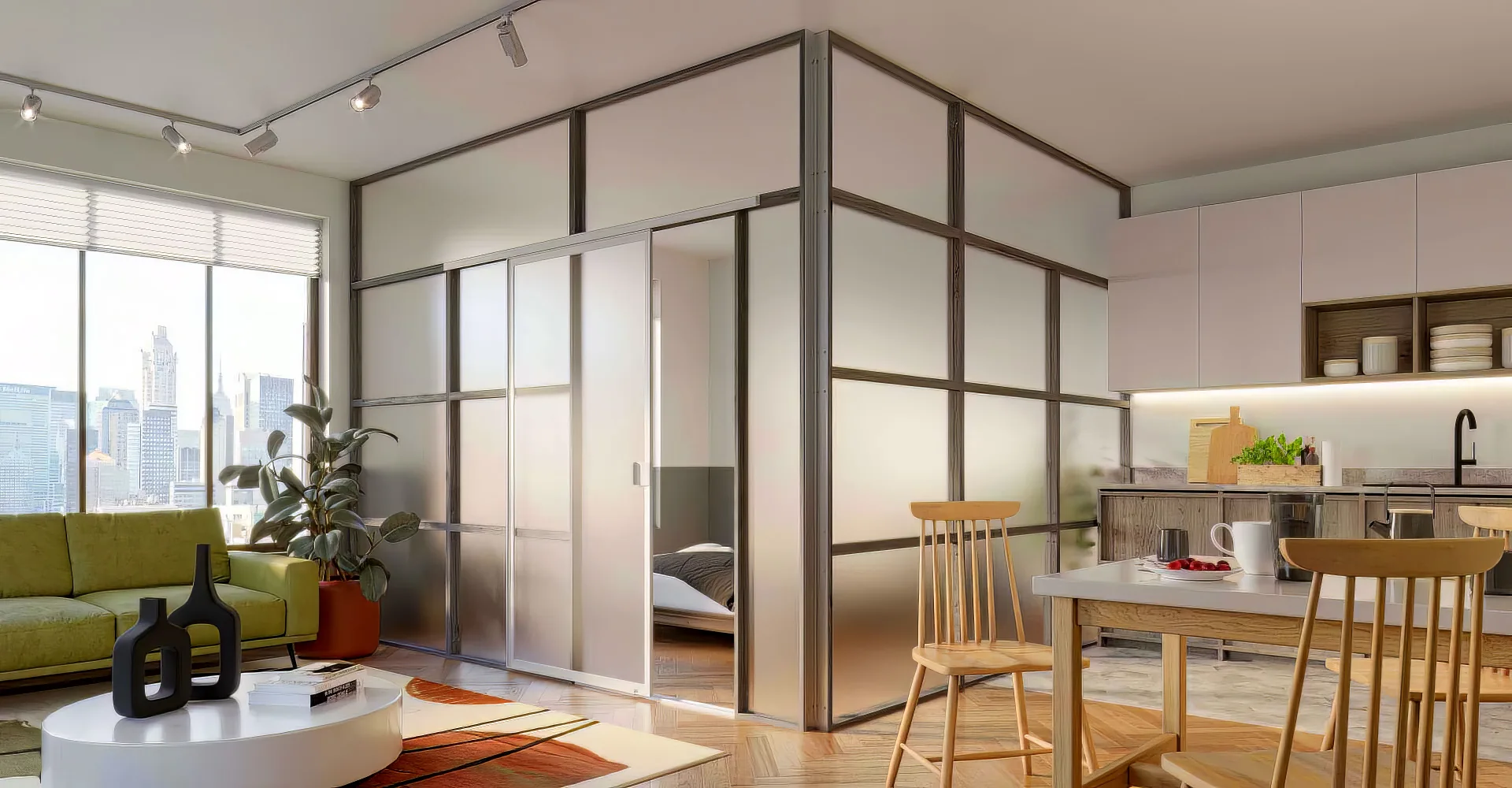
Same room, two dividers. The short screen leaves a standing call fully audible and visible; the full-height wall does not. Note the ceiling above the tall one — it runs unbroken, because nothing is attached to it.
The Absorption Trap
There are two ways to deal with sound, and they are almost opposites.
Absorbing means soaking up sound inside a room so it stops bouncing. Soft, light, porous things do this — fabric, foam, carpet, curtains. The room gets calmer. Voices stop ringing. It sounds expensive in there.
Blocking means stopping sound from getting out. That takes mass and a complete seal. Heavy, dense, and — this is the part everyone skips — no gaps anywhere.
Almost everything sold as an “acoustic divider” does the first job. Almost everyone buying one wants the second.
That’s the Absorption Trap: you searched for privacy, the market sold you ambience, and both of you used the same word.
Here’s the test that cuts through it. Ask yourself which sentence describes your problem:
- “This room is echoey and harsh and I’m tired of it.” → You want absorption. Soft panels will genuinely fix this, and cheaply.
- “I don’t want them to hear what I’m saying.” → You want blocking. No freestanding panel of any kind fully delivers this. Not ours either.
Why every divider leaks — and where
Sound behaves like water. Put a barrier in a stream and the water goes around it. Sound does the same, and it only needs one path.
Acousticians call this flanking — sound arriving by any route other than straight through the barrier. For a divider that stands on the floor, the routes are obvious once you look for them:
- Over the top. The biggest one, and it’s pure geometry. Any gap between the divider and the ceiling is an open door for sound.
- Around the sides. Same principle, sideways.
- Off the ceiling. In a room with a hard ceiling, sound goes up, bounces, and lands on the other side. This is why ceiling absorption matters as much as the partition does — open-plan office research has found ceiling absorption and partition height to be among the biggest levers in whether speech stays private.
This is why the word soundproof on a movable product should end the conversation. A thing that can be carried out of the room cannot be sealed into it. We’ve written the long version of that answer, and the short version is: nobody’s temporary wall is soundproof. Not pressurized, not accordion, not bookcase, not ours.
Chart 1 — what each kind of “acoustic divider” actually does
| What you can buy | Typical height | Reduces echo? | Stops words being understood? | Blocks the view? |
|---|---|---|---|---|
| Soft acoustic screen | 4–6 ft (chest to head) | Yes — this is its job | Barely | Only when seated |
| Accordion / folding partition | 6–8 ft | Some | A little | Mostly, with gaps |
| Curtain on a track | Floor to track | Some | No | Yes |
| Freestanding full-height wall | Built to your ceiling | Some | Noticeably — not reliably | Completely |
| Built wall, sealed, by a contractor | Structural | Depends on finish | Yes — the only row that does | Completely |
The one lever nobody tells you about: height
If you only change one thing, change how tall it is.
Sound going over the top is the dominant leak in almost every room, and it is the one you can actually do something about. A 5-foot screen stops sound aimed at a seated torso. Standing conversation, a phone held to an ear, a laptop speaker on a desk — all of that travels straight over it.
Going from chest height to near-ceiling height changes the geometry more than any fabric choice will. It is not glamorous and no product page leads with it, but it is the difference people actually notice.
Second lever: what’s above you. A hard ceiling reflects everything the divider just redirected. If the ceiling is bare and the floor is bare, a divider is fighting the room. Soft ceiling treatment, a rug, and full bookshelves do more for speech privacy than most people expect.
Third lever, and the cheapest: a steady background sound. Offices have used low-level masking for decades because a conversation you can hear but not follow stops being distracting. A quiet fan does a surprising amount of this for free. It feels like cheating. It works.
The honest turn — what ours does, and what it doesn’t
We build freestanding walls, so weigh this accordingly, then hold us to it.
Ours is not soundproof, and we will not use that word. A full-height panel built to your ceiling makes a space significantly quieter and blocks sightlines completely. That is sound dampening. It is not sound isolation, and the gap between those two things is where most disappointment in this category lives.
What it reliably does: removes the visual, which changes how present someone feels more than the decibel change alone suggests; cuts the direct path of sound between two points; and adds real height where a screen gives you none.
What it does not do: guarantee that a determined listener can’t make out your words. In a quiet apartment at night, with two people speaking normally on either side, you will hear that there’s a conversation. You may well catch some of it.
And it touches nothing. It stands on adjustable leveling legs, on the floor, attached to no wall and no ceiling. That’s the trade being made: because it does not seal to the building, it cannot isolate sound — and because it does not attach to the building, it needs no permit, no board approval, and puts no deposit at risk. What “classified as furniture” actually means. You cannot have both. Anyone offering you both is describing construction.
What to buy, honestly, for each problem
“The room echoes.” Soft panels, a rug, curtains. Cheap, effective, and you do not need us.
“I need to not see them and not be seen.” Full height, floor to near-ceiling. This is the problem freestanding solves outright, and the sound reduction comes along with it.
“I need a room I can close.” Full height with a real door — a door is a large hole in a wall until it isn’t, so if you want the space to behave like a room, it needs to close.
“Open-plan office, people can’t concentrate.” Height plus ceiling absorption plus masking, together. Any one alone underdelivers. Dividing an open plan without construction covers the layout side, and what that overflow is costing you covers the money side.
“Confidential audio, legally or ethically required.” Contractor and acoustician. Not us, not anyone selling portable panels. Say no to whoever says otherwise.
Full height, made to your ceiling. No word we can’t defend.
Send us your dimensions and a photo. You’ll get a layout and a quote back within 24 hours — built in our Brooklyn shop, delivered finished, installed with a drill and two clamps. From $1,176.
Frequently asked questions
Not completely, and be sceptical of anyone who says otherwise. It will make the space noticeably quieter and remove the sightline entirely, which together make a normal conversation much less intrusive. It will not stop someone in a quiet apartment from catching some of what you say. If that’s the requirement, you need built construction.
Absorbing softens sound inside a room — less echo, less harshness — using light, porous material. Soundproofing stops sound leaving a room, and needs mass plus a complete seal with no gaps. They’re nearly opposite jobs. Most products labelled “acoustic” do the first one. Most people shopping for them want the second.
Yes, and it’s the single biggest thing you control. The dominant leak in most rooms is sound travelling over the top, so a chest-height screen misses standing conversation, phone calls and laptop audio entirely. Going to near-ceiling height changes the geometry more than any change of surface material will.
Often, yes — they’re doing a different job, so they stack. Panels, a rug and a soft ceiling reduce the reflections that carry sound around the divider. If the room is hard and bare, the divider is working against the room, and treating the room is usually cheaper than upgrading the divider.
That depends on your actual problem, which is worth being honest with yourself about. For privacy from sightlines, focus while someone else is in the room, a guest space, or a home office you can step away from, it solves the thing people are really bothered by. For confidential audio it doesn’t, and no portable product does.
A heavy curtain is a legitimate option and we’ll say so. It blocks the view, softens the room, and costs a fraction. What it won’t do is feel like a room, hold a door, stay put when someone walks past, or give you a surface to put anything against. Choose it when the view is the whole problem.
Sources & further reading
- ASTM E1130 (open-plan speech privacy) and ASTM E2638 (speech privacy class for closed rooms) — the published test methods by which speech privacy is actually measured, as opposed to claimed.
- Open-plan office acoustics research (National Research Council Canada; Journal of the Acoustical Society of America) — findings that ceiling absorption, partition height and workstation size are among the strongest determinants of speech privacy, and that masking sound is part of a working solution rather than an optional extra.
- General acoustics literature on absorption versus transmission loss — the distinction between light, porous materials that absorb sound within a space and dense, sealed assemblies that block sound between spaces.
- 1W2R guides: our full answer on sound · the freestanding range · office partitions.
Get the spec PDF + 24h quote
No contractor, no permit, ships nationwide.