

The Overflow Tax: Manhattan Ran Out of Room, and Every Exit Just Got Narrower


Reach me: 212.671.0722 · sales@1w2r.com
Last reviewed by Amit · July 2026
22.8 million square feet. That’s how much office space Manhattan leased in the first half of 2026 — the strongest first half since 2002, according to Colliers.
Read that as good news if you own a building. Read it differently if you run one of the companies doing the leasing, because the same report says availability fell to 13.0%, the lowest since October 2020, down from an 18.2% peak in February 2024. Free rent is drying up too: average abatements fell to 12.4 months, the lowest since 2019.
Then, on July 28, the quarterly coworking numbers landed. Manhattan’s shared-office inventory shrank again — down 200,800 square feet in the second quarter — while the price of a Manhattan desk climbed to $821 a month, up 4.6% in a single quarter.
Put those three together and you get the thing nobody has named yet.
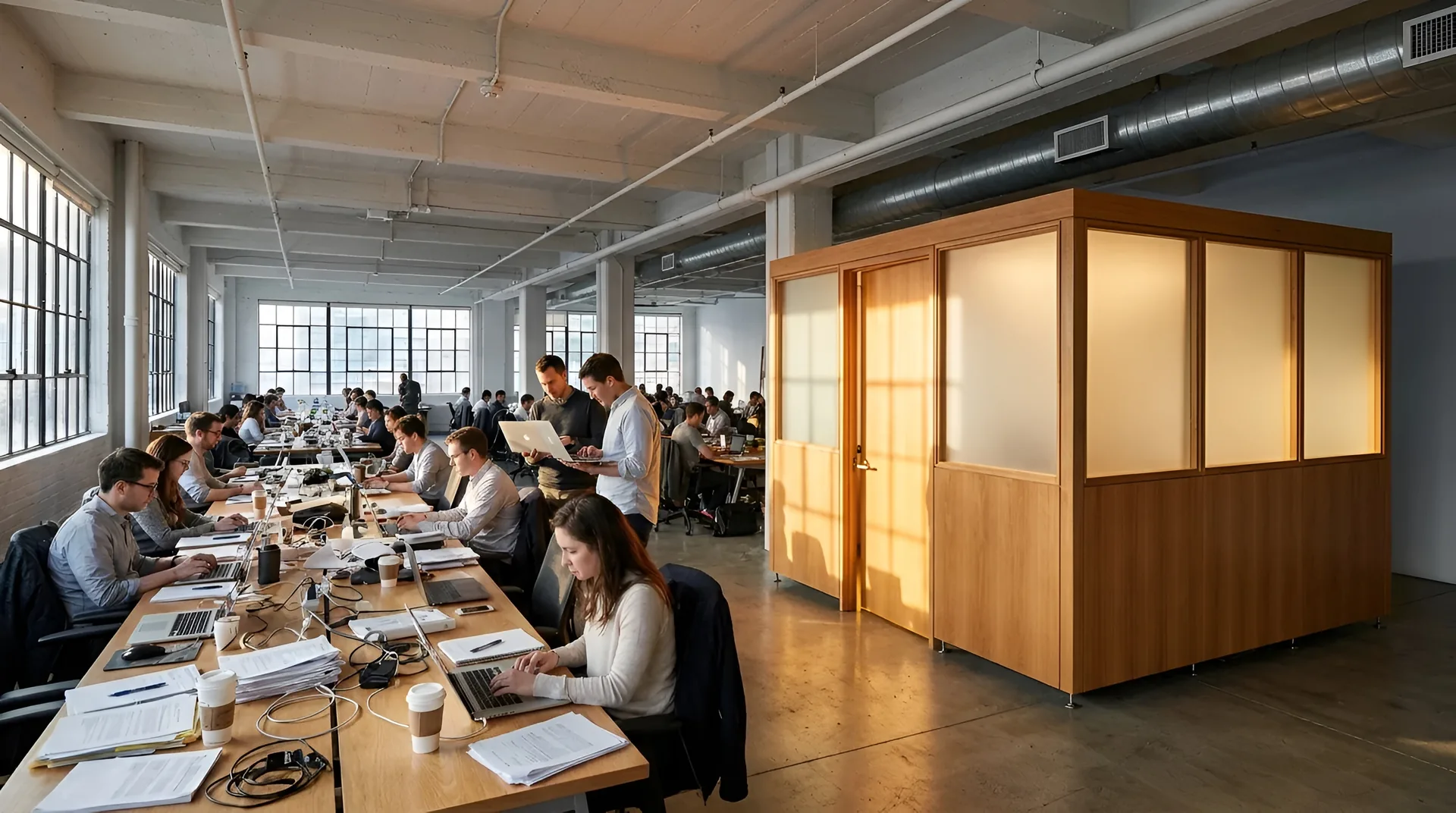
A floor with the square footage but no rooms in it — and one private room standing free on that same floor. Note the ceiling: it runs unbroken above the wall, because nothing is attached to it.
The Overflow Tax
Every growing company in this city pays it, and almost none of them have it on a line item.
The Overflow Tax is what you spend every month to house the people your own floor can’t fit. The two desks in the coworking place around the corner. The conference room you book by the hour because yours is always taken. The Tuesday when eleven people show up for nine seats and two of them work from a coffee shop on the company card.
It isn’t one big invoice. That’s exactly why it never gets fixed. It’s a hundred small ones, spread across three budget codes, and it recurs forever.
And in the summer of 2026, all three of the usual escape hatches narrowed at the same time.
Exit one: lease more space
Harder and pricier than it’s been in five years. Availability at 13.0%, Manhattan asking rents up 3.2% in the quarter to $72 a square foot, and landlords handing out three months less free rent than they were. A lease is also a five-to-ten-year answer to a problem that, for most hybrid teams, shows up on Tuesdays and Wednesdays.
Exit two: rent the overflow
Coworking was the pressure valve. It’s tightening. Manhattan shed 200,800 square feet of shared office in Q2 while the going rate rose to $821 per desk per month. Ten overflow people at that rate is $8,210 a month — $98,520 a year, renewed forever, for space you will never own.
Exit three: go to Brooklyn
This one is actually working, and it’s the most interesting number in the whole report. Brooklyn added 122,600 square feet of coworking in Q2, up 6.2%, with the biggest jump in Bay Ridge–Sunset Park. A Brooklyn desk runs $720 against Manhattan’s $821. Credit where it’s due — if your team can move, the borough is genuinely cheaper.
But moving the company is not a Q3 decision. It’s a Q3 next year decision, and the Tuesday problem is this week.
The question almost nobody asks first
Here’s what I’ve seen on a lot of walkthroughs, and it changes the math completely:
Most companies calling us are not out of square feet. They’re out of rooms.
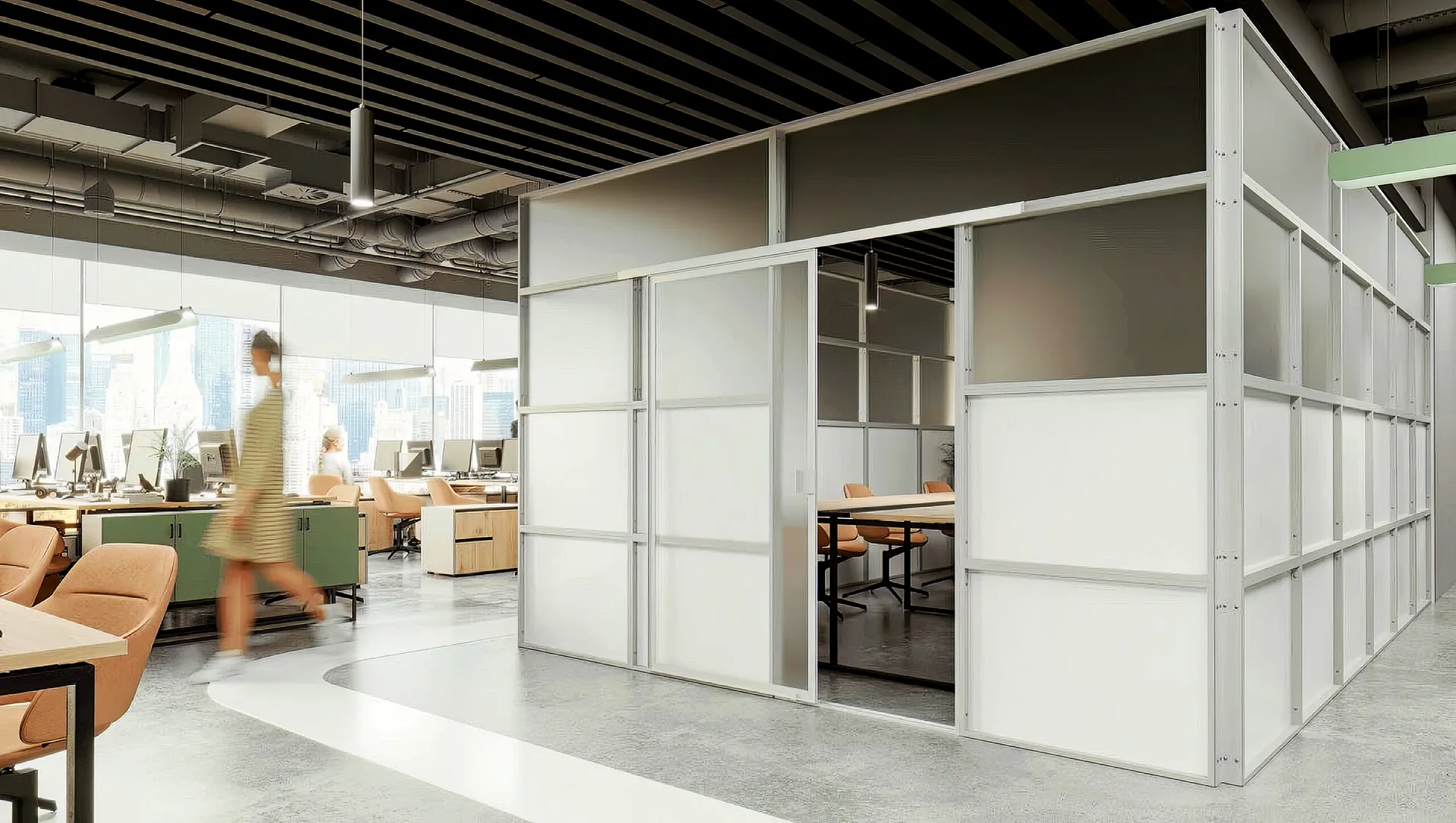
An open floor at 200 square feet a head has plenty of room by the spreadsheet. What it doesn’t have is a door. No place to take an offer call. No room to run a 1:1 without the whole floor hearing it. No interview space that isn’t the kitchen. So the private conversations leave the building — and you start renting rooms somewhere else while paying $72 a foot for the ones you already have.
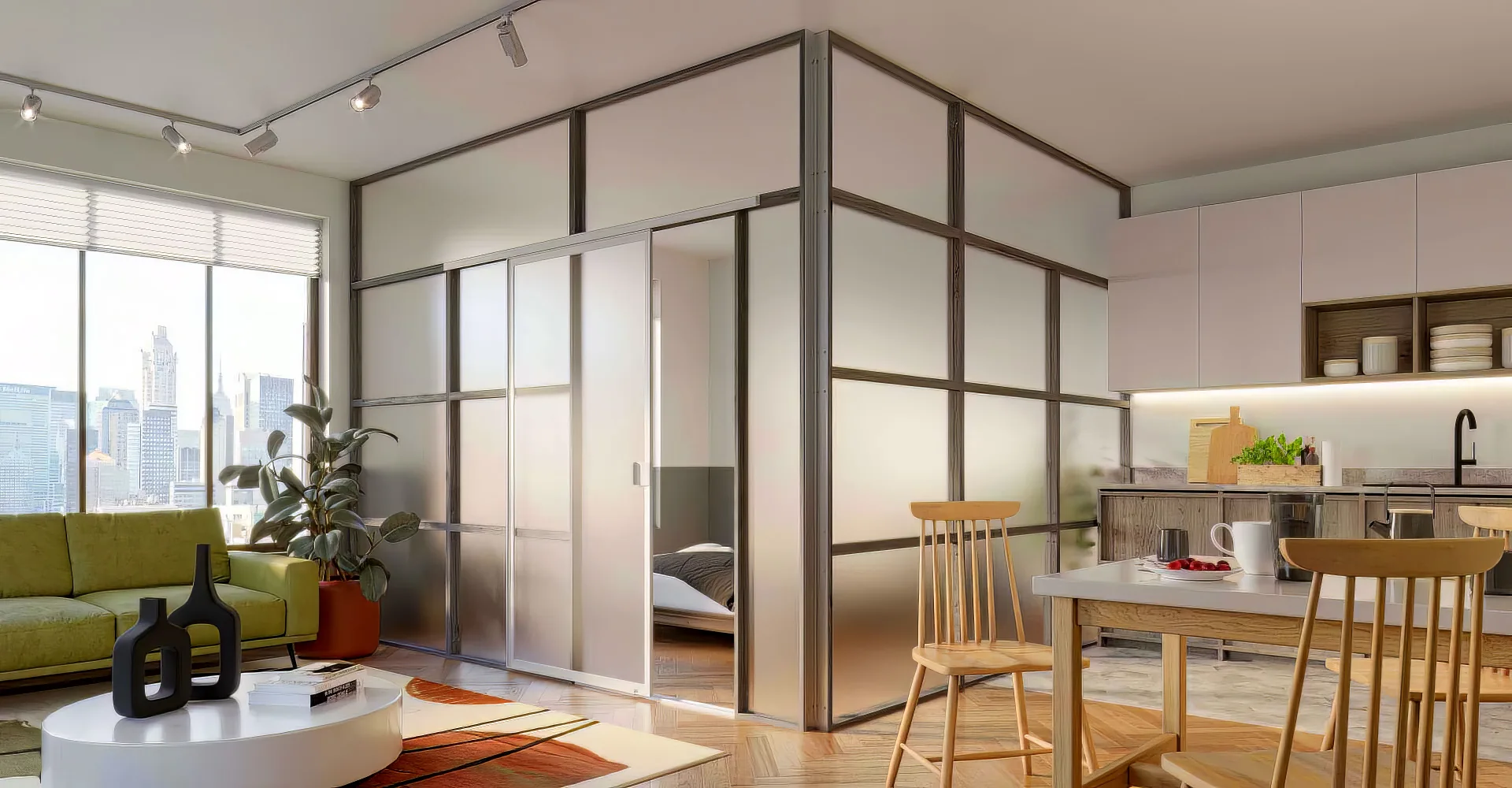
That’s the Overflow Tax at its purest: paying twice for the same square footage. Once on the lease, again on the overflow, because the space you hold has no walls in it. Partition walls built for commercial floors exist for exactly that gap, and how a freestanding wall actually stands up is the part worth understanding before you buy one.
Chart 1 — Four ways to get more room, and what each one really costs
| Option | How fast | What it costs | If headcount changes | What you own after |
|---|---|---|---|---|
| Sign more space | 3–9 months | $72/sq ft asking, 5–10 yr term, less free rent than 2025 | Locked in | Nothing — a lease obligation |
| Coworking overflow | Days | $821/desk/mo Manhattan · $720 Brooklyn | Flexible | Nothing — rent forever |
| Build out your floor | Weeks of construction | Contractor, filing, landlord consent, downtime | Demo to change it | An improvement you leave behind |
| Divide the floor you already lease | Same day, local | One-time purchase, from $1,176 | Reconfigure or roll it | The walls — they’re yours, and they move |
Why this lands differently for a hybrid team
The office everyone signed for was a five-day office. The office everyone uses is a three-day office — and those three days are the same three days across every company in the city.
EY moved its European staff to 12 in-office days a month starting July 1 — its US tax staff went to three days a week back in April. Microsoft, Paramount, and Instagram all tightened to three-to-five days for 2026. Nobody staggered. So the floor sits at 60% on Monday and Friday, and breaks on Wednesday.
You cannot lease for the peak and pay for the trough. What you can do is make the peak day survivable: turn the floor you already hold into rooms when you need them, and open it back up when you don’t. Reconfiguring without a build-out is the whole point — straight one week, an L the next, rolled aside for the all-hands on Thursday.
The honest turn — what a partition will not do for you
We build freestanding walls, so weigh this section accordingly, and then hold us to it.
A divider does not create square footage. If you genuinely have more bodies than floor — people standing, no legal room to seat them — no partition on earth fixes that, and you need a bigger lease. What a partition fixes is a room shortage on a floor that already has the footage. Be honest with yourself about which one you have before you call anyone, including us.
It is not soundproof. No partition is — not demountable, not glass-front, not ours. A full-height panel makes a space significantly quieter and blocks sightlines completely. That is sound dampening, not sound isolation, and if someone sells you the word “soundproof” for a room you can carry out of the building, walk. Our full answer on sound is here.
It is not a code-compliant enclosed office. If your plan requires a permanent room — one that changes egress, sprinkler coverage, or your certificate of occupancy — that is a contractor and a filing, not furniture. Freestanding works precisely because it changes none of those things.
And it touches nothing. Ours stand on adjustable leveling legs, on the floor, attached to no wall, no ceiling, no fixture. That’s not a slogan — it’s the entire argument. Attach nothing, alter nothing, and what you’ve installed is furniture: no permit, no landlord alteration request, no restoration clause waiting for you at the end of the term. What “classified as furniture” actually means.
What to do before you sign anything
If you’re in the market right now, do these in order. It takes an afternoon.
Count rooms, not seats. Walk the floor on your busiest day and count how many private conversations had nowhere to go. That number, not your headcount, is what’s driving your overflow spend.
Add up the tax. Coworking seats, day passes, hourly meeting-room bookings, the coffee-shop reimbursements. Annualize it. Most teams are surprised, and the number is the business case.
Then price the cheap fix first. Dividing an open plan without construction is a one-time purchase against a recurring bill, and it does not commit you to a decade. If it doesn’t solve it, you’ve lost an afternoon and you go sign the lease with better information.
If you run the building, not just the floor
The same arithmetic runs one level down, and it’s worse there.
Most buildings carry square footage that earns nothing because it has no rooms in it. A basement level with no rooms in it is storage. A parking level half-used for boxes is storage. Both are on the tax roll, both are heated, and neither is rentable as anything.
That’s the Overflow Tax with the sign flipped — not paying twice for space you hold, but earning nothing on it. For building operators and property managers, dividing that footage into usable rooms is the shortest distance between a cost centre and a line of revenue, and it needs no permit because nothing gets attached.
And get one sentence in writing from whoever you hire — “no fasteners into the premises” — before a crew walks in. That sentence is the difference between furniture and an alteration, and it’s the one your landlord’s lawyer will look for.
Stop paying twice for the same square footage.
Send us your floor dimensions and a photo. You’ll get a layout and a quote back within 24 hours — built to your ceiling height in our Brooklyn shop, delivered finished, and assembled on site — the drill only ever goes into our wall, never your building. Most local jobs go up the same day.
Frequently asked questions
Because “using it better” usually means somebody leaves the floor to take a call. The spend shows up as coworking seats, hourly room bookings and day passes rather than as rent, so it never gets compared against a one-time purchase. Add those up for a year and then compare — that’s the whole exercise.
A freestanding wall touches only the floor, the same as a filing cabinet or a bookcase, so there’s no alteration to approve and nothing to restore at the end of the term. Plenty of building managers still want a heads-up, and we’ll send a vendor letter and a certificate of insurance for that conversation. What we won’t do is drill into the building.
The layout changes with it — straight, L-shaped, or a full enclosed room — and some configurations roll aside for an all-hands and roll back after. When the lease ends it comes with you and goes back up in the next space. You bought it; it’s an asset on your side of the move, not an improvement you hand to the landlord.
Yes — full-height, with a real door, closing off a corner of an open plan. It will be dramatically quieter and completely private to look at. It will not be acoustically sealed, and nobody’s temporary room is. If your requirement is confidential audio through a wall, you need construction and an acoustician, not us.
Send dimensions and a photo, get a layout and quote back within 24 hours. We build to your ceiling height in Brooklyn, deliver finished, and assemble on site — the drill only ever goes into our wall, never your building. Most local jobs go up the same day, with our own crew across the five boroughs and New Jersey. We ship nationwide for self-install.
Sources & further reading
- Colliers, Manhattan Office Market Q2 2026 (reported July 2026 by CNBC, Commercial Observer and CRE Daily) — 22.8M sq ft leased in H1, the strongest first half since 2002; availability 13.0%, lowest since October 2020, down from an 18.2% peak in February 2024; average rental abatements 12.4 months, lowest since 2019.
- PropertyShark / CoworkingCafe, NYC Office Market Report Q2 2026, published July 28, 2026 — citywide coworking inventory 15.2M sq ft; Manhattan down 200,800 sq ft, Brooklyn up 122,600 sq ft (+6.2%) to 2.1M sq ft; Manhattan asking rent $72/sq ft (+3.2% Q-o-Q); desk pricing $821 Manhattan, $720 Brooklyn.
- Hubble, New York City Office Report Q2 2026 (July 15, 2026) — independent confirmation of the coworking inventory and desk-price figures above.
- Return-to-office reporting, 2026 — EY (Europe/UK policy) at 12 in-office days per month from July 1, 2026, with US tax staff at three days a week from April 2026; Microsoft, Paramount and Instagram at three-to-five days for 2026.
- 1W2R guides: the RTO meeting-room crunch · demountable partitions in NYC · partitions that roll.
Get the spec PDF + 24h quote
No contractor, no permit, ships nationwide.