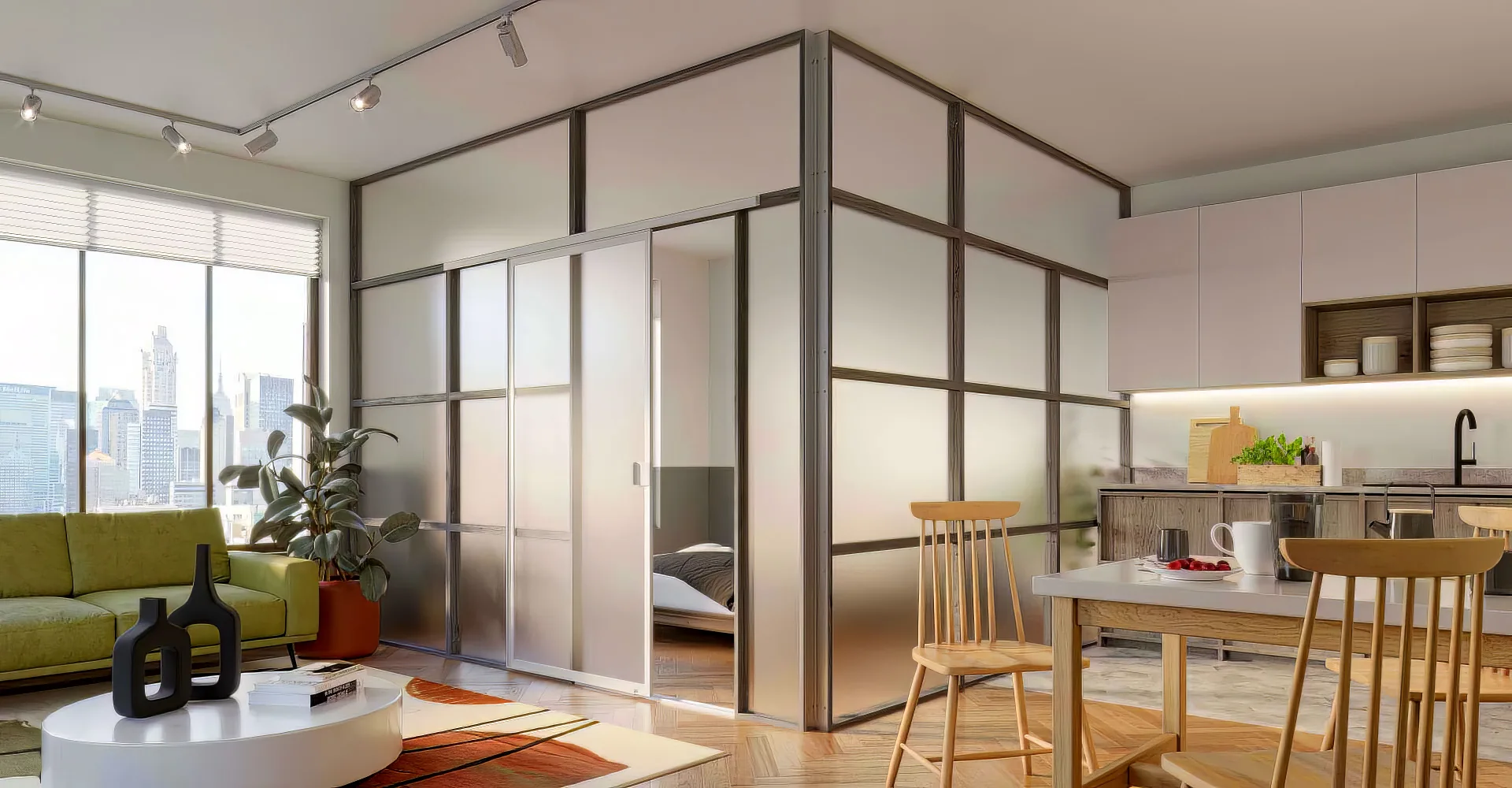




NYC Co-op House Rules and Temporary Walls: What Your Board Can (and Can’t) Actually Enforce

Last reviewed by Amit · July 2026
If you live in a NYC co-op — or you’re about to sign a lease in one — the house rules document is one of the most consequential things you’ll encounter as a tenant. In the last several years, it’s also become the primary mechanism through which co-op boards have cracked down on pressurized walls.
But here’s what most renters don’t fully understand: house rules have jurisdictional limits. They cannot prohibit you from using furniture. And the distinction between regulated construction versus unregulated furniture is more defined — and more tenant-friendly — than most boards let on.
What Are Co-op House Rules, and Where Do They Get Their Authority?
A co-op apartment is a unique ownership structure: you don’t actually own your unit. You own shares in a cooperative corporation. Your proprietary lease and the house rules attached to it are essentially a private contract between you and the co-op corporation.
Co-op rules can be broader than standard tenant protections — but there are hard limits:
- House rules cannot contradict NYC housing laws that protect tenants
- House rules cannot be applied selectively or discriminatorily
- House rules must be reasonably related to a legitimate building management purpose
- House rules cannot prohibit normal, ordinary use of an apartment — including furnishing it
Why Co-op Boards Started Targeting Pressurized Walls
Three converging pressures drove the wave of prohibitions:
- DOB Compliance Exposure — The NYC DOB classifies pressurized walls as unauthorized construction. DOB violations attach to the building’s record, not just the tenant’s unit.
- Physical Damage — Pressurized wall systems exert 40–80 pounds of sustained pressure on ceilings and floors. In older pre-war buildings with plaster ceilings, this causes real structural damage the co-op corporation must repair.
- Insurance Liability — An unauthorized sleeping room without proper egress windows creates fire liability. Insurers have flagged this repeatedly.
What the Rules Actually Say — and What They Don’t
NYC co-op house rules on this issue typically use one of two formulations:
Formulation A — Narrow: “No shareholder shall install pressurized walls, tension walls, or floor-to-ceiling partition systems without prior written approval.”
Formulation B — Broad: “No structural alterations, construction, or installation of any partition system, temporary or permanent, shall be made without prior written approval.”
Formulation A clearly targets pressurized walls. A freestanding room divider falls entirely outside this prohibition. Formulation B uses the word “installation” — which implies a fixed, anchored element. A freestanding system that requires no installation, no anchoring, and no tools is not an “installation” in the ordinary meaning of the term. Courts interpret ambiguous co-op rule language based on the ordinary meaning of the words used.
The Legal Bright Line: Construction vs. Furniture
The NYC Department of Buildings draws a clear line:
Regulated construction: Any partition that is anchored, attached, fastened, or relies on structural pressure against the building to remain in place. Includes pressurized walls, drywall partitions, and framed temporary walls.
Unregulated furniture: Any freestanding element that is supported entirely by its own structural weight, can be moved without tools, and does not modify or apply force to the building structure. Includes bookcases, wardrobes, modular shelving, and freestanding panel systems.
A premium freestanding wall system meets the same legal criteria as a tall bookcase. Co-op house rules have no authority to prohibit it.
What Happens If a Board Challenges You
Challenges to freestanding systems in co-ops are rare — sophisticated property managers understand the legal distinction. But if it ever comes up:
- Step 1: Ask for the specific rule citation in writing. Most managers will recognize the distinction when pressed.
- Step 2: Provide the DOB classification in writing — confirming your system is self-supporting furniture with no attachment to floors, walls, or ceilings.
- Step 3: Know your resources — NYC Commission on Human Rights if selective enforcement is suspected; standard civil dispute resolution under the proprietary lease.
The realistic outcome: boards that understand the legal distinction back down. Boards that don’t, typically do when presented with written documentation.
Living in a co-op and want to divide your space legally? Get a free layout consultation →
Get the spec PDF + 24h quote
No contractor, no permit, ships nationwide.