



All Week Walls Alternative: The Wall That Needs No One’s Approval


Reach me: 212.671.0722 · sales@1w2r.com
Last reviewed by Amit · July 2026
Every temporary-wall company in New York claims some version of “no permits, landlord-approved.” All Week Walls says it right on their site. Here’s the thing: that claim is only as strong as why it’s true. A pressurized wall is a floor-to-ceiling layout change — the DOB has said it doesn’t distinguish those from regular walls. A freestanding divider attaches to nothing and is furniture by engineering. Same slogan, very different foundations. Let’s compare.
What All Week Walls offers
All Week Walls is a long-running NYC installer of pressurized temporary walls, with pricing by configuration and door choice. Their terms, as published on their company policy page, include removal conditions worth reading closely: 30 days’ advance notice required, removals performed only on Mondays, and a listed removal fee of $850 with that advance notice in the first year — with pricing subject to change after it. The model is crew install, crew removal, and a wall built for one specific room. Compare that structure against the five questions below.
The five questions to ask before you sign with anyone
- Am I buying this wall or leasing it? A lease means renewal fees if you stay — and NYC renters stay. Two-year terms with fees for years three and four means you can pay for the same wall twice and own nothing at the end.
- What does removal cost after the “free” window? Across the industry, free removal is conditional: a time window, 30 days’ to four weeks’ written notice, and scheduling availability in the May–October crunch. Documented fees when conditions aren’t met: $420 per wall at one major provider, $850 at another (which only removes on Mondays), up to $1,000 standalone.
- Will anything be screwed or nailed into my apartment? Whatever the answer, get “no fasteners into the property” in writing. If hardware goes into floors, walls, or ceilings, the damage and any fines are the tenant’s problem, not the installer’s.
- Can the wall move with me? Pressurized and built-in bookcase walls can’t — they’re sized and assembled for one specific room, and their own FAQs say so. If there’s any chance you move within the wall’s life, you’re paying to build and demolish the same asset.
- What does the DOB think this is? The city doesn’t file pressurized walls under “furniture” — a floor-to-ceiling layout change can require a permit, and most boards ban them outright. Our full breakdown: NYC temporary wall DOB rules in 2026.
The other model: freestanding, and yours
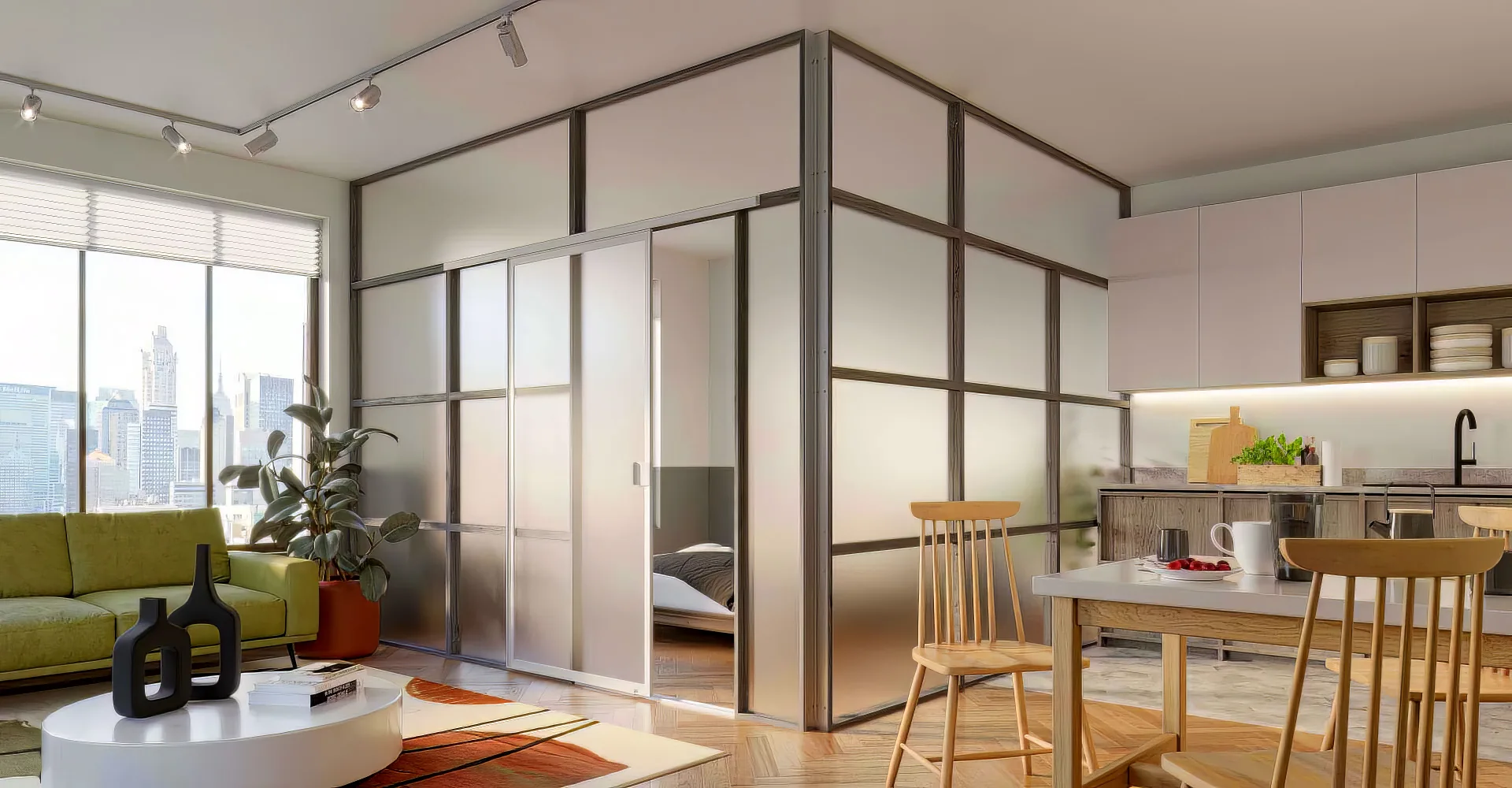
1W2R builds the alternative category: a freestanding modular partition system that stands on its own engineered base with leveling legs — no ceiling tension, no fasteners, nothing attached to the apartment, which is why it’s classified as furniture and landlord-approved by design. It arrives finished from our Brooklyn shop (no on-site cutting, priming, or painting), installs with a drill and two clamps, and comes with real single or double sliding doors. You buy it once. It slides fully built, reconfigures between straight, L, and Z runs, disassembles for your move, and goes up again in the next apartment. And if your building only allows “approved vendors,” there’s nothing to approve — no crew is required. Self-install with a drill and two clamps, and the gatekeeping question disappears.
| The structural difference | Crew-installed pressurized / bookcase model | 1W2R freestanding model |
|---|---|---|
| Ownership | Often a lease — renewal fees to stay; nothing owned at the end | You buy it once — it’s yours |
| Attachment | Ceiling/floor tension or built-in assembly on site | Nothing touches the apartment — furniture, not construction |
| Removal | Crew visit; “free” only inside window + notice; documented fees $420–$1,000 otherwise | Self takedown with the same drill — $0 |
| Moves to your next place | No — per the companies’ own FAQs | Yes — disassembles, reconfigures, reinstalls |
| Board / landlord approval | Banned by many boards; needs building sign-off | Furniture classification; vendor letter available |
| Vendor access to your building | Must be an approved vendor in gatekept buildings | None needed — delivery + self-install |
| Storage option | Bookcase versions: raw-wood or melamine shelves (scuffs, rings, swells) | Built-in modular unit: adjustable shelves, hanging, slide-outs, built-in desk |
Who should choose which — honestly
A crew-installed pressurized wall can make sense if you own the apartment or have explicit written board approval, plan to stay put for years, and want a permanent-feeling build you’ll never touch again. That’s a real customer and it might be you.
The freestanding model wins if you rent, if your lease or board is hostile to alterations, if there’s any chance you move within a few years, if your building gatekeeps vendors, or if you simply don’t like paying for the same wall twice. For the full four-bill breakdown of what each model costs across install, living, removal, and move-out, read The Move-Out Test on our blog — and for how freestanding beats pressurized point by point, see this guide.
Get a quote you can compare line by line
Send us your dimensions and we’ll send a quote within 24 hours — from $1,176 for a standalone divider, doors and storage optional. We build in Brooklyn, ship nationwide, and our crew services all five boroughs and New Jersey.
Frequently asked questions
Ask what the claim rests on. The DOB’s stated position is that it doesn’t distinguish pressurized walls from regular walls when a layout changes — which is why most co-op and condo boards ban them regardless of marketing language. The only claim that needs no verification is the physical one: our dividers attach to nothing, so they’re furniture by design. “Landlord-approved” shouldn’t be a slogan; it should be a mechanism. Ours is.
You don’t need us to be. Approved-vendor lists govern contractors doing work in the building. A furniture delivery isn’t contractor work: your divider arrives finished, you bring it up, and it assembles with a drill and two clamps. Nothing attaches to the apartment, so there’s nothing for the building to approve. For the full playbook, see how to get a wall into a gatekept building.
Common call for us. Schedule removal through your installer (mind the notice window), and we’ll time delivery so the freestanding system goes up the same week — same spot, no construction, and this time you keep the wall.
Sources
- Removal-window terms (30-day notice, Monday-only removals, $850 fee) from All Week Walls’ company policy page — allweekwalls.com/company-policy/ — reviewed July 2026.
- Brick Underground — temporary pressurized walls guide and bookshelf walls guide
- 1W2R guides: DOB rules 2026 · true cost of a pressurized wall · rent vs. buy
Get the spec PDF + 24h quote
No contractor, no permit, ships nationwide.