


The Move-Out Test: What NYC Temporary Walls Really Cost — Pressurized vs. Bookcase vs. Freestanding


Reach me: 212.671.0722 · sales@1w2r.com
Last reviewed by Amit · July 2026
Every temporary wall in New York sends you four bills. Bill one arrives when it goes up. Bill two is the quiet one — what it’s like to actually live behind. Bill three shows up when the wall comes down. And bill four lands on move-out day, when the super walks in with a clipboard and starts writing numbers next to your deposit.
The companies selling temporary walls in NYC quote you bill one and go quiet on the other three. I’ve spent 25 years on the other side of that transaction — including the Saturdays we get called to install a freestanding partition wall in the exact spot where a pressurized wall just failed its move-out inspection. So let’s run the full math, all four bills, on all three options: pressurized walls, bookcase walls, and freestanding modular dividers.
Bill one: putting it up — and who has to do it
Here’s a question worth asking every wall company before you sign: can this go up without your crew? For two of the three options, the answer is no. And there’s a second question hiding behind it: what exactly will hold my wall up? Whatever the answer — tension, pressure, or anything involving screws and nails in your floors, walls, or ceiling — get “no fasteners into the apartment” in writing before the crew arrives. If anything is fastened into the property, the damage and the fines land on you, the tenant — not the installer, who will be long gone. That one sentence in writing is the cheapest insurance in this entire article.
Pressurized walls need a professional crew by definition — the panels are tensioned between your floor and ceiling with mechanical pressure, tuned so they don’t shift and don’t punch through a soft ceiling. That’s a scheduled appointment, a half-day of noise (your neighbors will remember it at the board meeting), and an install quote that starts around $700 for a basic wall with no door (per Temporary Walls NYC’s published range) — but most real-world quotes land between $1,000 and $2,500 once you include the door, and premium builds climb well past that: Brick Underground captions one Manhattan Pressurized Walls plexiglass installation at $4,600.
Bookcase walls — the workaround these same companies sell into buildings that banned pressurized walls — sound like furniture and arrive like construction. The units are seven feet tall, built from heavy panel stock, and assembled on site by their installers — a full construction morning in your living room. (Brick Underground’s classic guide to bookshelf walls you can live with walks through exactly how these installs work.) One question matters more than any other here, and almost nobody asks it: how is a seven-foot, fully loaded unit stabilized — and will anything be screwed or nailed into my apartment to do it? Every company will tell you “no damage.” Get it in writing before the crew arrives, because that answer is your security deposit. And while you’re asking questions, ask what the shelving is actually made of. Many of these units are raw wood shelving with paint rolled straight onto it — scuffs, stains, and rings the first time a sweating cold glass lands on it. Others use melamine shelving, which is fine until moisture finds any unsealed edge or opening — then it swells and there’s no fixing it. If the “bonus storage” can’t handle a cold drink or a damp umbrella, it’s decoration, not storage. Typical cost: $1,000–$2,000+ installed — Brick Underground’s guide puts basic models at $1,000–$1,500 with custom work past $2,000, and current providers quote from $1,200.
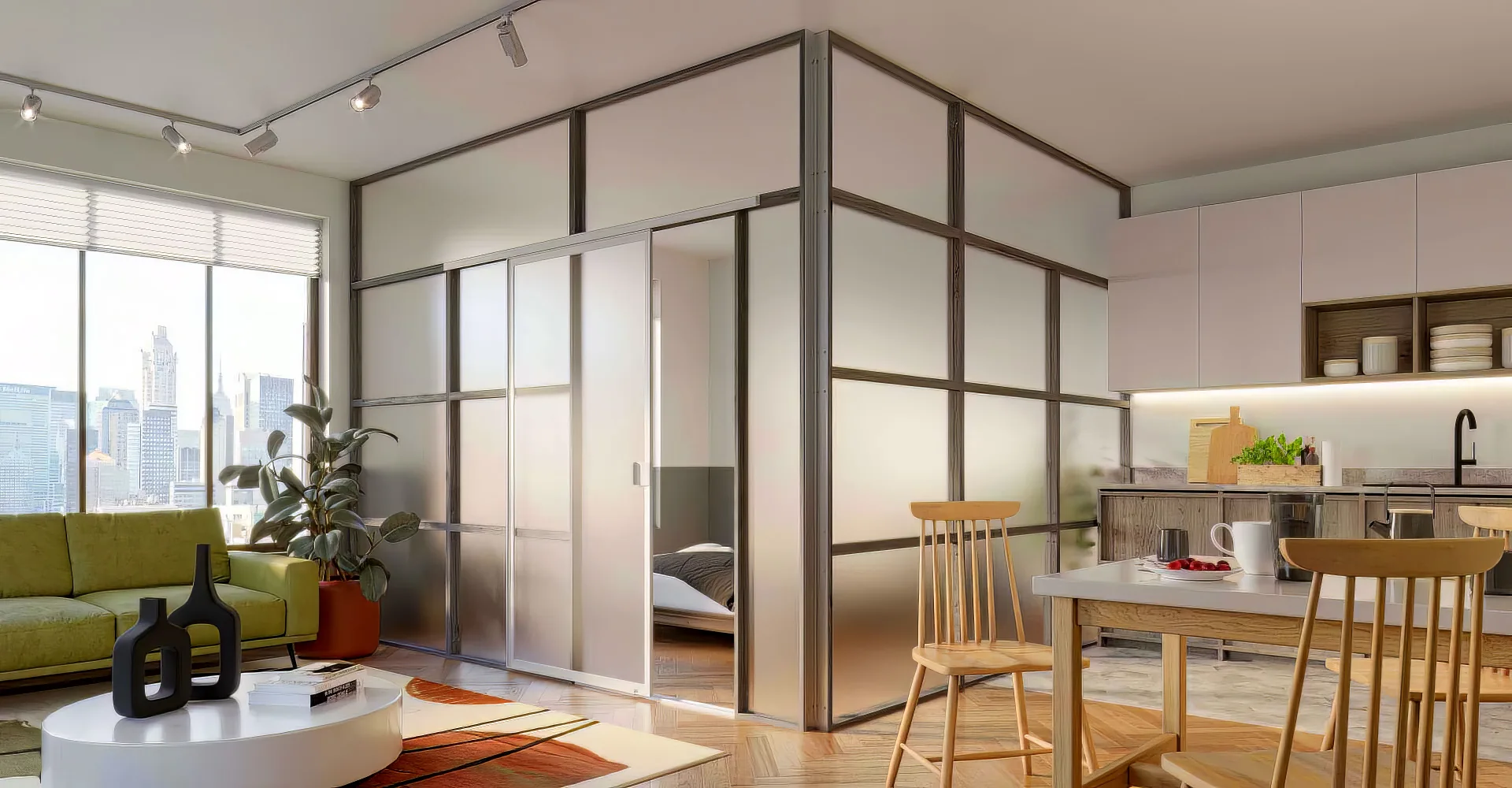
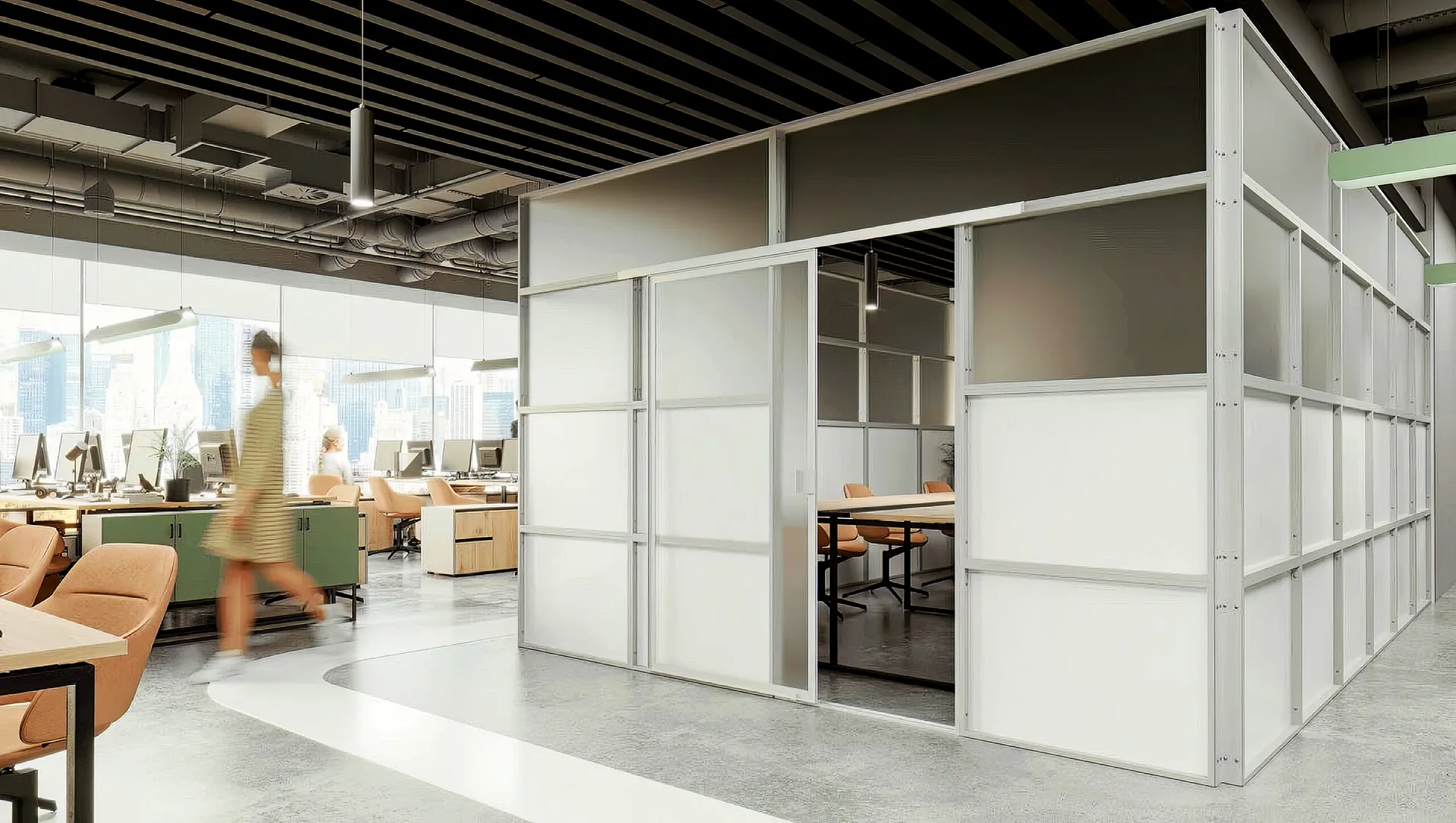
A freestanding modular divider stands on its own engineered base with leveling legs — no tension against your ceiling, no brackets in your walls, nothing anchored to the apartment. And here’s the difference in how it arrives: pressurized and bookcase-wall crews show up with raw material and build the wall inside your home — some panels come prefinished melamine with exposed raw edges that get trimmed on site, some get primer and paint in your apartment, and the bookcase versions arrive with drywall backing to be assembled A-to-Z in your living room. Cutting, painting, dust, fumes, a full construction morning. Our system arrives finished: panels, trim, and doors done at our Brooklyn shop, and the entire on-site toolkit is a drill and two clamps to connect the sections. Our crew can install it for you (same day, most NYC jobs — we bring a vacuum for the trim-cut debris, and leave the place cleaner than we found it), every kit we ship nationwide is self-installable with nothing but that drill and those two clamps — and if you’re in the five boroughs or New Jersey, our own crew installs and services it for you. Starting at $1,176 for a standalone freestanding divider — to compare apples to apples with a wall company’s “walk-around wall,” the final number depends on your span: a typical 11–13 ft run adds a few hundred dollars, and doors are optional add-ons. See configurations and pricing.
Real storage, if you actually want it
Since the bookcase-wall companies made “storage” their pitch, let’s end that argument properly. We build a modular shelving unit that integrates directly into the divider — not a painted plank pretending to be a shelf. Adjustable shelving that repositions as your stuff changes, a hanging section for clothes, shelves that slide out so nothing dies in the back, and even a built-in desk folded into the run — a home office and a room divider in the same footprint. It’s engineered as part of the freestanding system, which means it inherits the whole point of this article: when you move, it comes apart and comes with you — adjusted, reconfigured, or rebuilt for the next room. Their shelves are sized to a ceiling you no longer rent. Ours are yours.
Bill two: living behind it
The day-to-day scorecard is short. A pressurized wall gives you real visual privacy and decent noise reduction — credit where due. A bookcase wall gives you a foot of open air at the top: sound, light, and cooking smells pass freely, and the door situation is the landlord’s call, not yours — per Brick Underground’s reporting, doors are typically not permitted at all, just an opening; where they are allowed, sliding or pocket doors are usually the only options. A freestanding system gives you full visual privacy, a real single or double sliding door built into the divider’s own frame — placed wherever you want it, no landlord permission needed for a door style — and panels that dampen everyday room noise, full height, sized to your actual ceiling, plumb even on crooked pre-war floors.
The “soundproof” myth — read this before you buy any wall
One honest word about acoustics, because this industry abuses it: no temporary wall is soundproof — not pressurized, not bookcase, not freestanding, not anyone’s. Real soundproofing means two things: dense, heavy, mass-loaded materials, and a complete seal on all four sides — which includes the existing room itself. The existing walls, the ceiling above, and the floor below all transmit sound; a “soundproof” divider in an ordinary apartment is a marketing phrase, not a building condition. Any company that promises you a soundproof temporary wall is selling you a word.
What a good divider actually delivers is sound dampening: it takes the edge off TVs and conversations and kills the line-of-sight path noise travels. And here’s the part most people overbuy: effective acoustic treatment doesn’t have to run floor to ceiling. Noise travels at the height of its source — people talking, a TV on a stand — so a few felt or fabric acoustic panels placed at that height make a disproportionate difference, and they can go on the divider or on your existing walls. We can order acoustic panels for you through a third-party specialist, or you can order directly and apply them yourself. For most NYC households (roommates, nurseries, home offices) that’s the difference that matters. For the full honest breakdown, read our guide: are room dividers soundproof?
Bill three: taking it down — the invoice nobody mentions
There’s one more line item hiding in these contracts: with some companies, you never actually own the wall. Several NYC providers lease it to you — one major provider’s own FAQ describes a lease of up to two years, with extension fees for years three and four spelled out in the agreement. So a renter who stays put and renews a lease every two to three years — which is most of this city — pays again and again for a wall that’s already hanging in their apartment. And if you move and want it in your next place? One major provider states it plainly in their FAQ: their walls cannot be transferred from one location to another. The lease you signed is for a wall that stays behind, destroyed, while you start over. Our breakdown of renting vs. buying a temporary wall in NYC runs those numbers in detail.
Now ask the question this whole post is named after: when you leave, what do you still own? A demolished pressurized wall is garbage you paid to create and paid again to remove. A dismantled bookcase wall is a pile of heavy panels sized for an apartment you no longer live in — good luck reselling a seven-foot unit cut to someone else’s ceiling height.
A freestanding divider comes apart in panels, rides in the same moving truck as your couch, and goes back up in the next place. And if you don’t want it in the next place, it has resale value — it’s a product, not debris. One of these options is an expense. The other is an asset. That difference is the entire move-out test.
Bill three-and-a-half: the legality surcharge
We won’t re-litigate the whole legal landscape here — we already published the full breakdown of NYC temporary wall DOB rules in 2026 and the true cost of a pressurized wall. The short version: the DOB treats floor-to-ceiling pressurized walls like any wall — a layout change can require a permit — and work without a required permit carries fines starting around $2,500. Most co-op and condo boards ban them outright. Bookcase walls dodge the permit question with their 12-inch ceiling gap (that’s the furniture line) — though “furniture” covering seven feet of loaded shelving deserves the same get-it-in-writing question about how it’s stabilized. Freestanding systems attach to nothing, which is why “classified as furniture” is the phrase that gets walls landlord-approved — no permit, no board fight, no violation exposure to add to the bill.
How “freestanding” is freestanding? The slide test
Every company in this space calls its product freestanding. Only one of them means it.
A bookcase wall is technically furniture — in the same sense that a grand piano is technically portable. Seven feet of loaded panel stock, assembled in place for your exact room, doesn’t move; if you want it shifted three feet to rebalance the light, you’re scheduling a crew. A pressurized wall isn’t furniture at all — it’s wedged construction, and moving it means demolishing it.
A 1W2R divider is the only wall in this comparison that passes what we call the slide test: fully built, fully assembled, doors hung — and one person can still slide it forward or backward to rebalance a room. Rearranging for a party? Slide it. New furniture layout? Slide it. Moving day? It disassembles into panels and moves with you.
And because it’s modular, “moving it” can also mean redesigning it: take it apart and put it back together in a different configuration — a straight run this year, an L-shape around a new home office next year, a Z-shape after the next move — in a new finish if the next apartment calls for it. A pressurized wall gives you one wall, one shape, one room, one time. Ours keeps re-solving the space as your life changes. “Freestanding” shouldn’t describe how a wall was installed. It should describe how it lives with you.
| Cost item | Pressurized Wall | Bookcase Wall | 1W2R Freestanding |
|---|---|---|---|
| Professional install (required?) | Required — from ~$700 no door; typically $1,000–$2,500 with door; premium documented to $4,600. Built on-site from raw materials | Required — $1,000–$2,000+; assembled (and sometimes painted) in your apartment | Optional — from $1,176 (standalone divider, no door); typical 11–13 ft span adds a few hundred. Arrives finished; DIY = a drill + 2 clamps |
| Professional takedown (required?) | Required — “free” only with 30-day+ notice inside contract window; documented fees $420–$850+ otherwise | Required — same conditional scheduling; standalone removal at open-market prices | Not needed — disassembles like furniture, same drill it went up with |
| Do you own the wall? | Often no — some providers lease it (2–3 yr terms + renewal fees); it can’t transfer to your next apartment | Usually no — lease windows apply; heavy panels sized to your old ceiling | Yes — it’s yours; moves, reconfigures, or resells |
| Damage repair at move-out | Ceiling/floor pressure marks, patching, paint — $150–$400 | Depends on install — get “no screws or nails” in writing; patching if any — $100–$300 | $0 — nothing was attached |
| Security deposit risk | High | Moderate | None |
| Violation exposure (unpermitted work) | Fines from ~$2,500 if DOB gets involved | None (furniture line) | None (furniture by engineering) |
| What you still own at move-out | Nothing — demolished | Heavy panels sized to your old ceiling | The entire wall — moves with you or resells |
| Realistic 3-year net cost* | $1,400–$4,600+ with door, removal risk & possible lease renewals — all spent, nothing kept | $1,000–$2,800+ with removal risk — all spent, nothing kept | From $1,176 — minus resale/reuse value of a wall you still own |
*Install ranges per Brick Underground and Temporary Walls NYC’s published FAQ (verified July 2026); removal conditions and fees per provider lease agreements and FAQs (documented: $420 at one major provider, $850 at another). Your quotes will vary — but two of these columns are pure expense and one is an asset.
| What matters day to day | Pressurized Wall | Bookcase Wall | 1W2R Freestanding |
|---|---|---|---|
| Noise handling (nothing here is “soundproof”) | Dampens well (full height) — still not soundproof | Poor — 12" open gap at top | Sound-dampening panels; acoustic felt at source height cuts echo (order through us or direct) |
| Real door | Yes — swing, sliding or French, at extra cost | Doors typically not permitted; where allowed, usually sliding/pocket only | Single or double sliding door — built into the frame, your choice of position |
| Looks like architecture | Yes | Looks like a bookshelf | Premium finishes, straight / L / Z / angled runs |
| Usable storage | None | Painted raw-wood or melamine shelves — scuffs, rings, swells; “decoration, not storage” | Built-in modular unit: adjustable shelves, hanging, slide-outs, built-in desk — moves with you |
| Movable after install | Never — wedged in place | Realistically no — heavy panels, assembled in place, crew needed to move | Slides fully built; disassembles to move apartments |
| Landlord / board friction | Banned by most boards | Usually tolerated | Classified as furniture; vendor letter available |
Chart 3: how we stack up against the big national names
The wall companies above are the local crew-install players. But maybe you’ve also shopped the famous national brands — Versare’s accordion partitions, Raydoor’s architectural sliding walls, The Sliding Door Company’s glass systems. Fair comparison, so let’s make it. The short version: those are excellent products solving different problems — and each one either isn’t a real room, or attaches to your building, or both.
| Versare | Raydoor | The Sliding Door Co. | 1W2R Freestanding | |
|---|---|---|---|---|
| What it actually is | Folding/accordion office panels on casters | Track-mounted architectural sliding wall systems | Track-mounted glass partitions & doors | Modular freestanding wall system with real sliding doors |
| Starting price | $119–$3,100+ per their store; most popular divider units $200–$650 (no door, not full height) | Premium architectural systems — entry pricing in the low thousands per panel | Quote only — installed glass systems typically run several thousand per project | From $1,176 standalone divider; 11–13 ft spans add a few hundred; doors optional |
| Attaches to your apartment? | No — freestanding | Yes — tracks fixed to ceiling/walls; professional install | Yes — track-mounted; professional install | No — nothing touches ceiling or walls |
| Permit / landlord approval | None needed | Attached structure = alteration; board/landlord approval, permit questions case-by-case | They say usually no permit — but it’s still an attached alteration, so building approval applies | None — classified as furniture; vendor letter for boards available |
| Real door | No — gap openings | Yes — sliding panels are the system | Yes — sliding glass | Single or double sliding door, positioned where you want it |
| Creates a true private room | No — doesn’t reach ceiling, office look | Yes — premium architectural finish | Visual division; glass = limited privacy, sound passes | Full height, opaque, straight / L / Z / angled runs |
| Movable / reusable | Rolls away (but stores as a panel stack) | Fixed once installed; removal = demolition of the track | Fixed once installed | Slides fully built; disassembles, reconfigures, moves with you |
| Best for | Offices, classrooms, quick visual screens | Owners & high-end permanent renovations | Modern glass offices & owner renovations | NYC-area renters & anyone who can’t or won’t attach to the building |
Versare prices from their online store (July 2026); Raydoor and The Sliding Door Company quote per project. The pattern to notice: the two that make real rooms attach to your building; the one that doesn’t attach isn’t a room. Freestanding-with-doors is the gap in the market 1W2R was built for.
So which wall passes your move-out test?
If a company quotes you a pressurized wall, add the numbers they didn’t mention before you compare: takedown visit, patching, paint, deposit exposure, and the fact that you own nothing at the end. Then read why freestanding beats pressurized point by point.
If they pivot to the bookcase wall (they will, the moment your building says no to pressurized), ask three questions: “Will anything be screwed or nailed into my apartment — and will you put that in writing?”, “Who takes it down — and what does that cost after the free-removal window closes?”, and “Am I buying this wall or leasing it?” A wall you can’t move, can’t keep, and can’t remove yourself isn’t a workaround — it’s the same expense wearing a furniture costume.
If you want the only option that survives all four bills — goes up without a crew, lives like architecture, slides when you want it to, and leaves with you when you leave — that’s what we build in Brooklyn. Start with the room divider collection, the guides for Manhattan studios and Brooklyn apartments, or the walkthrough on dividing a studio without losing your deposit.
Comparing a specific company? We wrote a straight, model-vs-model guide for each: Manhattan Pressurized Walls, Wall 2 Wall NY, All Week Walls, Pressurized Walls NYC, Temporary Walls NYC, and 1DayWall.
Own the wall. Skip bills two, three, and four.
Freestanding, classified as furniture, installed in hours — and still yours on move-out day. We build in Brooklyn and ship nationwide; our own crew installs and services all five boroughs and New Jersey. Send us your dimensions; we’ll send a quote within 24 hours.
Frequently asked questions
In practice, yes. Pressurized walls come down the way they went up — with a crew releasing tension hardware without damaging the ceiling. Bookcase walls were assembled in place by a crew, so they come apart the same way — another scheduled visit. The “free removal” you were promised applies only inside a one-to-three-year window and only with 30 days’ to four weeks’ notice — miss either, or catch them overbooked in moving season, and the visit runs $400 to $1,000, plus any patching your surfaces need.
Yes — that’s the slide test. A 1W2R divider stands on an engineered base with leveling legs, so fully assembled you can slide it to rebalance a room. For an apartment move, it disassembles into panels with the same drill it went up with, and sets back up in the next space — no crew, no heavy tools, no patching.
Technically it’s marketed as furniture. Practically, it’s seven feet of heavy panels assembled in place for one specific room — it doesn’t slide, doesn’t reconfigure, and needs a crew to move. Before you sign, ask the one question that matters: “will anything be screwed or nailed into my apartment, and will you put that in writing?” A loaded seven-foot unit has to be stabilized somehow — their answer tells you what your deposit is risking.
No — and be suspicious of any company that says otherwise. Soundproofing requires dense, mass-loaded materials and a complete seal on all four sides, and the existing walls, ceiling, and floor transmit sound too. What a quality divider provides is sound dampening: reduced noise transfer, full visual privacy, and the option to add acoustic felt or fabric panels to reduce echo. Our freestanding system is engineered for mobility and reconfiguration — that portability is precisely why we won’t claim the word “soundproof.”
Yes — that’s exactly the situation self-install solves. Buildings can control which contractors work on-site, but a furniture delivery isn’t contractor work. Your divider arrives finished, you bring it up, and it assembles with a drill and two clamps — no crew, no vendor approval, no negotiating with the leasing office. And since nothing attaches to the apartment, there’s nothing for the building to object to afterward either.
No — citing authoritative sources (DOB rules, Brick Underground) is a quality signal, not a leak. The links below open in a new tab and none point to competitors. What actually hurts SEO is publishing unsourced claims.
Sources & further reading
- Brick Underground — “Bookshelf walls you can live with” (how bookcase-wall installs actually work in NYC)
- Brick Underground — “The insider’s guide to temporary pressurized walls” (DOB press office on permits; the 12-inch furniture line)
- Warshaw Hartz & Associates — “Temporary Walls and Legal Compliance in New York City” (landlord-attorney view)
- NYC Department of Buildings — 1 RCNY §102-01 penalty schedule (work without a permit)
- Competitor terms verified July 2026 on the companies’ own sites: lease/removal terms — mpwnyc.com/faq · removal policy — allweekwalls.com/company-policy · removal scheduling — wall2wallny.com/removal · pricing — temporarywallsnyc.com
- 1W2R guides: DOB rules 2026 · true cost of a pressurized wall · what “classified as furniture” means · freestanding vs. pressurized
Get the spec PDF + 24h quote
No contractor, no permit, ships nationwide.