

The Rent Freeze Is Here. Now Make Your Frozen-Rent Apartment Actually Work.


Reach me: 212.671.0722 · sales@1w2r.com
Last reviewed by Amit · July 2026
On June 25, 2026, the Rent Guidelines Board voted to hold rent-stabilized leases at 0% — on both one-year and two-year renewals. The board has frozen one-year leases before. It had never frozen a two-year lease in its history until that night. Roughly one million stabilized apartments — about 2.4 million New Yorkers, 40 percent of the city’s rental stock — just got told: your rent isn’t going up.
Mayor Mamdani called it “the relief that working people across our city deserve.” The landlord groups called it a lot of other things. We build walls for a living, so we’ll leave the politics to the politicians and talk about the part nobody is covering: what a frozen lease does to your floor plan.
What actually passed on June 25 — and who it covers
The vote adopted Apartment & Loft Order #58: 0% on one-year renewals and 0% on two-year renewals for rent-stabilized apartments, applying to leases that start between October 1, 2026 and September 30, 2027. For comparison, last year’s order was +3% on one-year leases and +4.5% on two-year leases — so a stabilized tenant renewing this fall keeps real money on the table.
Who it covers is just as important as what it covers. This is for rent-stabilized apartments — the roughly one million units, mostly in buildings built before 1974 with six or more units. If you’re market-rate, this order froze nothing for you (we’ll be honest about that below — the math still has something for you, but it’s different math).
The freeze dividend — what staying put is suddenly worth
Here’s the number that turns a policy story into a household decision. In April 2026, the median Manhattan rent hit $5,099 — an all-time record — with vacancy at 1.55%, the tightest in more than six years. The average one-bedroom set a record at $5,228. The average two-bedroom set one too: $8,338.
Do the subtraction. In Manhattan, the market price of “one more room” is about $3,110 a month — over $37,000 a year, every year, forever. That’s what leaving a stabilized one-bedroom for a market two-bedroom costs, before you count the broker, the movers, and the security deposit reset.
We call the gap between your frozen rent and the market the freeze dividend — the money the June 25 vote quietly deposits into your budget every month you stay. The freeze just made that dividend bigger and locked it in for two years. Nobody with a stabilized lease and a working calculator is giving one up in this market.
Your rent is frozen. Your life isn’t.
And that’s the squeeze. A baby arrives. The company calls everyone back two days a week and the kitchen table becomes an office. An adult kid moves home. A partner moves in. The lease you’d be crazy to surrender is attached to an apartment that stopped fitting your life somewhere around 2023.
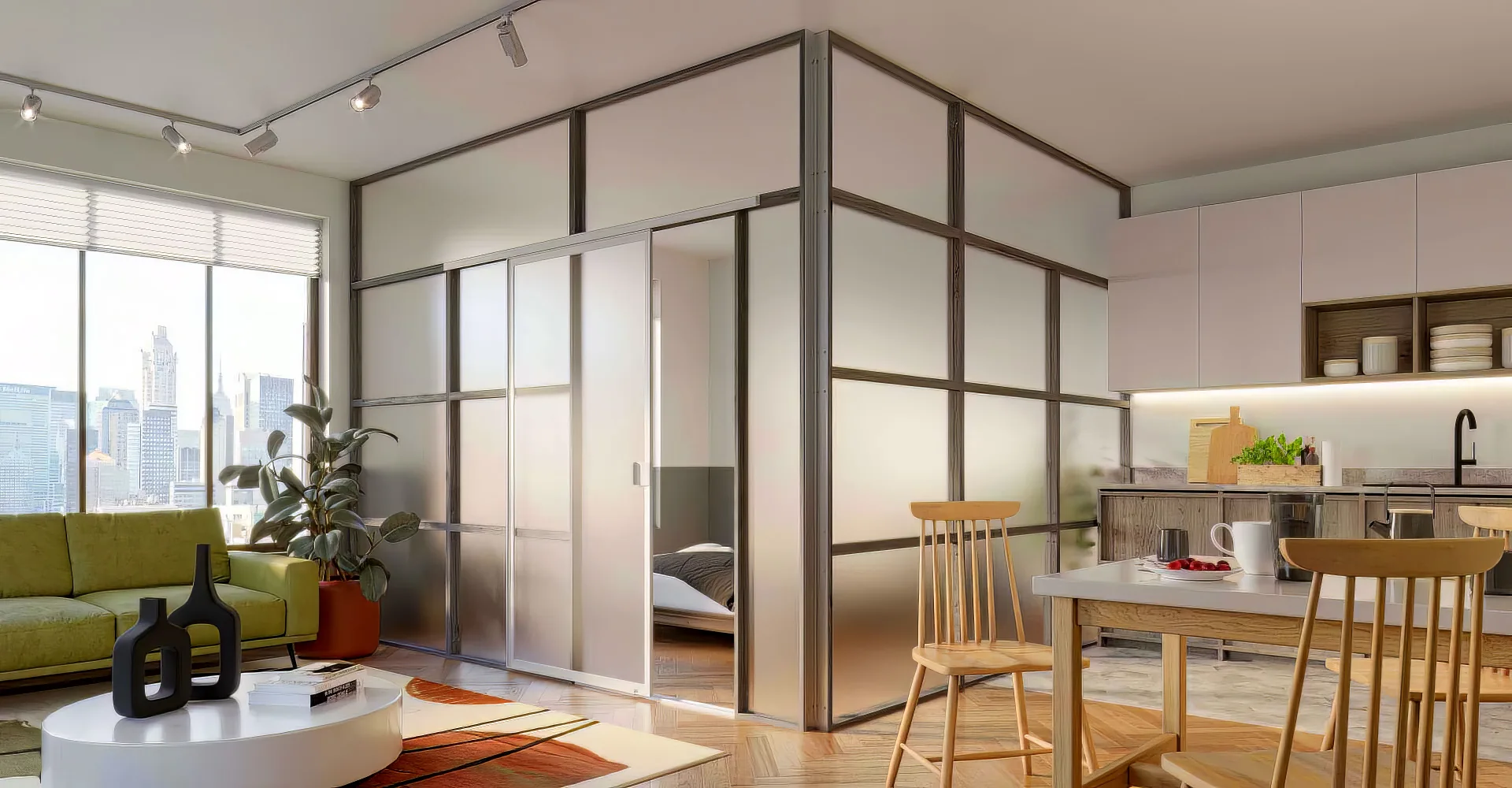
The old answer was to move up a bedroom count. The freeze dividend makes that answer irrational — you’d be trading a two-year 0% for a record-market lease. The better answer is the one I’ve been building for 25 years: keep the lease, change the layout. Take the living room you already pay for and carve a private room out of it — a real room, with a real door, that the light still passes through.
How to add a room without touching the lease you just won
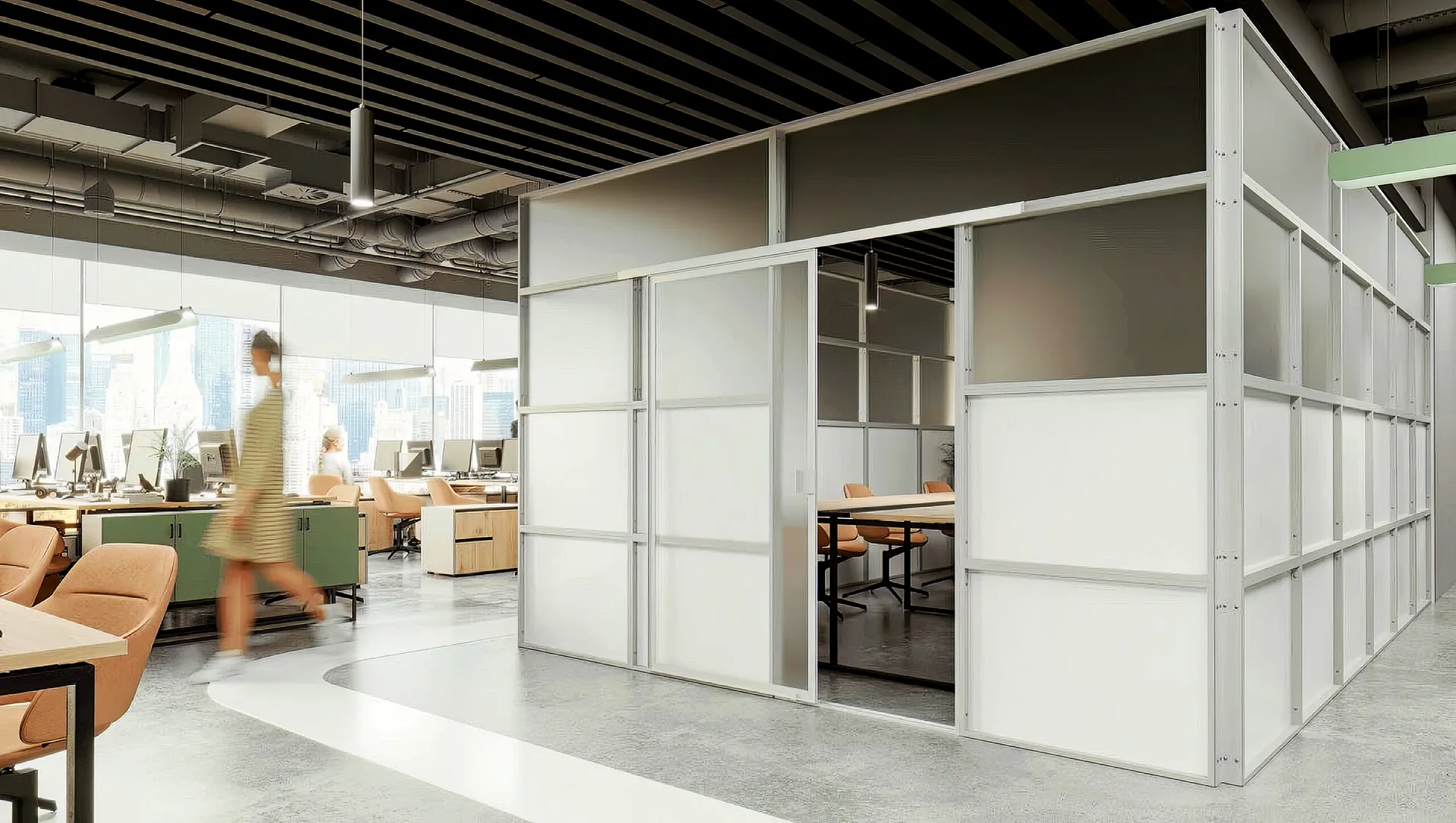
The reason our system fits stabilized apartments so well is the reason it fits every NYC apartment: it’s furniture, by engineering. A 1W2R divider is freestanding — it attaches to nothing. No ceiling tension, no floor anchors, no fasteners into the building. It arrives finished from our Brooklyn shop and the entire on-site toolkit is a drill and two clamps. Because nothing touches the apartment, there’s no DOB permit in play and nothing for a landlord to approve — the same legal logic as a bookcase, at the scale of a wall. We’ll give you a vendor letter for the building anyway, if you want one for the file.
Configurations run from a standalone divider at $1,176 — a typical 11–13 ft living-room span adds a few hundred dollars, and single and double sliding doors are optional add-ons. Our own crew installs across the five boroughs and New Jersey, most jobs the same day; everywhere else in the country, the kit ships and self-installs with that same drill and those same two clamps.
Chart 1 — What one more room costs in NYC, July 2026
| The option | The math | What happens to your lease |
|---|---|---|
| Move to a market-rate 2BR | ≈ $3,110/mo more than an average 1BR — over $37,000 a year at record rents | Stabilized lease surrendered — the freeze dividend goes to zero |
| Pressurized wall, crew-installed | Install quotes commonly $1,200–$2,800, plus documented removal fees later — see the full cost breakdown | Needs building sign-off; banned outright in many buildings; the wall was never yours |
| Do nothing — live around the squeeze | $0 | The apartment keeps not fitting — this is exactly how people talk themselves out of good leases |
| 1W2R freestanding divider | From $1,176 one-time — span and doors priced openly, no recurring fees | Untouched — it’s furniture; no permit, no approval, and it moves with you if you ever do leave |
The fine print — read this before you celebrate with a wall
Honesty section, as always.
If you’re market-rate, nothing froze for you. Order #58 covers stabilized renewals only. The stay-put math still favors you — record rents and 1.55% vacancy punish movers of every kind — but your dividend comes from a cheaper apartment made bigger, not from a frozen lease.
A divided room is not a legal bedroom. New York’s rules on light, air, and egress decide what counts as a bedroom, and no divider changes that — ours included. What you get is a private room with a real door. For most people — the WFH parent, the adult kid, the roommate — that’s the thing they actually needed. Here’s the legal picture in full.
No temporary wall is soundproof — not anyone’s. Ours dampens sound and blocks sightlines; it will not make a drummer invisible to a light sleeper. We wrote the honest version of that answer here.
Expect buildings to get slower, not faster. Operating costs rose 5.3% this year while revenue froze — owners said so at the hearings. Whatever you think of the argument, the practical read for tenants: discretionary cooperation from management is about to get scarcer. A wall that needs zero landlord cooperation — no crew access, no vendor approval, no alteration request — is built for exactly this world.
The rent is frozen. Un-freeze the floor plan.
Get a quote you can compare line by line
Send us your dimensions and we’ll send a quote within 24 hours — from $1,176 for a standalone divider, doors and storage optional. We build in Brooklyn, ship nationwide, and our crew services all five boroughs and New Jersey.
Frequently asked questions
If your renewal lease starts between October 1, 2026 and September 30, 2027, Order #58 sets the increase at 0% whether you sign for one year or two. Check the start date on the renewal form, not the date you sign it. The official order lives on the Rent Guidelines Board site — it’s two pages and worth reading yourself.
Not directly — no. The freeze covers stabilized leases only, and we’d rather tell you that plainly than sell you a story. What you share with stabilized tenants is the market around you: record rents and almost nothing vacant, which means moving up a bedroom count is brutally expensive for everyone. Dividing the space you have is the version of “more room” that doesn’t require winning a bidding war.
This is the question stabilized tenants should ask about anything, and here’s the honest mechanics: alteration clauses in leases govern changes to the apartment — drilling, anchoring, building in. A freestanding divider attaches to nothing, so there’s no alteration to object to; legally it stands in the same category as a wardrobe. We’ll provide a vendor letter describing exactly that for your building’s file, and our standing advice applies: if you ever hire any wall company, get “no fasteners into the apartment” in writing first.
No — and be suspicious of anyone who promises otherwise. Bedroom status runs through light, air, and egress rules that a partition doesn’t change. What you can honestly say: a private room with a real door. That’s what your mother-in-law, your night-shift partner, or your Zoom calls actually require.
Yes — that’s the point of owning it. It disassembles into finished panels with the same drill that put it up, moves like furniture, and reconfigures to the next floor plan — straight run to L to Z. A pressurized wall dies with the lease. Yours doesn’t.
Sources & further reading
- NY1, June 25, 2026 — Rent Guidelines Board freezes rents: 0% on both lease terms, ~1 million stabilized apartments, ~2.4 million residents; owners’ 5.3% operating-cost figure and the board-composition backstory.
- amNewYork, June 26, 2026 — board approves the freeze, fulfilling the mayor’s campaign pledge.
- ABC7 New York, June 2026 — final vote coverage — first two-year freeze the board has ever approved.
- Brick Underground, May 2026 — April 2026 market report: Manhattan median $5,099 (record), average 1BR $5,228, average 2BR $8,338, vacancy 1.55%, listings down 25%.
- NYC Rent Guidelines Board — official orders (Apartment & Loft Order #58; leases commencing Oct 1, 2026 – Sept 30, 2027; prior year +3%/+4.5%).
- 1W2R guides: what the DOB actually says in 2026 · the furniture classification, explained · the true cost of a pressurized wall.
Get the spec PDF + 24h quote
No contractor, no permit, ships nationwide.