


15 Room Divider Ideas, Ranked by What They Actually Block


Reach me: 212.671.0722 · sales@1w2r.com
Last reviewed by Amit · July 2026
Search room divider ideas and you'll get a hundred photos of folding screens and hanging plants. Beautiful. Most of them don't divide anything.
That's the gap this guide fills. We build freestanding dividers in Brooklyn, so we're not neutral — but we're also not going to tell you a custom divider is the answer when what you need is a curtain. Several ideas below are better than ours for the job you actually have.
So here they are, ranked by one honest question: what does it actually block? Sightlines, light, or nothing at all. And does it give you a door.
Tier 1 — Ideas that suggest a boundary
These block nothing. That's not a criticism — sometimes zoning is all you need, and these are the cheapest, fastest, most reversible options on the list.
1. Area rugs. The oldest trick and still the best free one. Two rugs with a gap between them reads as two zones instantly. Costs nothing if you already own them.
2. Lighting zones. A floor lamp over the reading chair and a different bulb temperature over the desk separates a room after dark better than most physical objects.
3. Plants. A tall fiddle-leaf or a row of snake plants on a low shelf softens a sightline without killing it. Best in bright rooms where a solid divider would make the back half a cave.
4. Furniture placement. Float the sofa with its back to the "other" room. A console table behind it doubles the effect. Free, and it's the move most designers reach for first.
5. Paint or wallpaper zoning. A different color on one wall segment tells the eye where a zone ends. Renter-friendly if you use peel-and-stick or repaint at move-out.
Reality check: none of these give you privacy. If someone's sleeping in the "bedroom," they can see the TV and the TV can see them.
Tier 2 — Ideas that block sightlines partially
6. Open shelving units. The compromise pick. Blocks about half the sightline, keeps light moving, gives you storage. Everything on the shelves is visible from both sides, so it needs styling upkeep you may not want.
7. Slat, cane, and beaded screens. Gorgeous in photos. Functionally these are decorative — you see through them from nearly every angle. Buy for the look, not the privacy.
8. Folding screens. The classic. Three or four hinged panels you can fold flat and store. Real sightline blocking when open, genuinely portable, priced from under a hundred dollars. Downsides: they tip, they're rarely taller than about six feet, and gaps open at every hinge.
9. Ceiling-track curtains. Underrated. A track curtain closes a sightline completely and disappears when you open it, and blackout fabric handles light too. Two catches: a curtain reads as a curtain — it moves, it billows, it never feels like a room — and most tracks screw into the ceiling, which is exactly what a lease usually prohibits.
Tier 3 — Ideas that block sightlines fully
10. Open-back bookcases. Full-height and packed with books, this blocks most of a sightline. Light still passes through the gaps. Nothing anchors it, so tall loaded shelving in a home with kids is a real tip hazard unless it's secured — and securing it means drilling.
11. Closed-back bookcases. Same footprint, solid backer panel, blocks the sightline completely. This is the category most "bookcase wall" companies sell. Worth knowing what you're buying: a loaded seven-foot unit assembled in place for your exact room doesn't slide, doesn't reconfigure, and needs a crew to move.
12. Tall wardrobes and armoires. Free storage plus a solid barrier. The back faces the other room and usually looks like the back of a wardrobe, so plan for what that side sees.
13. Portable partitions on wheels. Rolling panels that lock in place and strike flat in minutes. The right call when the layout has to change — a room that's an office on weekdays and open on weekends. See walls on wheels →
Reality check: everything in this tier blocks what you see. None of it blocks much of what you hear, and none of it gives you a door.
Tier 4 — Ideas that make an actual room
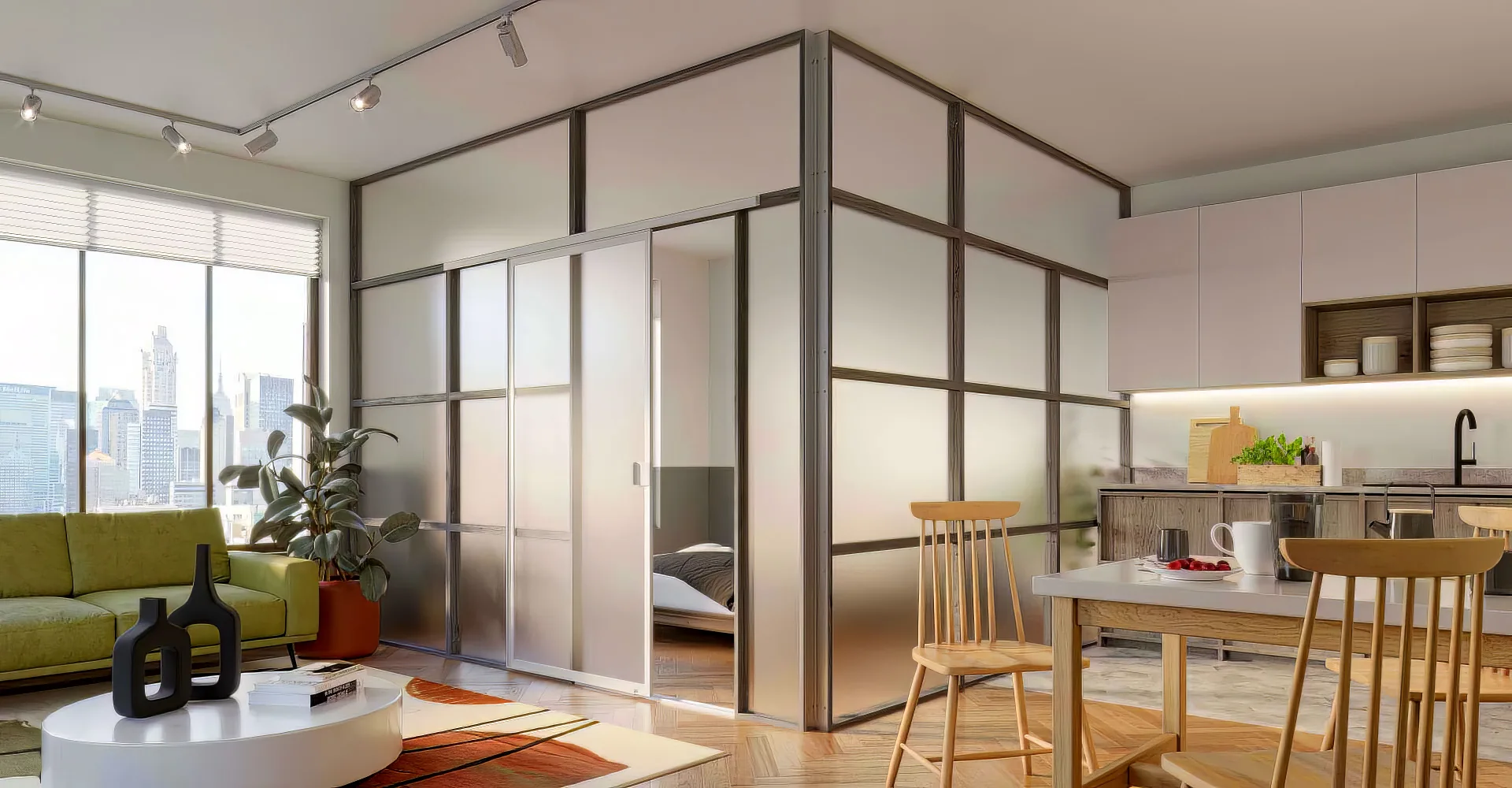
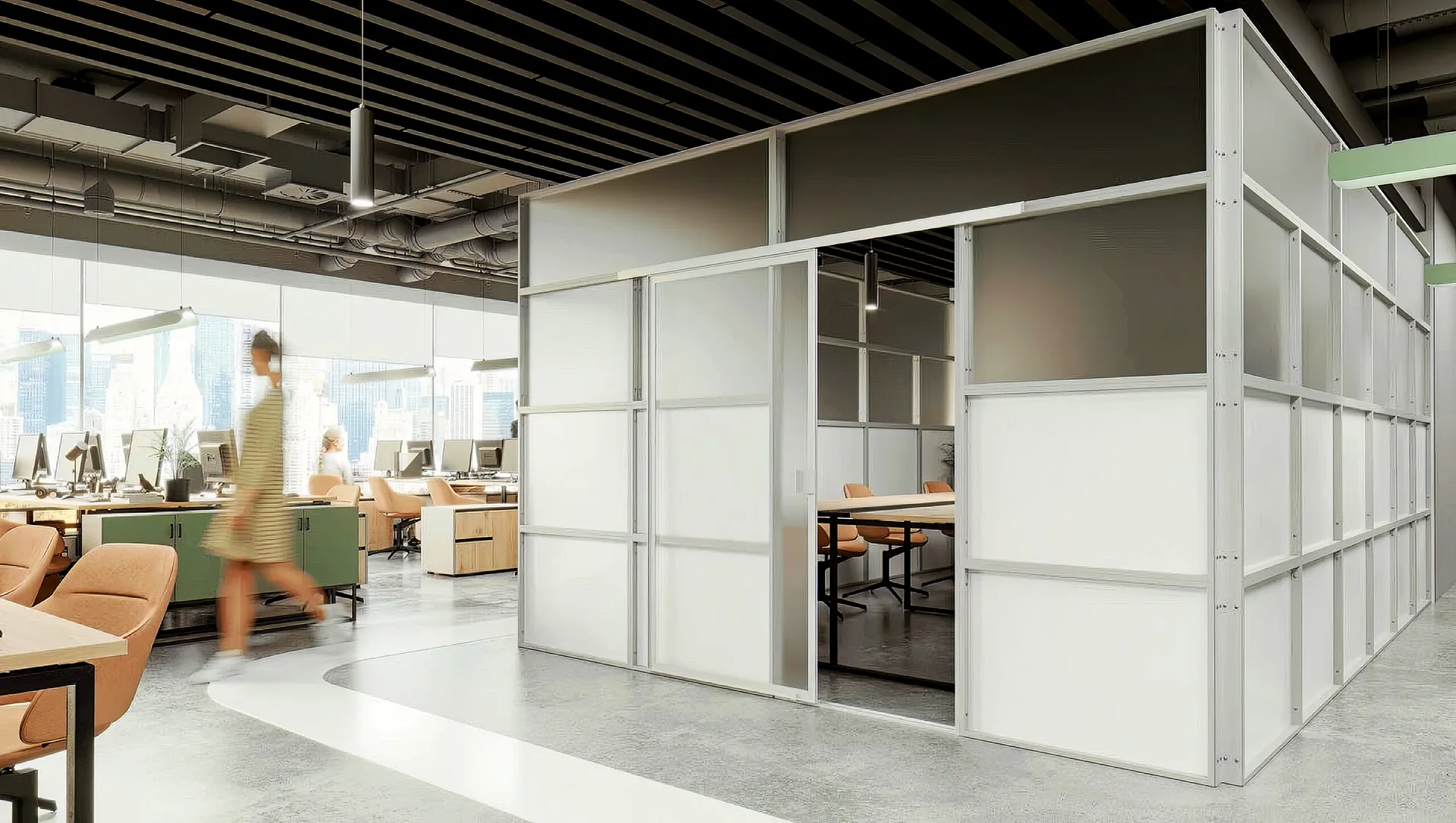
14. Freestanding modular dividers. Panel systems built floor-to-ceiling to your exact dimensions, standing on adjustable leveling legs that handle floors that slope — and most floors slope. Nothing screws into the room, which is why they're classified as furniture: no permit, no contractor, no board approval. Full height means a real sightline and light barrier, not a gap at the top.
15. Freestanding dividers with a sliding door. The only idea on this list that turns one room into two rooms.
A divider without a door is a screen. Add a sliding door and you get something you close behind you. Sliding rather than hinged, because a swing door eats three feet of floor in exactly the layouts that need dividing in the first place. See room dividers with a door →
Chart 1 — What each idea actually blocks
| The idea | Sightlines | Light | Gives you a door | Reads as a room |
|---|---|---|---|---|
| Rugs, lighting, plants, furniture | No | No | No | No |
| Open shelving | Partial | No | No | No |
| Slat and cane screens | No | No | No | No |
| Folding screens | When open | No | No | No |
| Ceiling-track curtains | Yes | Blackout only | No | No |
| Open-back bookcases | Mostly | No | No | No |
| Closed-back bookcases | Yes | Yes | No | Yes, but it doesn't move |
| Portable partitions on wheels | Yes | Yes | No | Yes — and reconfigurable |
| Freestanding divider | Yes | Yes | No | Yes |
| Freestanding divider with sliding door | Yes | Yes | Yes | Yes |
Which one fits your situation
Renting and worried about the deposit. Everything in Tiers 1 and 2 is safe. In Tiers 3 and 4, ask one question before you sign with anyone: will anything be screwed or nailed into my home, and will you put that in writing?
Studio apartment. Tiers 1–2 for zoning. A full-height divider if you need the bed genuinely out of sight — see the studio configuration guide with real layout examples.
One bedroom, two people who need separate space. Only Tier 4 does this. Here's how to add a bedroom to a one-bedroom.
The layout changes constantly. Portable partitions on wheels, every time.
Budget under $500. Folding screen or ceiling-track curtains. Don't let anyone talk you past this if it's what you can spend.
The Bottom Line
Most room divider ideas are decorating ideas. They zone a space, and for a lot of people that's genuinely enough — take the rug and the lamp and don't spend more.
But if you need someone to sleep while someone else works, or a kid to have a space of their own, decorating doesn't get you there. You need something full-height that closes.
Tell us your dimensions and we'll show you what fits
Send your measurements and a photo of the space and we'll come back within 24 hours with a configuration and a quote. Built to order in Brooklyn, ships nationwide.
Frequently asked questions
It depends on whether you need zoning or privacy. For zoning, a rug and separate lighting cost nothing. For genuine privacy — bed out of sight, light controlled — a full-height freestanding divider is the only category that delivers it without construction.
Yes. Freestanding dividers stand on adjustable leveling legs and touch nothing but the floor, which is why they're classified as furniture. Nothing gets screwed into walls, floors, or ceiling.
Freestanding modular systems are built to your measured ceiling height, so they close the gap. Most retail options — folding screens, bookcases, rolling panels — top out well short and leave an open band above.
It will make the space significantly quieter. It will not soundproof it. Be skeptical of anything marketed as soundproof at this price point, ours included.
Rearranged furniture and a rug, for free. After that, ceiling-track curtains or a folding screen for under a few hundred dollars.
Related reading
Get the spec PDF + 24h quote
No contractor, no permit, ships nationwide.