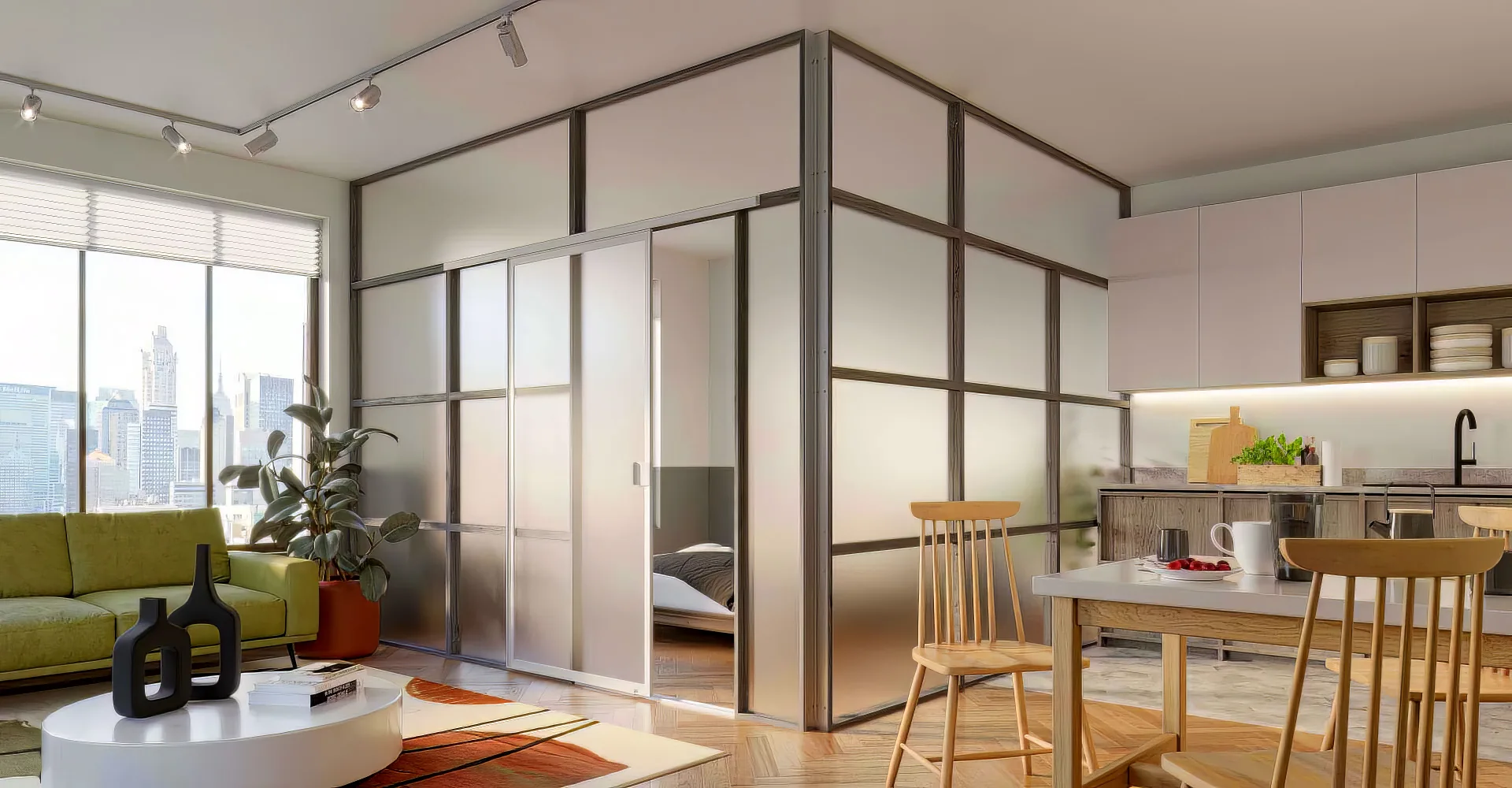




Room Divider or Temporary Wall? The NYC Companies, Compared


Reach me: 212.671.0722 · sales@1w2r.com
Last reviewed by Amit · August 2026
$420 to have a wall taken out at one New York company if you miss the notice window. $850 at another — thirty days’ notice, and only on a Monday.
Both fees are published on the companies’ own policy and FAQ pages. Neither is a scandal — they are normal terms of normal contracts, and every company in this city has terms like them somewhere. The problem is that almost nobody reads them until the lease is ending and the wall has to go.
Here is the first thing worth knowing, and almost nobody says it: most of the companies that come back when you search for a room divider in New York are not room divider companies. They are temporary wall companies that also sell a bookcase wall. That is a different business with a different contract, and it explains nearly everything about how the quote reads.
Here is the map, the numbers, and — further down — the cases where you should call one of the others instead of us.
The Ownership Line
Every company on this page sits on one side of a single line: they either lease you a wall or they sell you one. Almost every other difference — the removal fee, the notice period, whether a crew has to come back, what happens if you move in eighteen months — follows from which side they’re on.
Lease-side companies build the wall inside your apartment. It stays theirs. You pay to have it put in, you pay while it’s there, and you pay — or comply with a notice window — to have it taken out. This is a feature of the business, not of any one product: whether you take their pressurized wall or their bookcase wall, it is still their wall, and it still comes out on their schedule.
Purchase-side companies build a piece of furniture and hand it over. It’s yours. Nobody comes back.
Neither model is dishonest. They suit different situations, and the honest answer to “who’s best” is whichever side of that line matches how long you’re staying.
Who’s actually in this market
Three different kinds of business come back under one search term. Knowing which is which saves you a lot of wasted phone calls.
Temporary wall companies, not room divider companies — the lease side
These build temporary walls inside apartments, and each of them also offers a bookcase wall. Calling them room divider companies is how the search results describe them, not how they describe themselves — and the difference matters, because a wall company’s contract is written around a wall.
Wall2Wall — a full-range New York operator: pressurized walls, bookshelf dividers, storage units with doors and windows added on. Crew-installed, crew-removed. They suit renters or owners who want a crew-installed temporary wall or bookcase wall and are comfortable with a leased model.
Manhattan Pressurized Walls — the other established operator, and the one whose terms are easiest to read because they publish them. Their own FAQ describes a lease of up to two years with extensions after that, and a $420 per-wall charge when the contractual four-week notice is not given. They install bookcase dividers as well as pressurized walls — a straight divider with shelves and a sliding door starts around $1,300, an L-shape around $1,500, tax included. Brick Underground has captioned one of their plexiglass installations at $4,600, so these can run well past the entry price.
Two smaller operators work the same model: All Week Walls, whose policy page lists 30 days’ notice, Monday-only removals and an $850 removal fee, and 1DayWall, which markets on speed. Both lease, both send a crew to take it out.
The ones that actually make room dividers — the purchase side
Raydoor — Manhattan-based, on West 29th Street. Purchase side — they sell, they don’t lease. They build architectural sliding panel systems. Generally wants a ceiling track and a contractor. Raydoor does something we don’t.
1W2R — that’s us, in Brooklyn. Purchase side. We build freestanding room dividers to your dimensions and our crew installs them. From $1,176 for a standalone divider. Nothing attaches to your building, so there’s no permit, no landlord build-out approval, and no crew to schedule when you leave.
National modular systems
Versare, out of Minneapolis, and EverBlock, a New York company whose blocks Versare distributes. Versare sells portable partitions and folding screens; EverBlock sells modular interlocking blocks you assemble yourself. Purchase side too — neither leases. You buy, it ships, you build it. Genuinely yours and genuinely reconfigurable. EverBlock reads as a block wall, because it is one — right for some rooms, wrong for a bedroom you want to feel like a bedroom. Neither sends a crew to a New York apartment.
The comparison that matters
| Their pressurized wall | Their bookcase wall | 1W2R freestanding room divider | |
|---|---|---|---|
| What you own at the end | Nothing — leased | Nothing — typically leased too, up to two years | The room divider |
| Typical cost | $1,000–$2,000+ installed | From about $1,300 at one operator, with a door | From $1,176 for the divider; a sliding door is extra |
| Getting it out | Their crew takes it down; fees $420–$1,000, notice windows apply | Their crew takes it down; one operator charges $420 per wall when the four-week notice window is missed | You disassemble it — keep it, sell it, or reinstall it somewhere else |
| Where it’s actually made | In your apartment — a crew measures and cuts on install day, a few hours to a full day | Also assembled on site | In our Brooklyn shop — it arrives finished and goes up with a drill and two clamps |
| Movable once fully built? | No — the wedging holds it up | Only by taking it apart | Yes — it stays furniture, assembled |
| Reusable somewhere else | No — unless it was prefabricated, most of what comes out is construction debris | It goes back to them | Yes — next room, next apartment, or resold |
| Height | Floor to ceiling | Stops short of the ceiling | Built to your exact ceiling height |
| Permit / board approval | Permit territory — DOB has cited full-height partitions that create rooms; the violation lands on the building | Treated as furniture | None — classified as furniture |
Company-specific fees, lease terms, notice windows, and starting prices were verified in August 2026 from the companies’ own published policy, FAQ, and pricing pages where available, and from Brick Underground’s NYC temporary-wall guide. DOB-related language is based on NYC Department of Buildings guidance and enforcement materials. Terms change, so ask every company — including us — to put ownership, removal fees, and notice requirements in writing before you sign.
Two things that table cannot show you. The first is that a sticker price only means something once you know what you hold at the end of it — a lease that ends with a crew visit and an empty room is not the same purchase as a piece of furniture you still own. The second is what the thing actually is: ours is built as furniture, to be taken apart, moved and put back up somewhere else, which is why the same divider can follow you to the next apartment instead of going back on a truck.
That last row is the one people underestimate. A wall that gets cut and assembled in your living room is a building job that happens where you live, and what you are left with is a built wall. Unless it was prefabricated off site, most of it leaves as construction debris rather than as anything you could use again. Ours is made as furniture before it ever reaches you, which is why it can come apart, move, and go back up somewhere else without anyone rebuilding anything.
When you should call one of them instead of us
This is the part most comparison pages skip, so here it is plainly.
Call a pressurized-wall company if you own your apartment or have written board approval, you’re staying put for years, and you want a permanent-feeling build you’ll never think about again. A pressurized wall done well does the job it is meant to do, and our advantage disappears when you are not going anywhere.
Call 1DayWall if the deadline is genuinely this weekend. We build to order in Brooklyn, and built-to-order takes longer than off-the-shelf, so speed is a legitimate reason to choose someone else. Just know what comes with it: theirs is a pressurized system on the lease side, so it is fast in and a scheduled crew visit on the way out.
Order from EverBlock if you want a kit you assemble yourself into whatever shape you fancy — a wall this month, a bar or a bench the next — and you actively like the block look. Ours reconfigure too, into straight runs, L-shapes and new rooms, but they stay walls. Theirs don’t have to.
Call Raydoor if you want architectural sliding panels, you have a contractor, and a ceiling track is acceptable in your space. They’re on West 29th Street, so they are a genuine New York option. That is a different product, and we don’t pretend to compete with it.
Buy a curtain if you need to block a sightline and nothing more. A heavy curtain on a good track costs under two hundred dollars and solves that problem honestly. We’d rather tell you that than sell you a room divider you didn’t need.
And if you want a rolling divider you can move between rooms during the day, that’s a real category with real uses — just make sure whatever you buy is engineered against tipping, with a wide caster track and locking casters.
Five questions that decide it
Ask every company on your shortlist, including us:
- Am I buying this wall or leasing it? If it’s a lease, what are the renewal terms in year three?
- What does removal cost, and what notice do you need? Get the number in writing.
- Does it attach to my building? That single answer determines whether this is furniture or construction.
- What happens if I move in eighteen months?
- What’s the total over three years, not day one?
That last one changes the ranking more often than anything else. We wrote the full three-year arithmetic in the four bills a temporary wall sends you, and the shorter version in renting versus owning the wall. If your building is the obstacle rather than the budget, start with what changed when buildings began banning pressurized walls.
Frequently asked
The permit question comes up most, and we wrote it up in full in why buildings started refusing pressurized walls and what the DOB actually says.
Which room divider company is best in NYC?
There isn’t one best company — there’s a best fit. If you own your place and plan to stay, a crew-installed pressurized wall is a strong choice. If you rent, if your building is difficult about alterations, or if there’s any chance you move within a few years, a freestanding wall you own makes more sense. Ask every company the five questions above and the answer usually becomes obvious.
Do any of these need a permit in NYC?
Not a freestanding one. A freestanding divider attaches to nothing and stays movable even once it is fully built, which is what keeps it furniture rather than construction. A pressurized wall is a different object: it is wedged between your floor and your ceiling, the wedging is what holds it up, and it does not move again until a crew takes it apart. The Department of Buildings has issued violations for work without a permit over full-height partitions put up to create additional rooms, and those violations go to the building owner, not the tenant — which is exactly why a growing number of buildings now refuse them rather than carry the risk. “Temporary” describes the contract, not the wall. Ask any company outright whether what they install can be moved once it is up, skim your own lease, and if your layout is unusual, ask a design professional.
How much does a room divider cost in New York?
Crew-installed pressurized walls generally run $1,000 to $2,000 or more installed, with custom builds going higher. A 1W2R freestanding divider starts at $1,176 and rises with size, doors and finish.
Will any of these make the room quieter?
None of them are soundproof, and you should be careful of any company that suggests otherwise. A full-height wall gives real sound dampening — conversation becomes noticeably muffled rather than inaudible. If you need genuine sound isolation you need sealed, permanent construction, not a divider of any kind.
Does a room divider create a legal bedroom?
No. A legal bedroom depends on a window, egress and square footage, and no divider changes any of those. What it creates is a private, usable room — which is what most people actually want.
What happens to the wall when I move?
That depends entirely on which side of the Ownership Line you chose. On the lease side you schedule a crew, give notice, and often pay a fee. On the purchase side you disassemble it and it comes with you — keep it, sell it, or reinstall it somewhere else.
Send us your dimensions and we’ll send a quote within 24 hours — from $1,176 for a standalone divider, doors and storage optional. If a competitor is the better fit for your situation, we’ll tell you that too.
Get the spec PDF + 24h quote
No contractor, no permit, ships nationwide.