


What Is a Flex Apartment? Wall Shares, Flex 2s, Junior 4s and Convertibles, Explained


Reach me: 212.671.0722 · sales@1w2r.com
Last reviewed by Amit · July 2026
You're three weeks into the apartment hunt. Every listing under budget says something like "Flex 2," "convertible," "Jr 4," or "wall share friendly" — and none of them explain what you'd actually be renting.
We build the walls these listings are hinting at, so we read this language for a living. Here's the Listing Decoder: every flex term StreetEasy will throw at you, what it physically means, and the question to ask before you sign.
"Flex apartment" — the umbrella term
A flex apartment is a unit with fewer legal bedrooms than the number of private rooms people intend to carve out of it. A "Flex 2" is a one-bedroom that can be divided to sleep two households separately; a "Flex 3" is a two-bedroom aiming for three.
The key word is can. The listing is describing potential, not construction. Nothing has usually been built yet — the layout just has a dividable space: a deep living room, an alcove, a dining area with its own window.
The question to ask: "Divided how, and by whom?" Some landlords allow only freestanding partitions. Some still permit pressurized walls with conditions. Some say flex and mean nothing more than "the sofa can face the other way."
"Wall share" — the roommate version
A wall share is the flex apartment's social contract: roommates split a flexed unit, and the wall is what makes the split livable. One person takes the real bedroom, the other takes the divided half of the living room, and the rent math beats two studios by hundreds a month each.
Where it goes wrong is never the wall — it's the paperwork. Who paid for the wall, who owns it when someone moves out mid-lease, and did anyone ask the landlord in writing.
The question to ask: "Whose name is on the wall?" If you're buying the divider, own it outright — a freestanding wall is furniture, so it's yours the way a couch is yours, and it leaves with you.
"Junior 4" and "Junior 1" — the alcove family
A Junior 4 is a one-bedroom with a fourth "half room" — usually a windowed dining alcove off the living room — that generations of New Yorkers have converted into a second sleeping space. (Count: living room, kitchen, bedroom, alcove = four.) A Junior 1 is the same idea one size down: an alcove studio whose sleeping nook can be closed off into something bedroom-like.
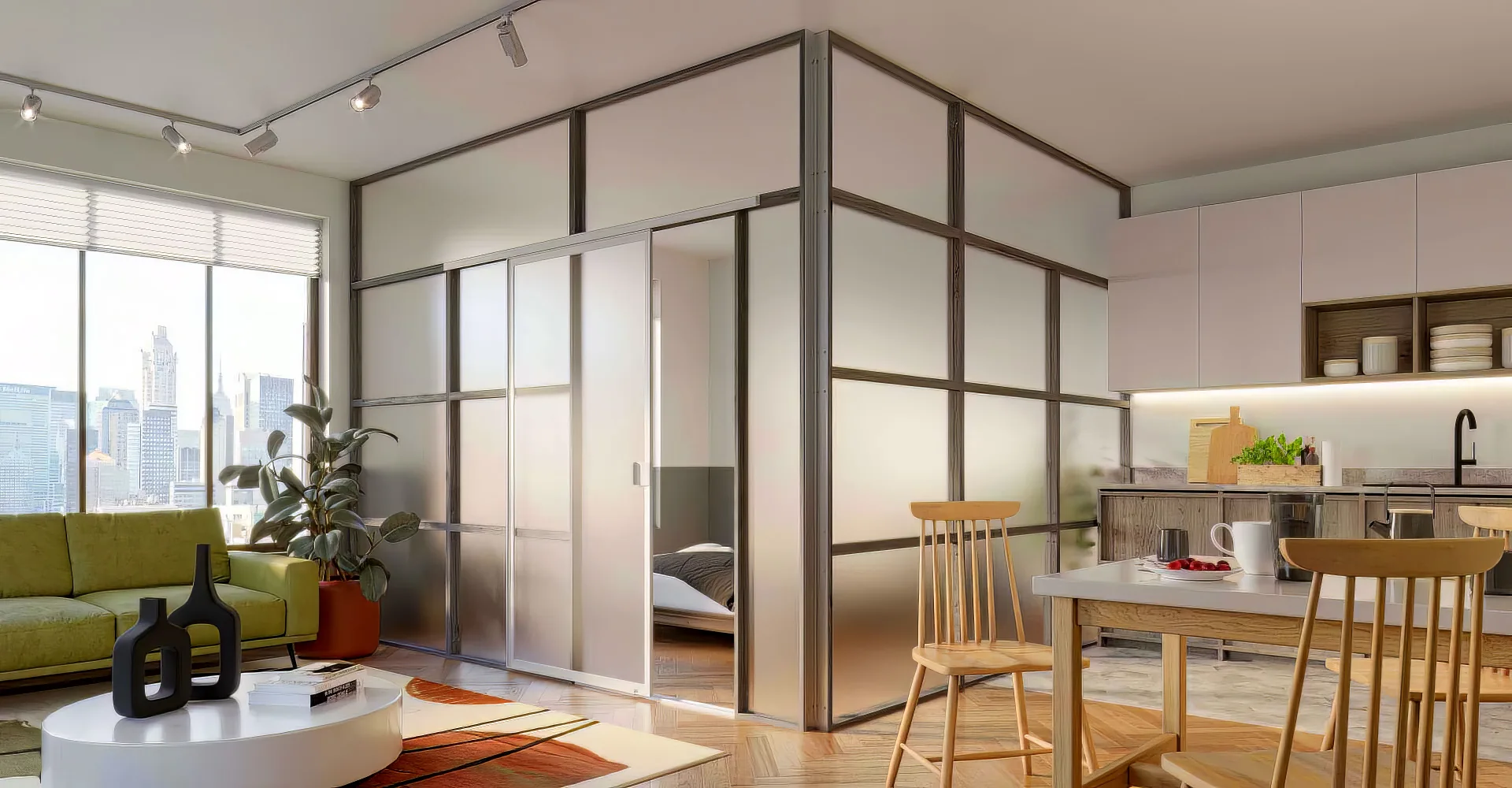
Junior 4s are the best flex candidates on the market, because the alcove usually has its own window and a natural doorway line — the divider goes up in an afternoon and the room reads intentional.
The question to ask: "Does the alcove have a window?" It decides how the divided room feels — and with our frosted panels, even a windowless split keeps the daylight moving between spaces.
"Convertible" — the honest maybe
A convertible (as in "convertible 2-bedroom") is broker language for a Flex 2 — a layout that can be converted, with the same unstated follow-up: converted with what, and with whose permission. Treat "convertible," "flexible layout," and "home office potential" as the same word wearing three outfits.
"True 2-bedroom" — the tell
When a listing says "true 2-bedroom," it's distinguishing itself from all of the above — two legal bedrooms, each with its window, square footage, and egress. The word "true" existing at all tells you how common flexing is. You pay for the word: that's the two-bedroom premium, and it reset to a record this summer.
Chart 1 — The Listing Decoder at a glance
| Listing says | What it physically is | What's usually missing | Ask before signing |
|---|---|---|---|
| Flex 2 / Flex 3 | Dividable 1BR / 2BR — nothing built yet | The wall itself | Divided how, and by whom? |
| Wall share | Roommates splitting a flexed unit | Written landlord consent + wall ownership | Whose name is on the wall? |
| Junior 4 | 1BR + windowed dining alcove | A door on the alcove | Does the alcove have a window? |
| Convertible | Same as flex — potential, not construction | Permission details | Converted with what, per the lease? |
| True 2BR | Two legal bedrooms | Nothing — you pay the premium | Is the premium worth ~$1,400+/mo? |
The honest turn — what flexing never gives you
A flex bedroom is not a legal bedroom. Legal bedrooms have code minimums — square footage, a window, egress. Flexing gives you a private room with a real door inside the unit you're already paying for. For roommates, offices, nurseries, and guests, that's usually the entire point. If your situation requires a bedroom that exists on paper, only the "true" listing delivers it.
And the history worth knowing: the classic flex tool was the pressurized wall, and many buildings banned them years ago — which is why the modern flex runs on freestanding walls that attach to nothing and need no approval. Here's how the legal freestanding version works.
Found the flex listing? We'll make it a room.
Send the floor plan or a photo and your dimensions. Our Brooklyn shop builds the wall to your ceiling height, delivers it finished, and installs with a drill and two clamps — no permit, no board approval, yours when the lease ends.
Frequently asked questions
A flex apartment has fewer legal bedrooms than the private rooms renters plan to create in it — a Flex 2 is a one-bedroom dividable into two sleeping spaces. The listing describes the layout's potential; the wall itself usually doesn't exist yet.
Roommates splitting a flexed apartment, with a partition making the split private. Get two things in writing before anyone pays: the landlord's consent, and who owns the wall if someone leaves mid-lease.
A Junior 4 is a specific layout — a one-bedroom with a windowed dining alcove that converts naturally. A Flex 2 is any one-bedroom a landlord markets as dividable. Every Junior 4 is a Flex 2 candidate; not every Flex 2 has the Junior 4's alcove.
Freestanding walls are — they attach to nothing, which classifies them as furniture, like a wardrobe. Pressurized walls that press into the building's surfaces are restricted or banned in many buildings. Always confirm your building's rules in writing.
A legal bedroom does. A flex room doesn't have to — but a windowless room feels like it. Frosted panels keep daylight flowing into the divided space while blocking the sightline, which is the closest a flex room gets to having its own window.
Sources & further reading
- Corcoran / Brick Underground, June 2026 rental reports — the record medians and the 1BR/2BR gap behind the "true 2-bedroom" premium.
- 1W2R guides: flex walls — the legal freestanding alternative · what the DOB actually says in 2026 · co-op house rules and temporary walls · adding a bedroom without losing the deposit.
Get the spec PDF + 24h quote
No contractor, no permit, ships nationwide.