

The Off-Campus Math Columbia and NYU Parents Need Before Signing a Lease


Reach me: 212.671.0722 · sales@1w2r.com
Last reviewed by Amit · August 2026
The Cost-Per-Door Test
Stop comparing apartments to dorms. Compare cost per private door.
A private door is a space one person can close behind them: a dorm single, a bedroom in a share, a divided half of a living room with a real sliding door on it. It’s the unit students actually consume, and it’s the unit that decides whether the year goes well.
Housing gets priced per apartment. Students live per door. Almost every expensive mistake in this market lives in that gap.
Chart 1 — What one private door costs near Columbia and NYU
| Option | Monthly, per private door | What’s bundled | Term |
|---|---|---|---|
| Columbia residence single | ~$1,900–$2,800 | furniture, utilities, academic-year term | ~9 months |
| Private bedroom in a share, Morningside Heights | ~$1,459 average | usually nothing | 12 months |
| Private bedroom in a share, Hamilton Heights | ~$1,304 average | usually nothing | 12 months |
| Private room in a share near Columbia (range) | $1,100–$1,600 | varies | 12 months |
| Private room in a share near NYU (range) | $1,200–$1,700 | varies | 12 months |
| Morningside Heights 1BR | $3,200–$4,250 for one door | nothing | 12 months |
| Morningside Heights studio | $3,600–$3,900 for one door | nothing | 12 months |
Columbia Housing rates for 2026–27 run $12,522 for first-year and $13,914 for upperclass housing, with a standard meal plan at $6,580 (Columbia Housing / Columbia Residential). Neighborhood room and apartment figures from StreetEasy and NYC student-housing cost surveys, 2026. Verified August 2026.
Read the last two rows against the middle ones. A Morningside Heights one-bedroom is one door for $3,200 to $4,250 — two to three times what the same neighborhood charges for a private bedroom in a share. A studio is worse still: $3,600 to $3,900 for one door and no second room to divide.
That’s the whole trap in two lines. The apartment that feels like the grown-up choice is very often the worst price per door on the board, and the dorm single that looks expensive at $1,900 is competitive the moment you stop comparing it to a whole apartment.
Where the divider changes the arithmetic
Now the part I have an interest in, stated in one paragraph so you can weigh it and move on.
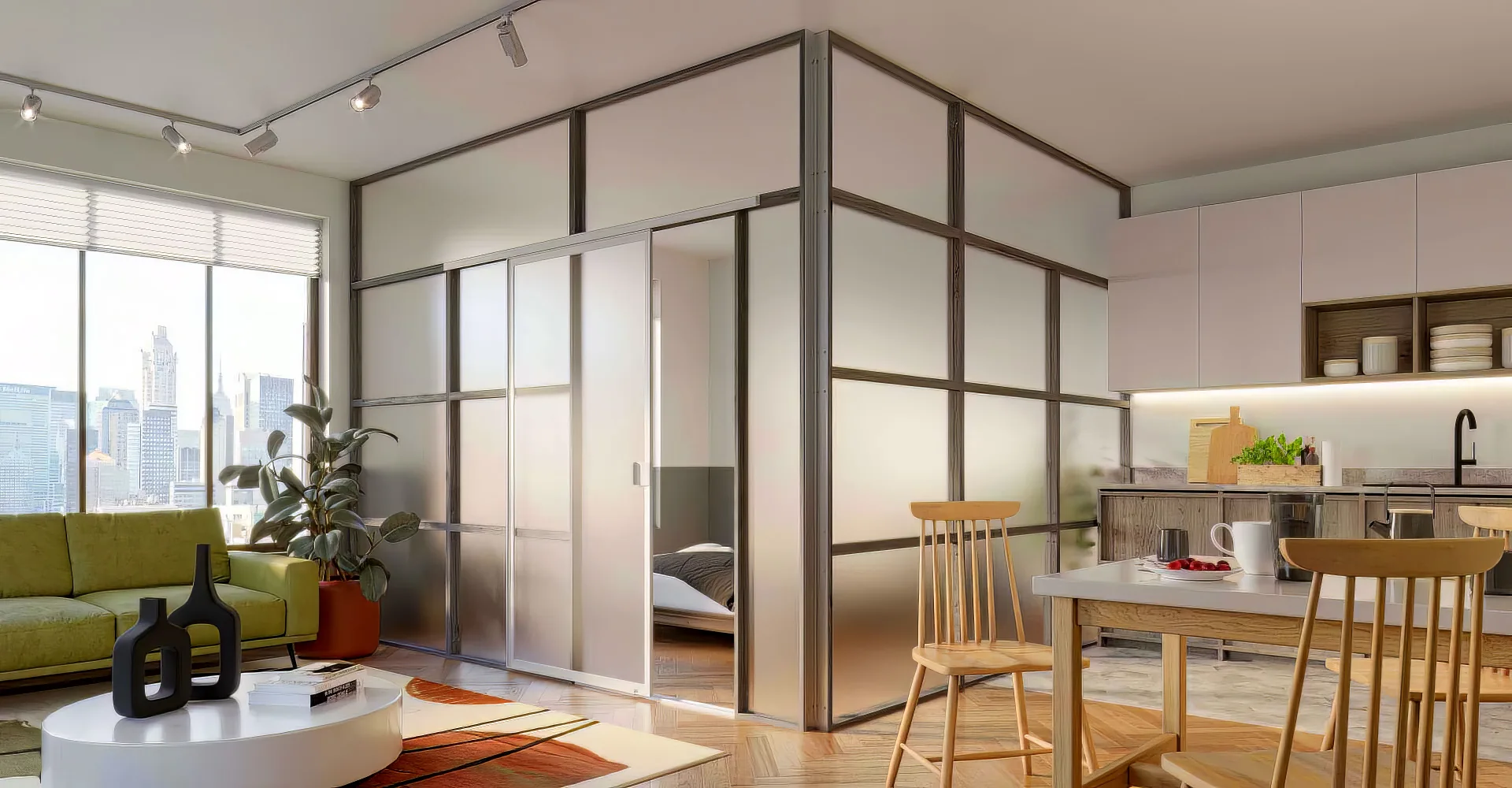
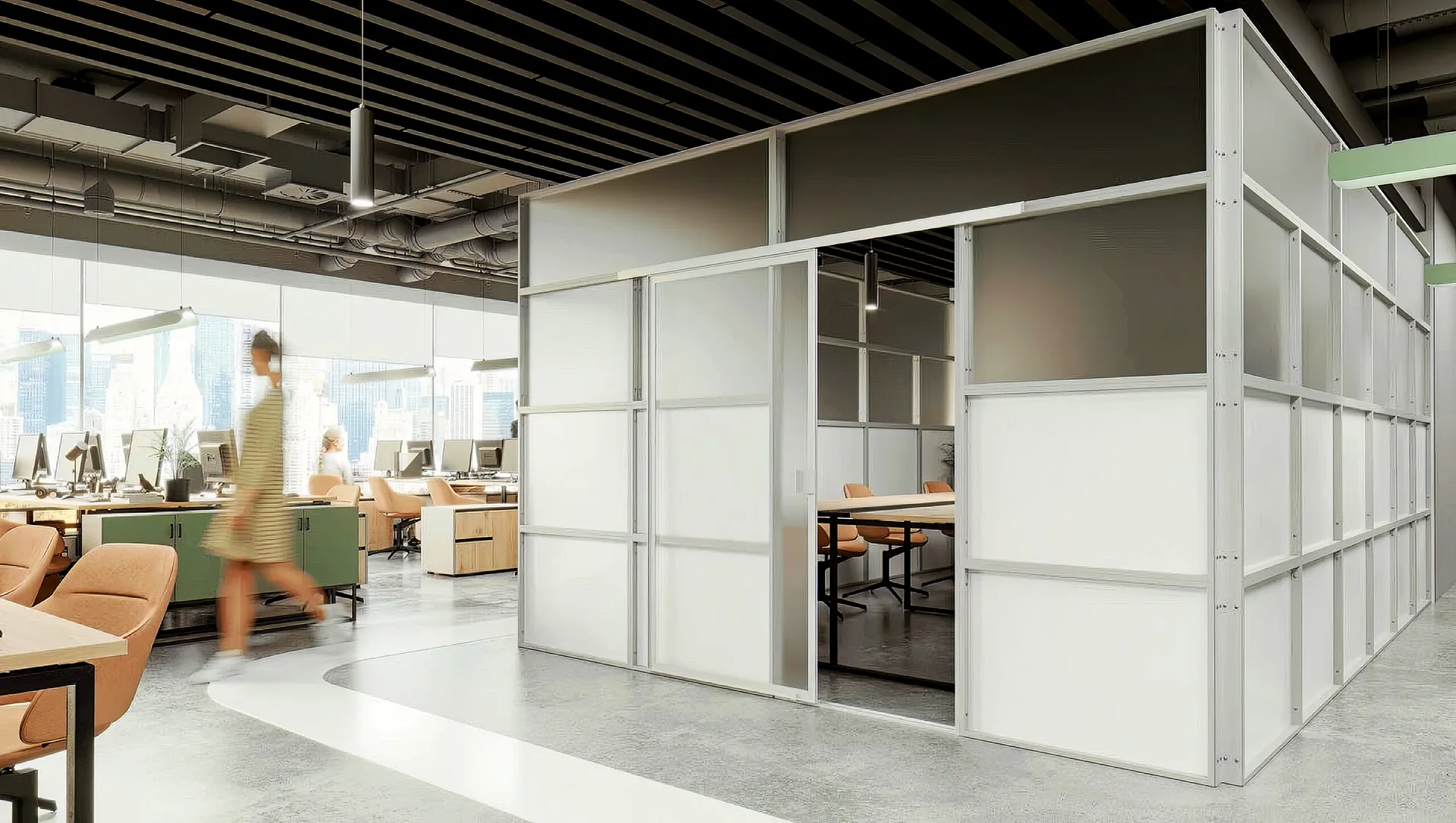
Most student two-bedrooms have a living room doing very little work — a place where a sofa waits for people who are at the library. A full-height divider with a sliding door across part of it turns two private doors into three, and the same rent divides three ways instead of two. Our standalone dividers start at $1,176, once, and the wall goes to next year’s apartment or gets resold. That’s the whole pitch. If you want the long-form version of that arithmetic, it’s on The Door Premium.
The reason I’m not going to dress it up further is that for a student lease, the money is the easy part and the rules are the hard part. That’s the next section, and it’s the one worth your time.
The honest turn — three things this does not do
This is the section I’d want to read if I were the one signing.
1. It does not create a legal bedroom. Ever. A legal bedroom in New York City needs a minimum of 80 square feet, at least eight feet in both length and width, a minimum eight-foot ceiling, at least one operable window of roughly 12 square feet facing a street or yard — a window onto a neighbor’s wall does not count. A freestanding wall standing on the floor changes none of those. What you get is a private space with a real door, which is what a student actually wants. What you do not get is a room you can advertise as a bedroom. Anyone who tells you otherwise is selling you a violation.
2. It does not override the lease or the occupancy rules. New York’s roommate law (Real Property Law § 235-f) protects a tenant’s right to share, but it is narrower than people assume: with one tenant on the lease, that’s the tenant, one additional occupant, and that occupant’s dependent children. The general rule is that occupants not named on the lease shouldn’t outnumber those who are — two names on the lease, no more than four people. You’re also required to tell the landlord the new occupant’s name within 30 days. Adding a wall does not add a legal occupant. If the plan is a third student in a two-person lease, that’s a lease conversation, not a furniture purchase, and it should happen before anyone signs.
3. It is not soundproof, and neither is anything else. No temporary wall is soundproof — not pressurized, not bookcase, not freestanding, not anyone’s. Ours dampens sound and makes a space significantly quieter; full height does more for that than any material choice. In an apartment where one student keeps 2 a.m. hours, manage expectations honestly. Here’s what these things actually do to noise.
There’s a fourth, and it’s the one that decides most calls: some living rooms are too small. If giving up eight feet leaves a walkway, the answer is no. Send dimensions and I’ll tell you that rather than sell you something.
Why parents care about the last day of the lease
Students think about September. Parents think about the following August, and they’re right to.
The reason we build these freestanding is what happens at the end. It attaches to nothing — no screws into the floor, ceiling, or walls — so there is nothing to patch, nothing to argue about, and no line item on the deposit return. It arrives finished from our Brooklyn shop, so nobody is painting or cutting inside the apartment. The entire on-site toolkit is a drill and two clamps.
Then it disassembles into panels and goes to next year’s apartment. Or sophomore year’s. Or gets sold.
Compare that to a lease structure where a company installs a wall, charges you monthly, and charges you again to remove it. If you want that comparison run properly across the NYC companies, it’s here.
Two more practical notes, because August is late: get “no fasteners into the apartment" in writing from any company before a crew arrives, ours included. And if the building’s management asks what’s coming up the freight elevator, we’ll write a vendor letter.
Price the doors, not the apartments.
The dorm isn’t overpriced and the apartment isn’t a bargain. They’re different products sold in different units, and once you convert both to cost per private door, the decision usually makes itself in about four minutes.
Send us the dimensions of the room you’re thinking about. We’ll send a quote within 24 hours — and if the room won’t take a wall, we’ll say so.
Frequently asked
Is it cheaper for my student to live off campus in New York?
Per private door, usually yes — a room in a share near Columbia runs roughly $1,100–$1,600 a month against $1,900–$2,800 for a residence single. But the dorm bundles furniture, utilities and a nine-month term, while an apartment is a twelve-month lease you pay through the summer. Convert both to cost per door and then add three months of summer rent before you decide.
Can we divide a two-bedroom into three rooms for three students?
Physically, often yes, if the living room has the width to spare. Legally, that depends entirely on the lease and occupancy rules, not on the wall — under RPL § 235-f, occupants not named on the lease generally shouldn’t outnumber those who are, and the landlord must be told the new occupant’s name within 30 days. Settle that with the landlord before signing, not after.
Does the divided space count as a bedroom?
No. It’s a private space with a real door. A legal NYC bedroom requires 80 square feet minimum, eight feet in both dimensions, and an operable window facing a street or yard. Nothing freestanding changes those requirements, and we won’t tell you it does.
Will the landlord allow it?
It’s freestanding — it attaches to nothing and alters nothing, which makes it furniture by engineering rather than a modification. Most tenants don’t need permission for furniture. Buildings vary, so if management asks, we’ll provide a vendor letter.
What happens at the end of the school year?
It comes apart into panels. It moves to the next apartment, reconfigures from straight to L-shape to Z-shape, or resells. Nothing to patch and nothing withheld from the deposit, because nothing was ever fastened to the apartment.
How fast can this happen? Classes start in weeks.
Send dimensions and you’ll have a quote within 24 hours. We install across the five boroughs and New Jersey with our own crew and ship nationwide for self-install. If the timeline is genuinely too tight for your move-in date, we’ll tell you rather than take the order.
Sources & further reading
- Columbia Housing / Columbia Residential, 2026–27 rates — $12,522 first-year and $13,914 upperclass housing, with a $6,580 standard meal plan; residence singles at roughly $1,900–$2,800 per month.
- StreetEasy, on-campus vs. off-campus cost of living and Columbia-area rentals (2026) — Morningside Heights room averages near $1,459 and Hamilton Heights near $1,304; studios $3,600–$3,900 and one-bedrooms $3,200–$4,250 in Morningside Heights.
- 2026 NYC student-housing cost surveys — private rooms in shares at $1,100–$1,600 near Columbia and $1,200–$1,700 near NYU, and what a typical $1,500–$1,800 all-in monthly figure covers.
- New York Real Property Law § 235-f (the Roommate Law) — a tenant’s right to share, the one-additional-occupant structure, the rule that unnamed occupants shouldn’t outnumber named tenants, and the 30-day notification requirement.
- NYC Building Code / DOB guidance on legal bedrooms — the 80 sq ft minimum, 8-foot dimensions, and operable-window requirements, and why unpermitted subdivisions draw violations.
Send us the dimensions of the room you’re thinking about and we’ll send a quote within 24 hours — from $1,176 for a standalone divider. If the room won’t take a wall, we’ll say so.
Get the spec PDF + 24h quote
No contractor, no permit, ships nationwide.